 Complex Network Dynamics Lab
Complex Network Dynamics Lab
Complex Network Dynamics Lab
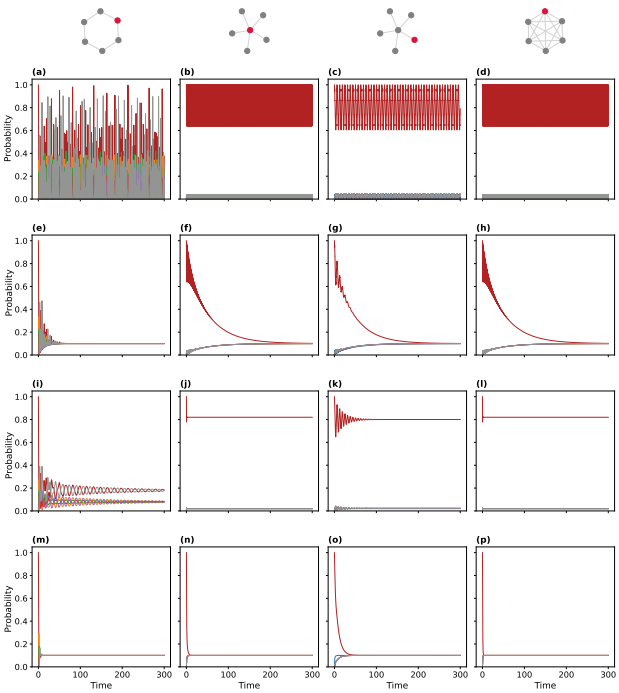
Network structures don't just shape classical processes they also leave a deep imprint on quantum dynamics. Take scale-free networks, for example: here, differences in how central a node is like how many connections it has (degree) or how close it is to others (closeness) can dramatically affect how a quantum walker moves. If the most connected node and the most central node are different and the walker is initially on any of the nodes, the quantum walker ends up between the two nodes, showing out-of-phase oscillations. But when both centralities belong to the same node, something remarkable happens, the walker stays strongly localized there, even when decoherence is introduced. On the flip side, if the walker starts on a low-degree node, it quickly spreads out. These patterns reveal just how important the network structure, not just for classical spreading, but for preserving quantum behavior in complex networks.
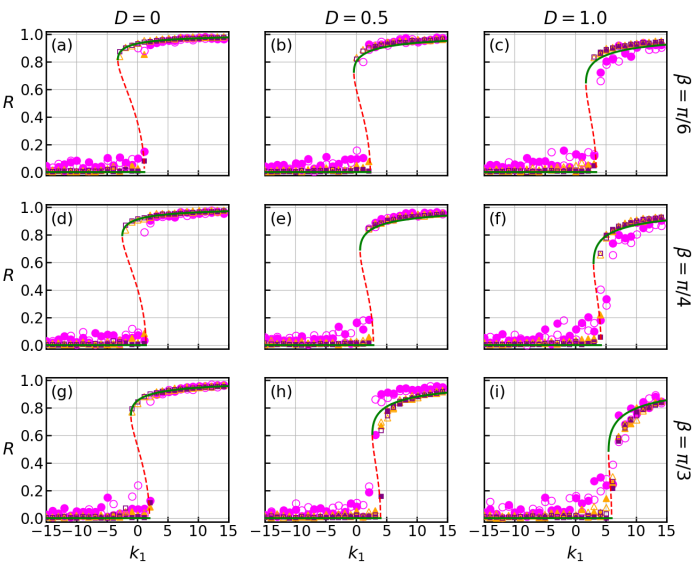
Synchronization is a ubiquitous phenomenon that can be found in nature, spanning from the synchronous behavior of fireflies to periodic firing of neurons in the brain. The phenomenon can be explained using the coveted Kuramoto-Sakaguchi model, in which the system's participating elements act as oscillators with a sine function. We are studying and observing synchronization in the Kuramoto oscillator system. The model, because of its simple structure, captures rich dynamics of different systems. The collective dynamics of the system is usually captured using a global macroscopic quantity called Order-parameter (r), which measures the degree of synchronization. When r = 0, the oscillators are completely desynchronized, and for r = 1, the oscillators are completely synchronized, forming a one-cluster state. For any value 0 < r < 1, the system is in a partially synchronized state.
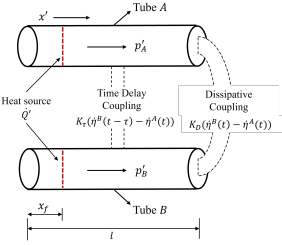
We investigate thermoacoustic systems, particularly focusing on the complex dynamics within combustor systems. Our research delves into the non-linear modeling of these systems to understand the intricate interactions between acoustic waves, unsteady heat release, and fluid flow. By analyzing these severe non-linearities, we aim to map out stability boundaries and predict the onset of large-amplitude, destructive oscillations. This mathematical and computational modeling is crucial for developing safer, more efficient, and cleaner combustion engines and aerospace propulsion technologies by actively predicting and mitigating thermoacoustic instabilities.
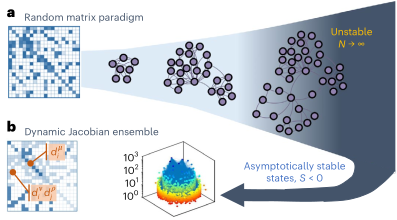
Our research focuses on understanding how large, interconnected networks maintain stability and how complex behaviors emerge from simple local interactions. We study high-dimensional nonlinear systems to uncover the mechanisms behind robustness, synchrony, and sudden transitions in networked structures. By blending tools from dynamical systems theory, statistical physics, and complex graph analysis, we explore how topology and heterogeneity influence system-wide behavior. A central theme is the spontaneous emergence of order—how coherence or instability arises without central control. This work has broad implications, from predicting failures in infrastructure networks to understanding collective behavior in biological and social systems.
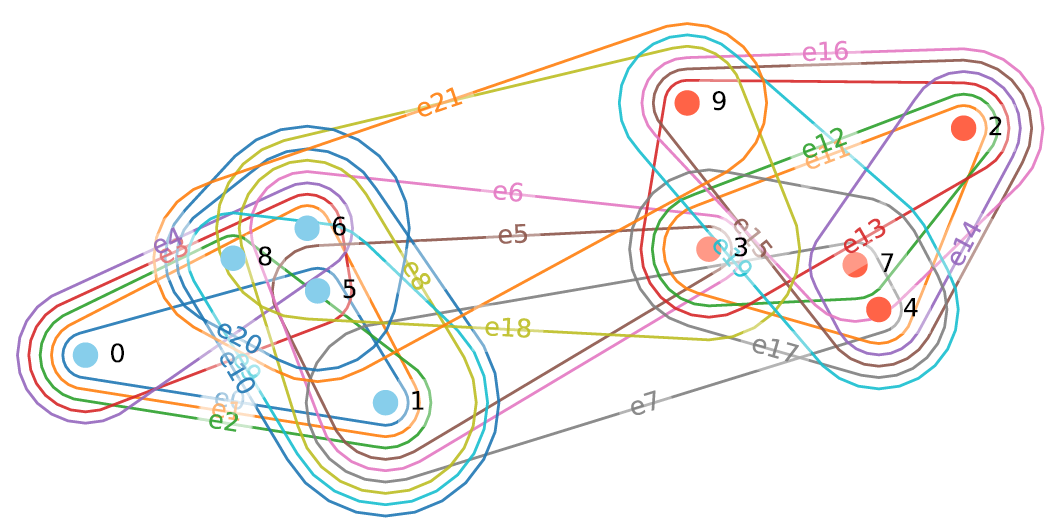
Homophily in networks refers to the principle that nodes are more likely to connect with others that share similar attributes or belong to the same group, think people forming friendships within the same cultural or professional community. Traditional studies often assume pairwise (dyadic) connections, but real-world systems, like social groups, biochemical reactions, or co-authorship networks, frequently involve interactions among more than two entities at a time. This calls for the concept of higher-order homophily, where similarity is preserved not just in individual links but across groups of nodes interacting within hyperedges or simplices. Capturing higher-order homophily allows for a more accurate representation of how communities form and evolve in complex systems.