 Complex Network Dynamics Lab
Complex Network Dynamics Lab
Complex Network Dynamics Lab
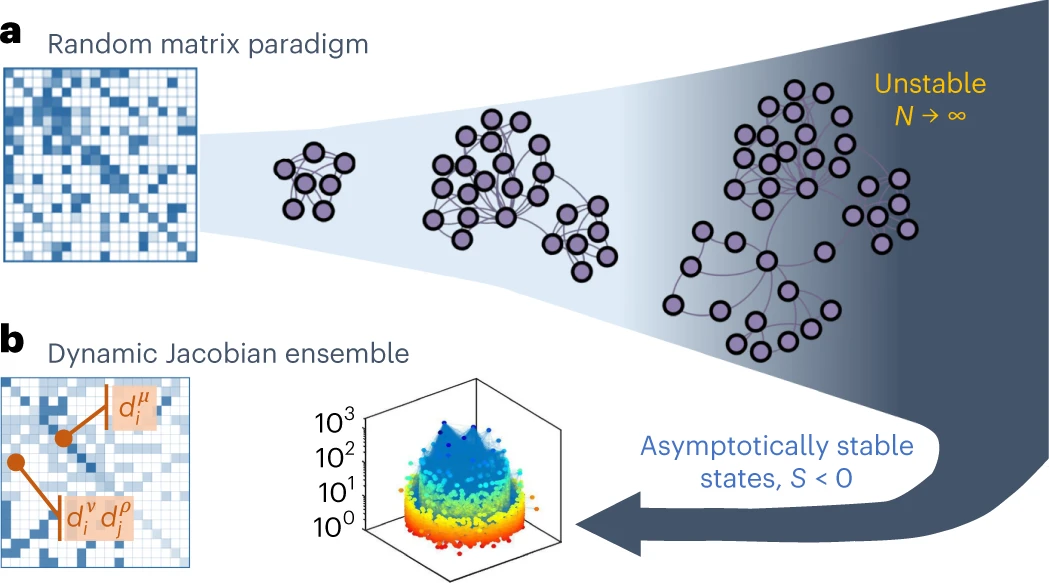
We introduce the dynamic Jacobian ensemble to systematically investigate the fixed-point stability of complex systems. Our analysis uncovers discrete stability classes, identifying an asymptotically stable regime where large and heterogeneous networks acquire guaranteed stability. This demonstrates how network scale and heterogeneity naturally organize system stability against changing environments.
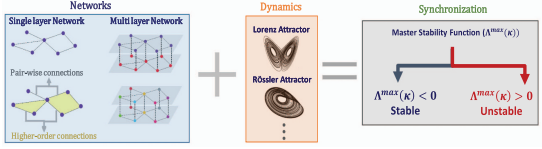
This article presents a simplified and unified analysis of master stability functions (MSF) across various undirected, directed, multilayer, and higher-order networked systems. We complement theoretical developments with numerical algorithms for computing MSF and classifying synchronization behaviors. Furthermore, we highlight underexplored areas such as estimating MSF using machine learning approaches.
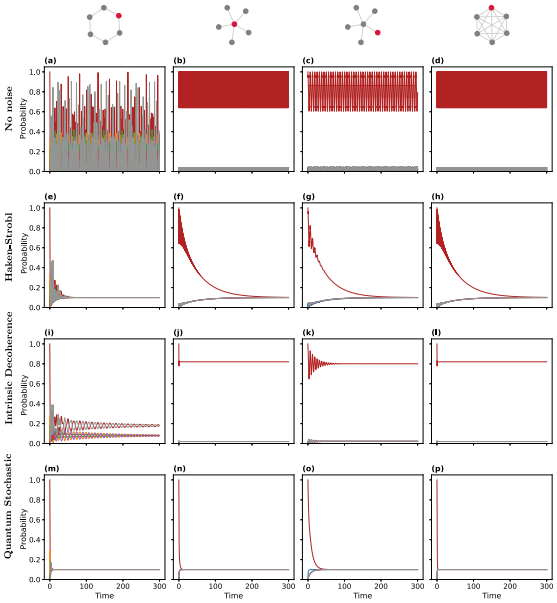
We investigate the stability of continuous-time quantum walks across distinct network topologies subjected to three separate decoherence mechanisms. Our findings reveal a fundamental trade-off between inherent spatial localization and quantum coherence preservation. Additionally, we demonstrate how local topological features significantly impact overall relaxation dynamics.
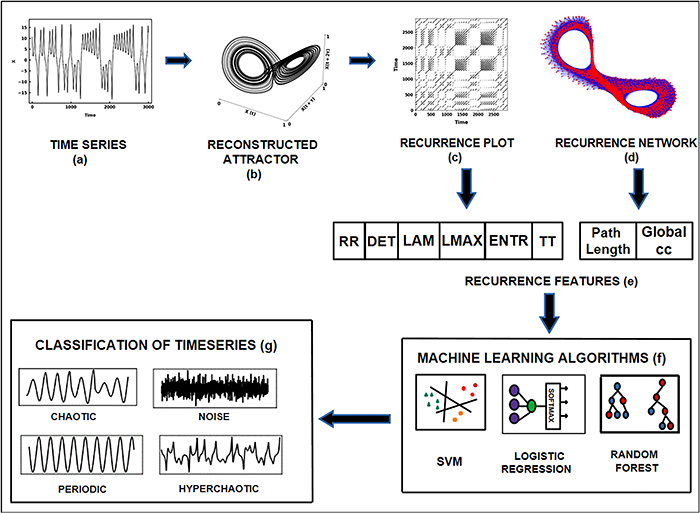
We integrate machine learning classifiers with recurrence network measures to categorize nonlinear time series into periodic, chaotic, hyperchaotic, or noisy states. The algorithms successfully identify key density features and predict the dynamical states of real variable stars like SX Her and AC Her from their light curves. This demonstrates the robustness of recurrence-based features in time series analysis.