Page 3
CMS-SMP-25-008
Page 1
September 7th, 2026
Page 2
CMS-SMP-25-008
Evidence for the dead-cone effect in bottom quark initiated jets produced in proton-proton collisions at √s = 13 TeV
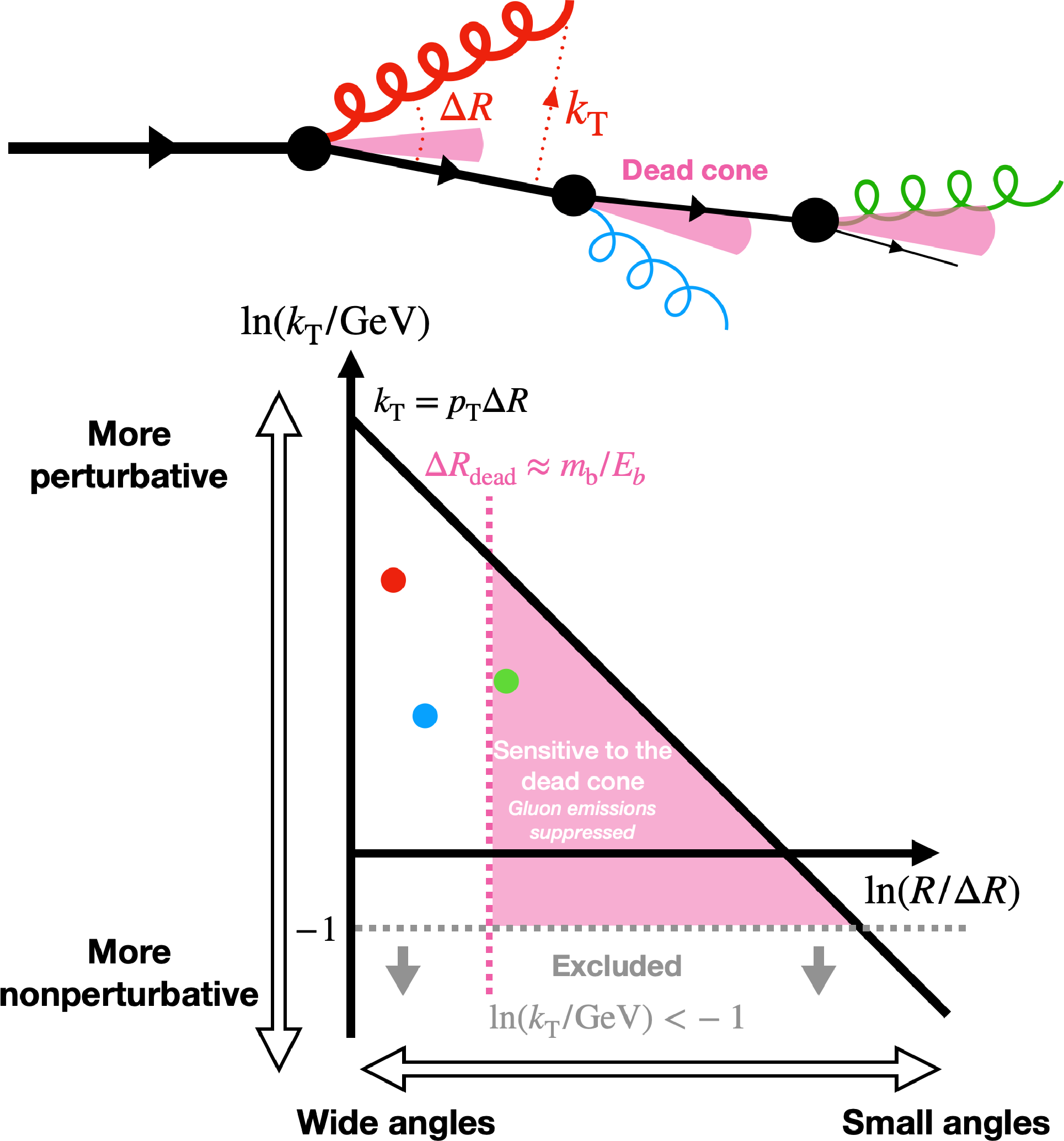
The suppression of collinear gluon emissions from a massive quark, or the “dead-cone effect,” is the primary manifestation of quark mass effects in parton showers. A proton-proton collision data set recorded by the CMS experiment at √s = 13 TeV with an integrated luminosity of 59.8 fb−1 is analyzed. A differential measurement is presented of the emission density of bottom quark jets, studied as a function of the angular separation between iteratively declustered subjets. The measurement is performed in bottom quark initiated jets with transverse momenta between 40 and 200 GeV originating from top quark pair production. Compared to data, a parton shower Monte Carlo model that includes the dead-cone effect is favored, while a model without the dead-cone effect is disfavored with a significance of 4.3 standard deviations.
Page 3
CMS-SMP-25-008
Page 4
CMS-EXO-24-005
Search for scalar leptoquarks produced via muon-quark scattering in proton-proton collisions at √s = 13 TeV
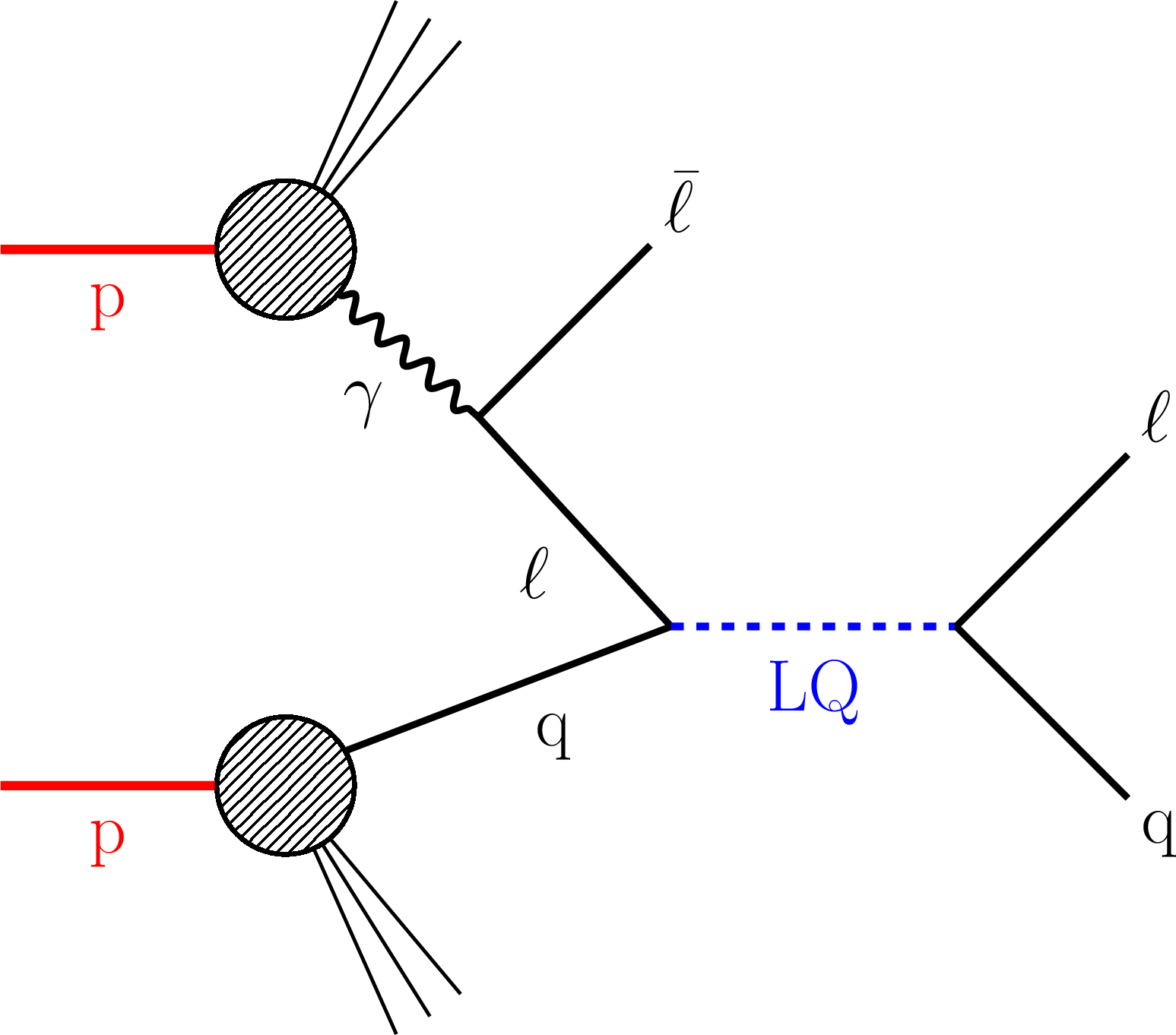
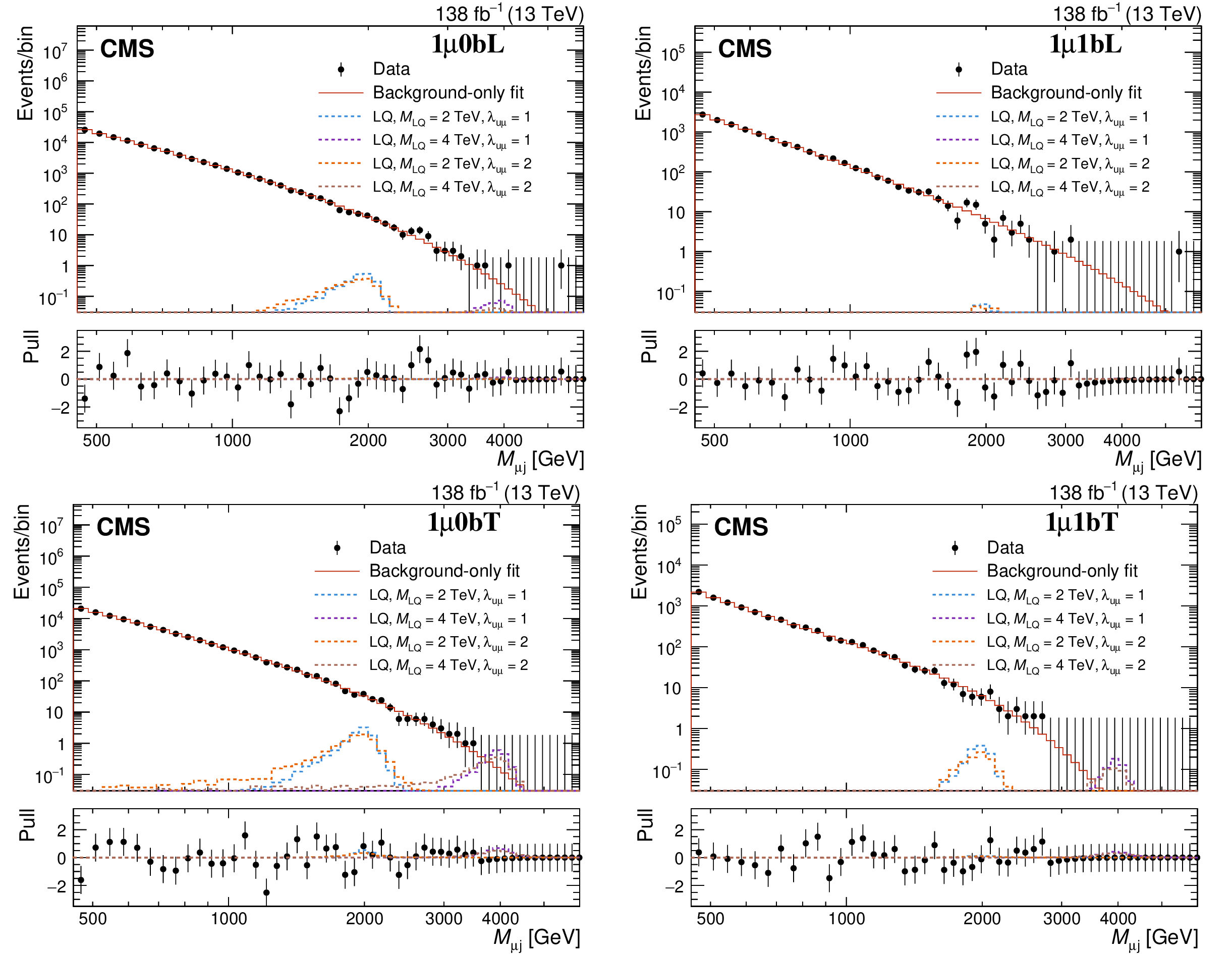
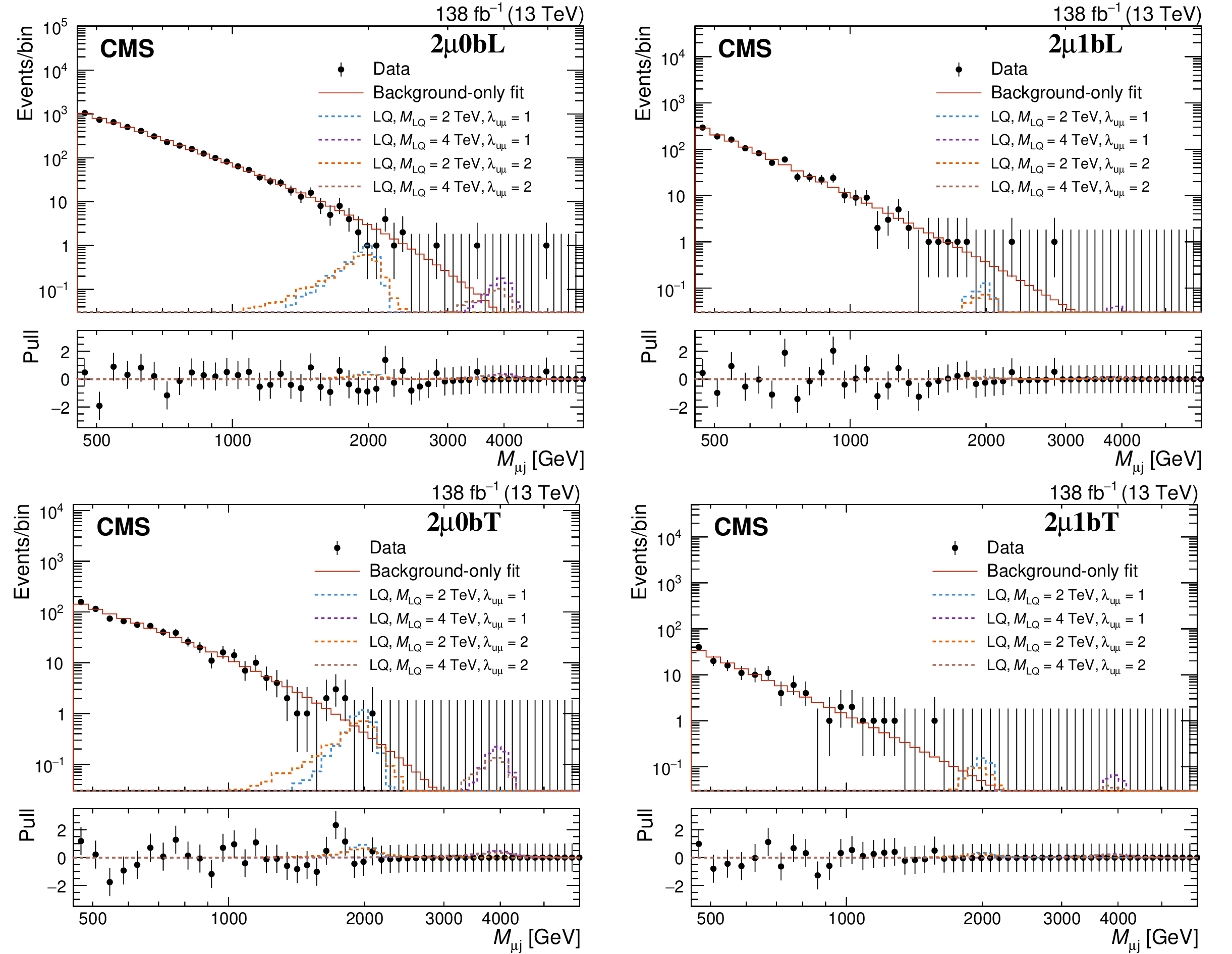
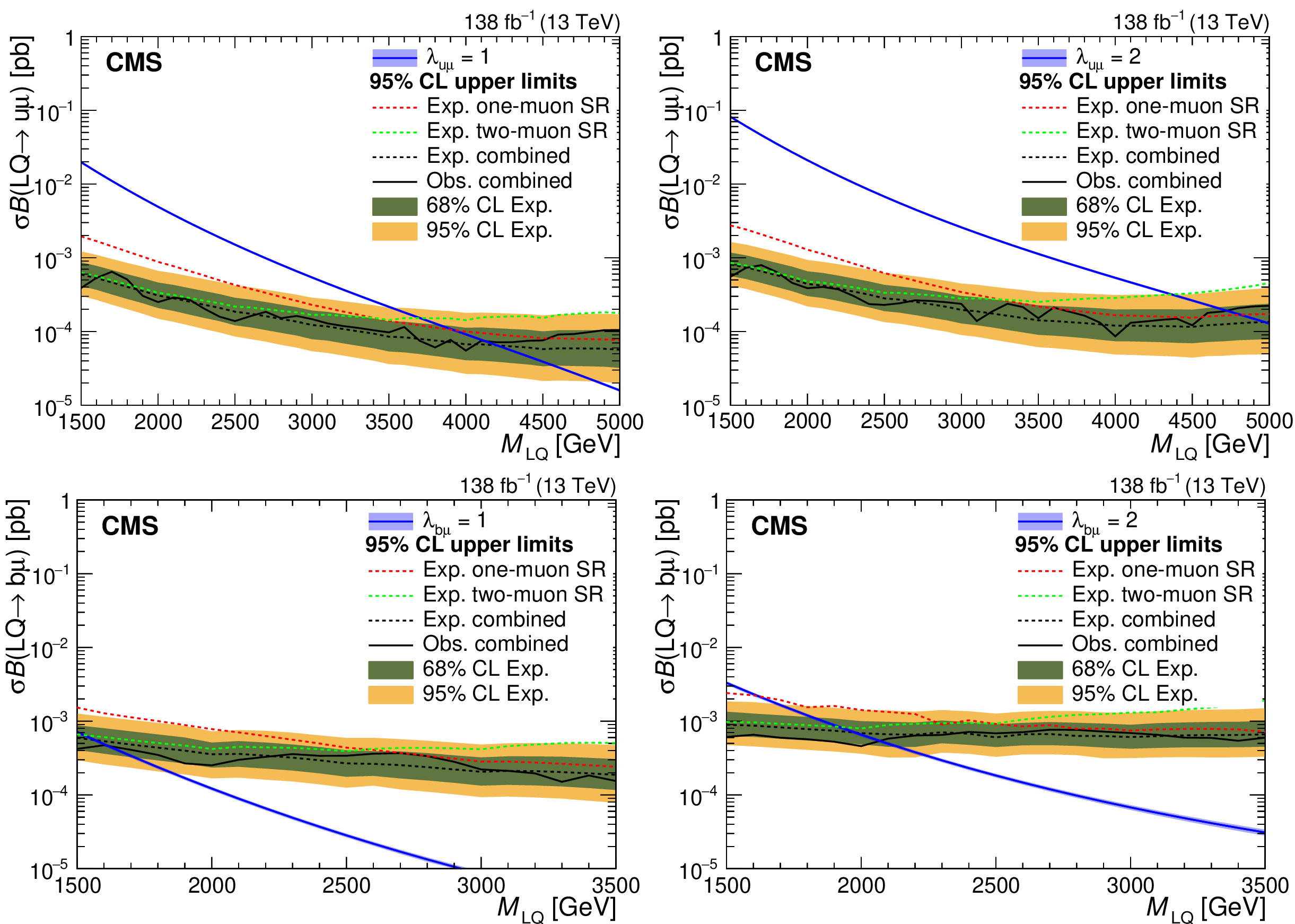
The first search for TeV-scale scalar leptoquarks (LQs) produced in muon-quark (μq) interactions is presented. It is based on proton-proton collision data recorded at a center-of-mass energy of 13 TeV with the CMS detector at the LHC, corresponding to an integrated luminosity of 138 fb−1. Quantum fluctuations inside the proton generate charged-lepton components, enabling the study of lepton-induced processes. In particular, the interaction of a muon from one colliding proton with a quark from the other proton enables the study of resonant production of a single LQ and its subsequent decay. The final state includes one or two muons and a jet that can come from the hadronization of either a light quark (u) or a b quark. The primary observable is the invariant mass of the muon-jet system, whose distribution peaks at the LQ mass. The data are found to be in agreement with the background predictions. Upper limits are set on the product of the LQ production cross section and its decay branching fraction to the μq final state. The results exclude broad regions in the parameter plane of the LQ mass and the LQ-μq coupling, improving upon previous CMS searches by extending the coverage for LQs with masses between 1.5 and 3.6 TeV, and couplings between 0.2 and 0.6 for the LQ(uμ) scenario; and masses above 1.8 TeV, and couplings above 1 for the LQ(bμ) scenario.
Page 5
CMS-EXO-24-005
Page 6
CMS-EXO-24-005
Page 7
CMS-EXO-24-005
Page 8
CMS-EXO-24-005
Page 9
CMS-HIG-25-004
Constraint on the Higgs boson width in the diphoton final state using signal-background interference in proton-proton collisions at √s = 13 TeV
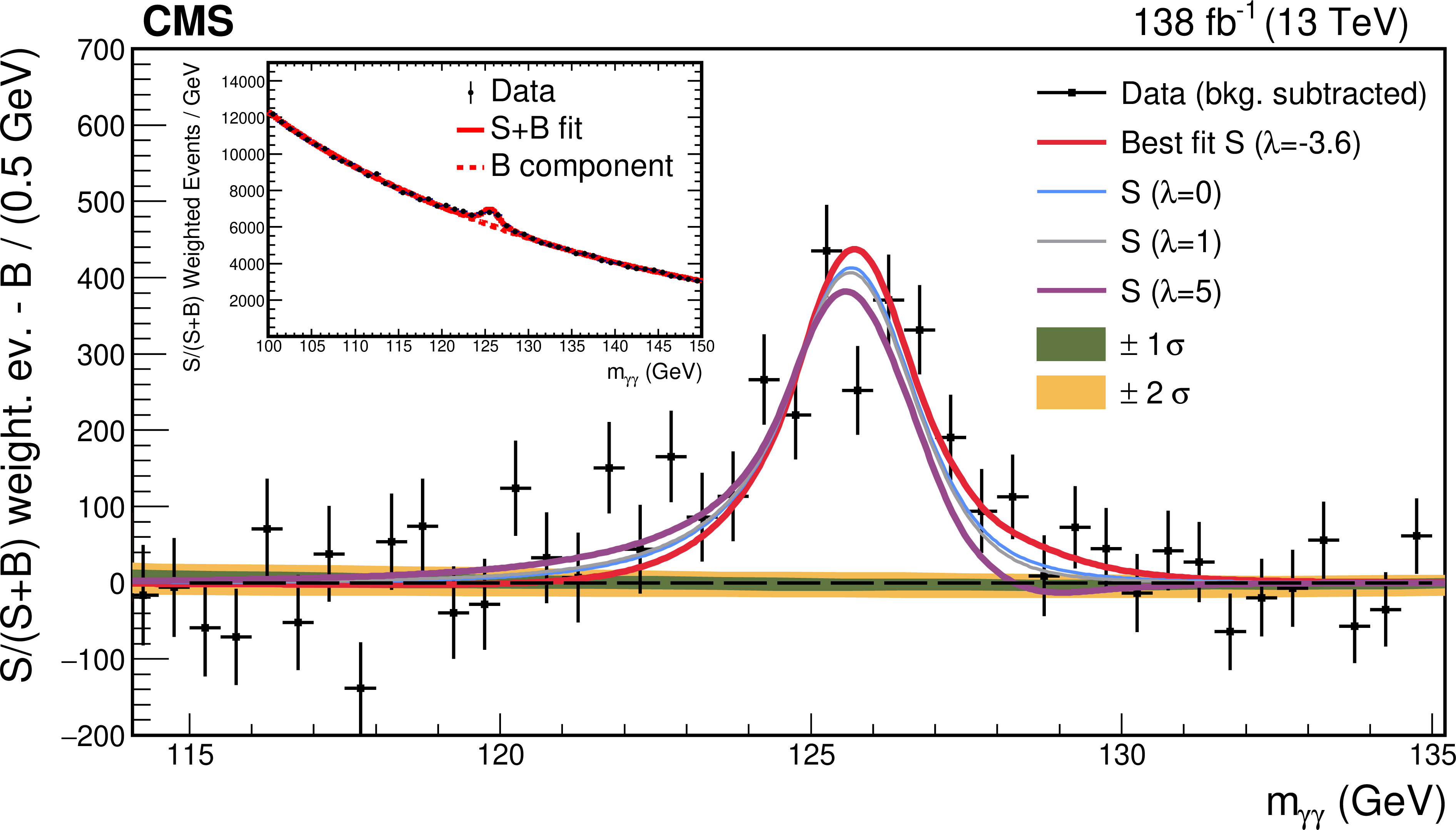
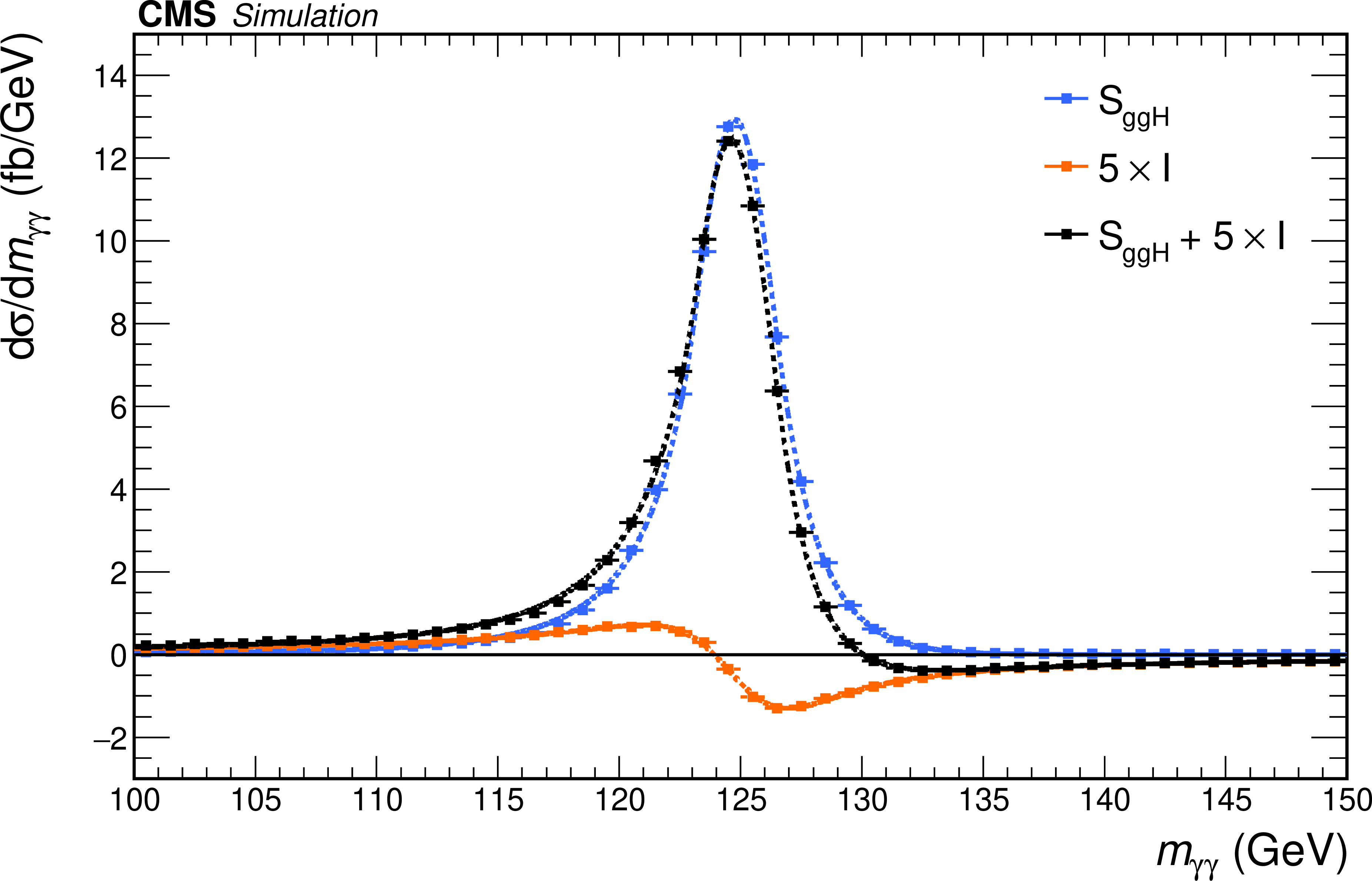
The standard model Higgs boson, with a mass of 125 GeV, has a predicted decay width, ΓH, of 4.1 MeV. This Letter presents the first constraint on ΓH obtained through the interference between the resonant H → γγ process and the continuum γγ production, both produced via gluon-gluon fusion. The analysis is performed using proton-proton collision data at √s = 13 TeV, collected by the CMS experiment between 2016 and 2018, corresponding to an integrated luminosity of 138 fb−1. The observed (expected) limit on the Higgs boson width is ΓH < 92 (138) MeV at 95% confidence level. This is the most stringent constraint on ΓH from on-shell Higgs boson measurements to date.
Page 10
CMS-HIG-25-004
Page 11
LHCb Collab
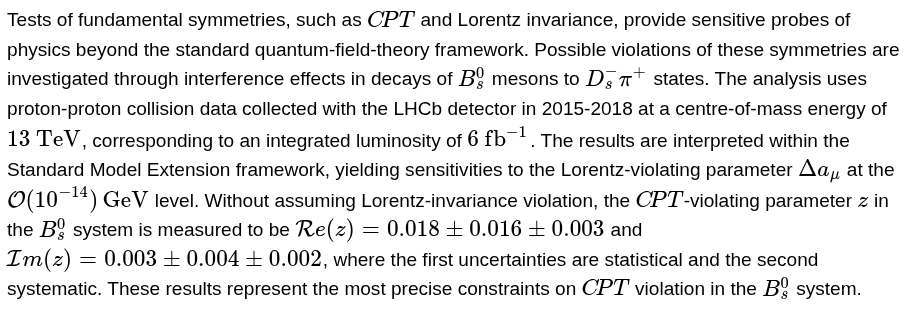
Stringent limits on CPT- and Lorentz-invariance violation from B0s meson decays
Page 12
Anomaly detection for multijet scenarios
C. Yede et al
Signals of physics beyond the Standard Model continue to resist discovery at the LHC. Recent years have seen the proliferation of new anomaly detection techniques, promising discovery with significantly fewer model assumptions than traditional approaches. Strategies based on weak supervision have been especially successful, but so far were largely limited in scope by their reliance on a resonance manifesting a decay into a pair of jets. In this work, we demonstrate that a well-established idea from jet substructure physics - recursive soft drop - in combination with the CATHODE technique for anomaly detection can be used to simultaneously perform anomaly detection for signals with an arbitrary number of jets in the final state, greatly increasing the scope of such searches.