Page 3
CMS-TOP-25-015
Page 1
August 24th, 2026
Page 2
CMS-TOP-25-015
Search for top quark flavor-changing neutral currents in multilepton final states using an effective field theory approach in proton--proton collisions at √s = 13 TeV
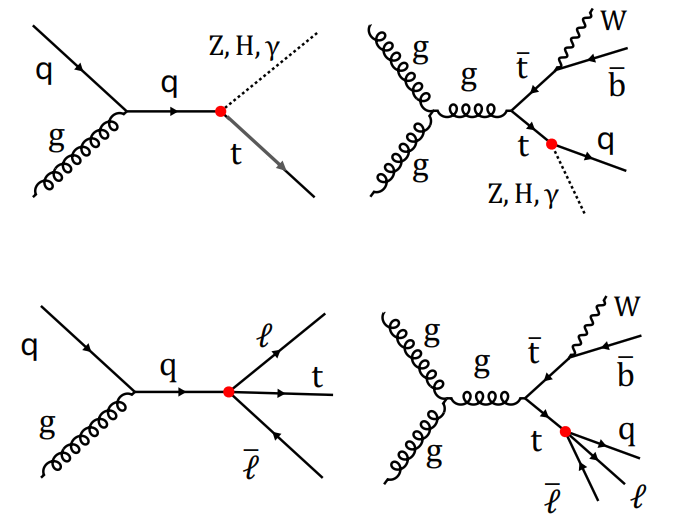
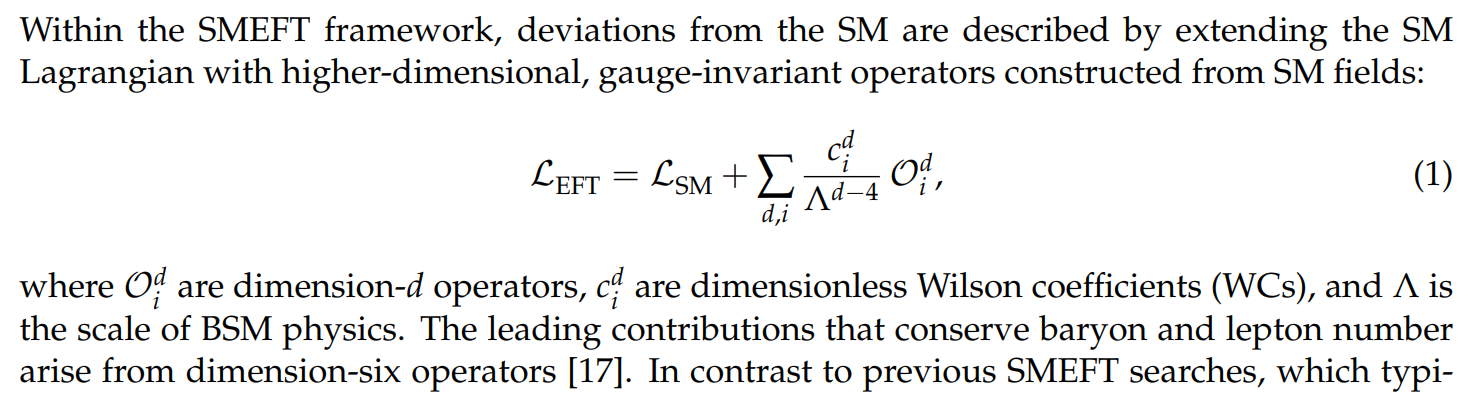
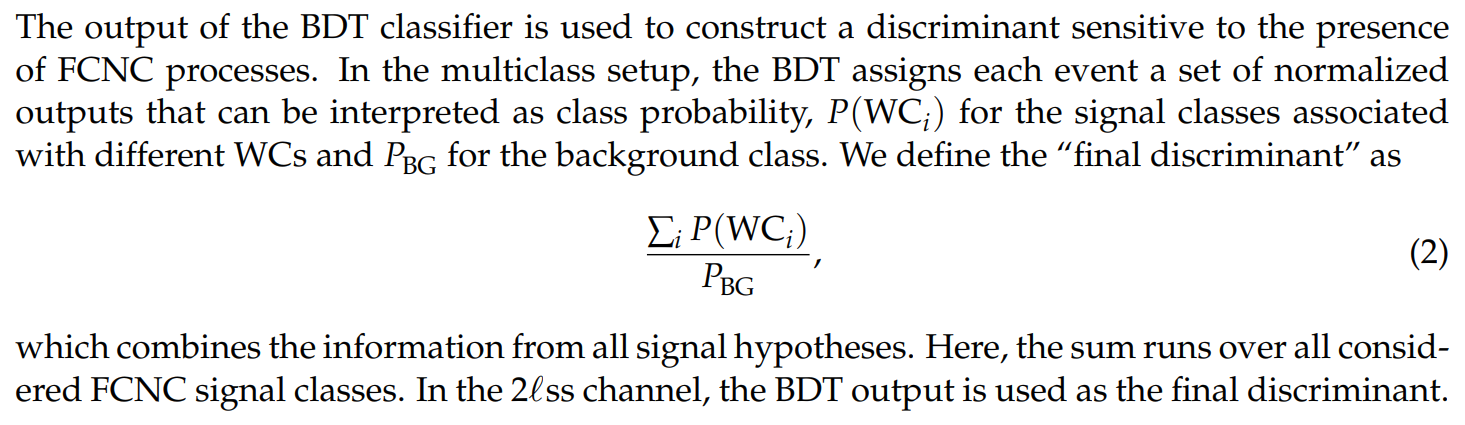
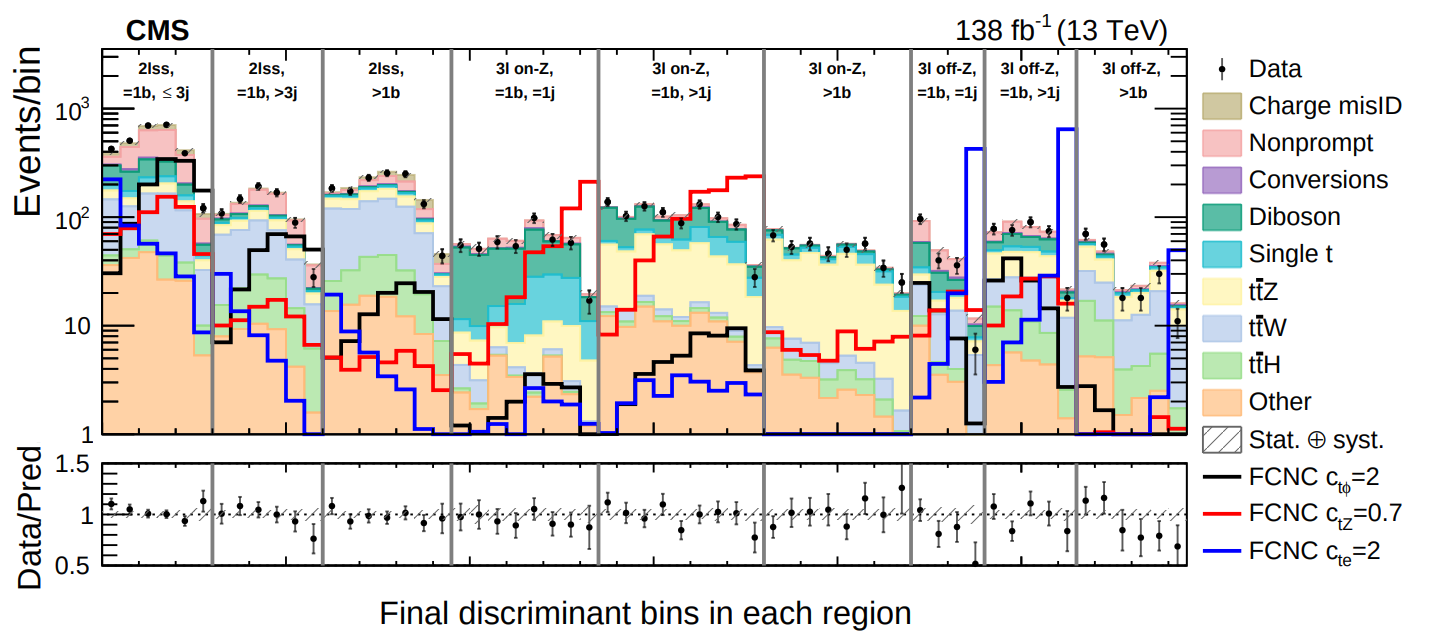
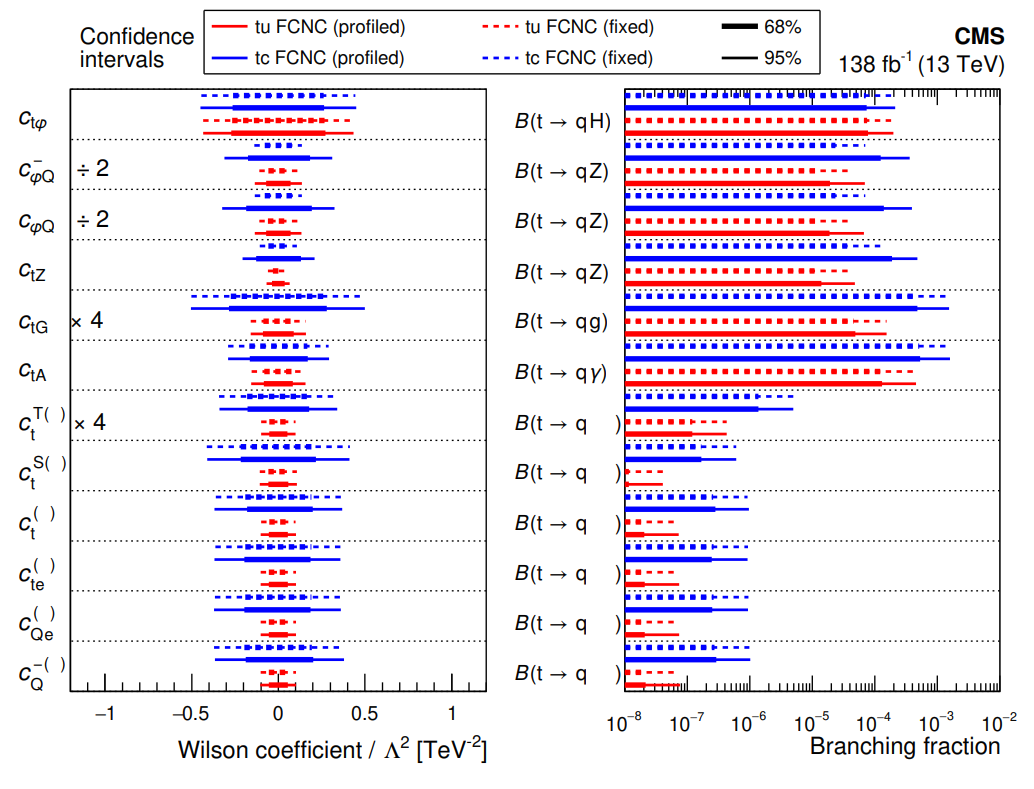
We present a search for flavor-changing neutral current (FCNC) interactions involving the top quark in production and decay. This analysis establishes the first global search in the top quark FCNC sector within the standard model effective field theory where all relevant operators are constrained simultaneously in a single fit to data, providing a framework for future measurements and combinations at the LHC. The analysis uses proton−proton collision data collected at √s = 13 TeV by the CMS detector, corresponding to an integrated luminosity of 138 fb−1. Signal contributions are probed in final states with two same-sign charged leptons or three leptons. Multivariate discriminants are used to separate signal from background, and their distributions enter a likelihood fit to determine 95% confidence intervals for 24 Wilson coefficients. No evidence for FCNC interactions is observed. These results provide the first simultaneous constraints on the complete operator set and place the most stringent limits to date on FCNC top quark decay branching fractions via two-quark−two-lepton interactions.
Page 3
CMS-TOP-25-015
Page 4
CMS-TOP-25-015
Page 5
CMS-TOP-25-015
Page 6
https://arxiv.org/abs/2503.22382
CMS-TOP-25-002
Observation of an excess at the top quark pair production threshold in the single-lepton channel
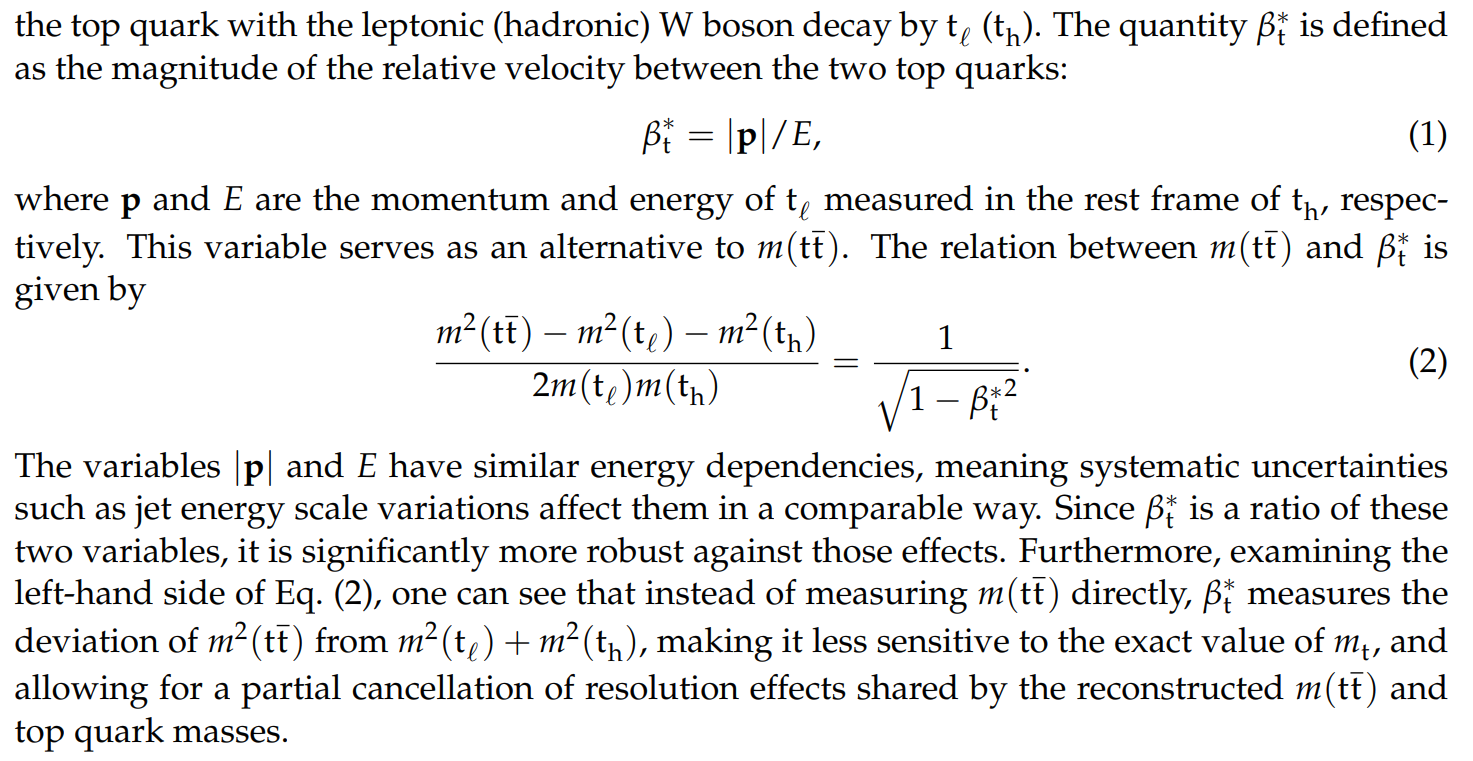
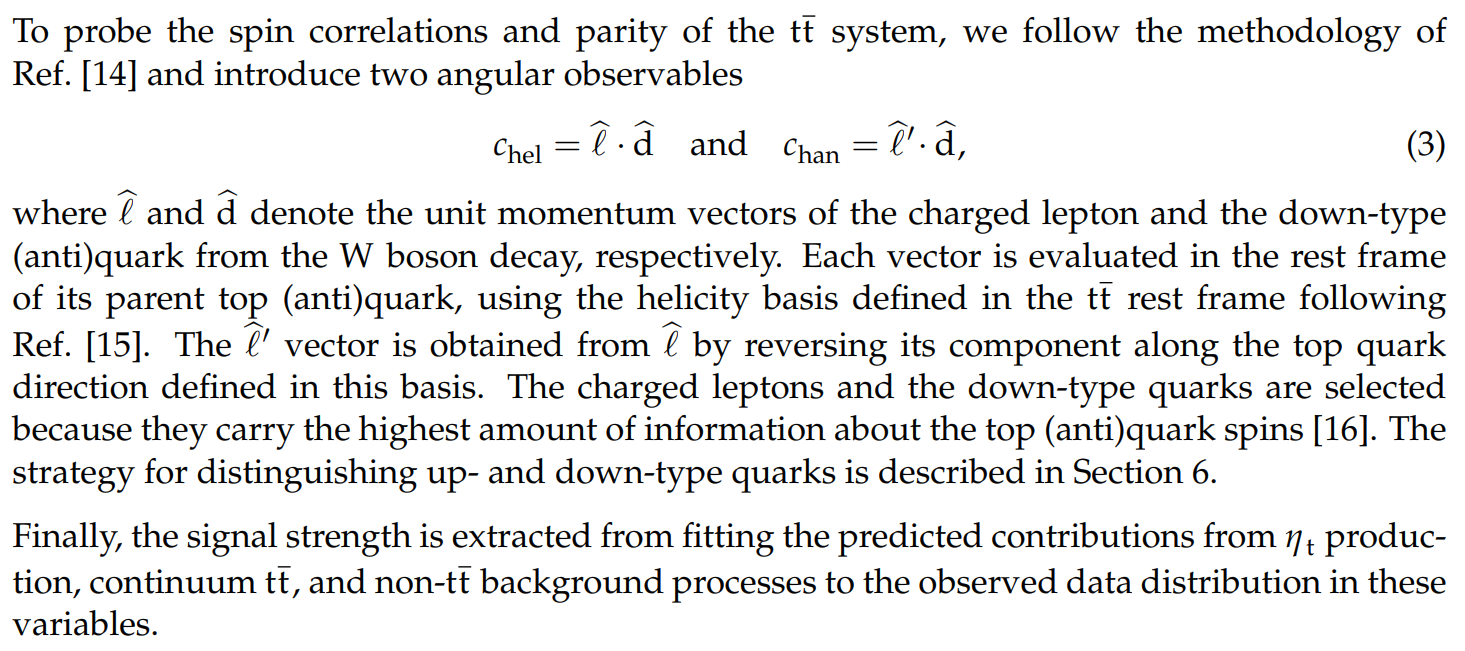
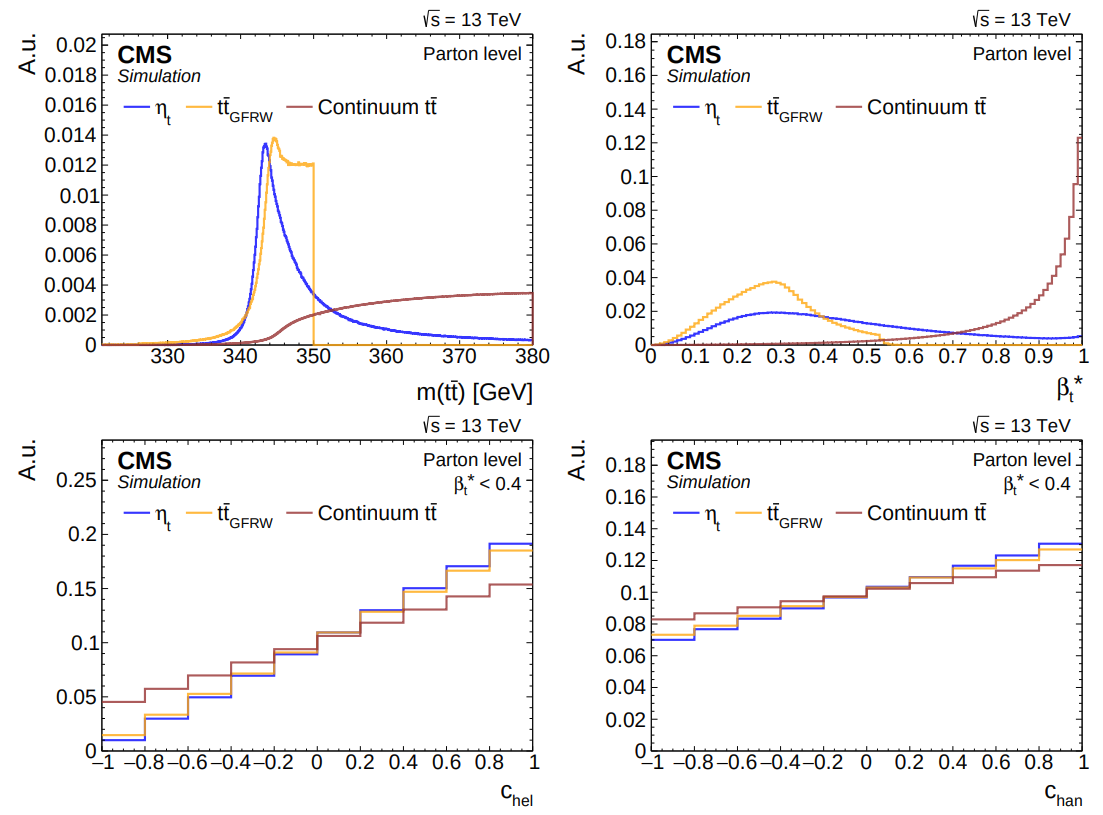
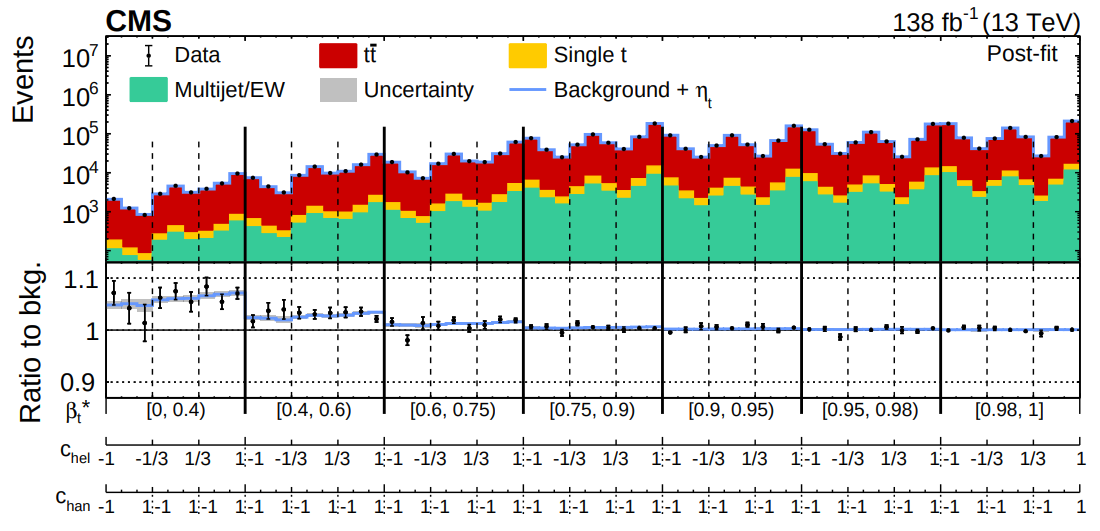
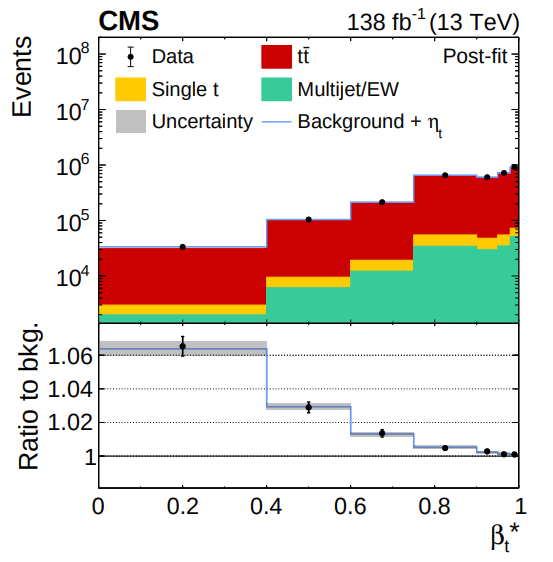
A search is presented for top quark-antiquark (tt) quasi-bound “toponium” states, near the kinematic tt production threshold in final states with a single electron or muon and jets. The study uses proton-proton collision data at √s = 13 TeV, collected by the CMS experiment at the CERN LHC, corresponding to an integrated luminosity of 138 fb−1. The analysis examines the relative velocity between the top quark and antiquark, along with two angular observables sensitive to the parity and spin of the tt system. A significant excess of events is observed relative to the standard model prediction for tt production calculated at next-to-next-to-leading order in perturbative quantum chromodynamics (QCD). The excess corresponds to an observed total cross section of 5.1±0.9 pb and is consistent with a simplified model of a color singlet pseudoscalar toponium motivated by nonrelativistic QCD, with a resulting observed significance of 6.1 standard deviations. The result provides an independent confirmation of the excess reported in the dilepton channel.
Weekly: April 7th, 2025
https://arxiv.org/abs/2503.22382
Page 7
CMS-TOP-25-002
Page 8
CMS-TOP-25-002
Page 9
CMS-TOP-25-002
Page 10
CMS-TOP-25-002
Page 11
Electroweak Baryogenesis in Top-Philic Type-III Two-Higgs-Doublet Model motivated by the tt Excess at the LHC
Y. Matusoka
Recently, the CMS and ATLAS Collaborations reported an enhancement near the production threshold in the invariant-mass distribution of top-antitop pairs. Possible interpretations include a pseudoscalar toponium quasi-bound state and an additional elementary pseudoscalar that coexists or mixes with toponium.
Motivated by the latter interpretation, we identify the additional pseudoscalar with the CP-odd Higgs boson of a top-philic Type-III two-Higgs-doublet model (2HDM). This possibility is also interesting from the viewpoint of electroweak baryogenesis: the extended scalar sector can support a strong first-order electroweak phase transition, while the additional top-quark Yukawa interaction can provide a CP-violating source through the bubble-wall background. We therefore investigate whether the same parameter region motivated by the tt¯ threshold enhancement can also account for the observed baryon asymmetry of the Universe (BAU).
We compare two scenarios with different origins of CP violation. In the explicit CP violation scenario, a complex phase is introduced into the additional top-quark Yukawa coupling ρtt. In the transitional CP violation (TCPV) scenario, a CP-odd field configuration is generated dynamically inside the bubble wall through finite-temperature effects. Within the present one-loop treatment, explicit CP violation remains a scheme-dependent possibility, whereas no viable transitional CP violation branch is identified. In addition, we discuss the physical differences and viability of these two scenarios.
Page 12
CMS-SMP-25-001
Search for anomalous couplings in WW and WZ production with single-lepton final states in proton-proton collisions at √s = 13 TeV
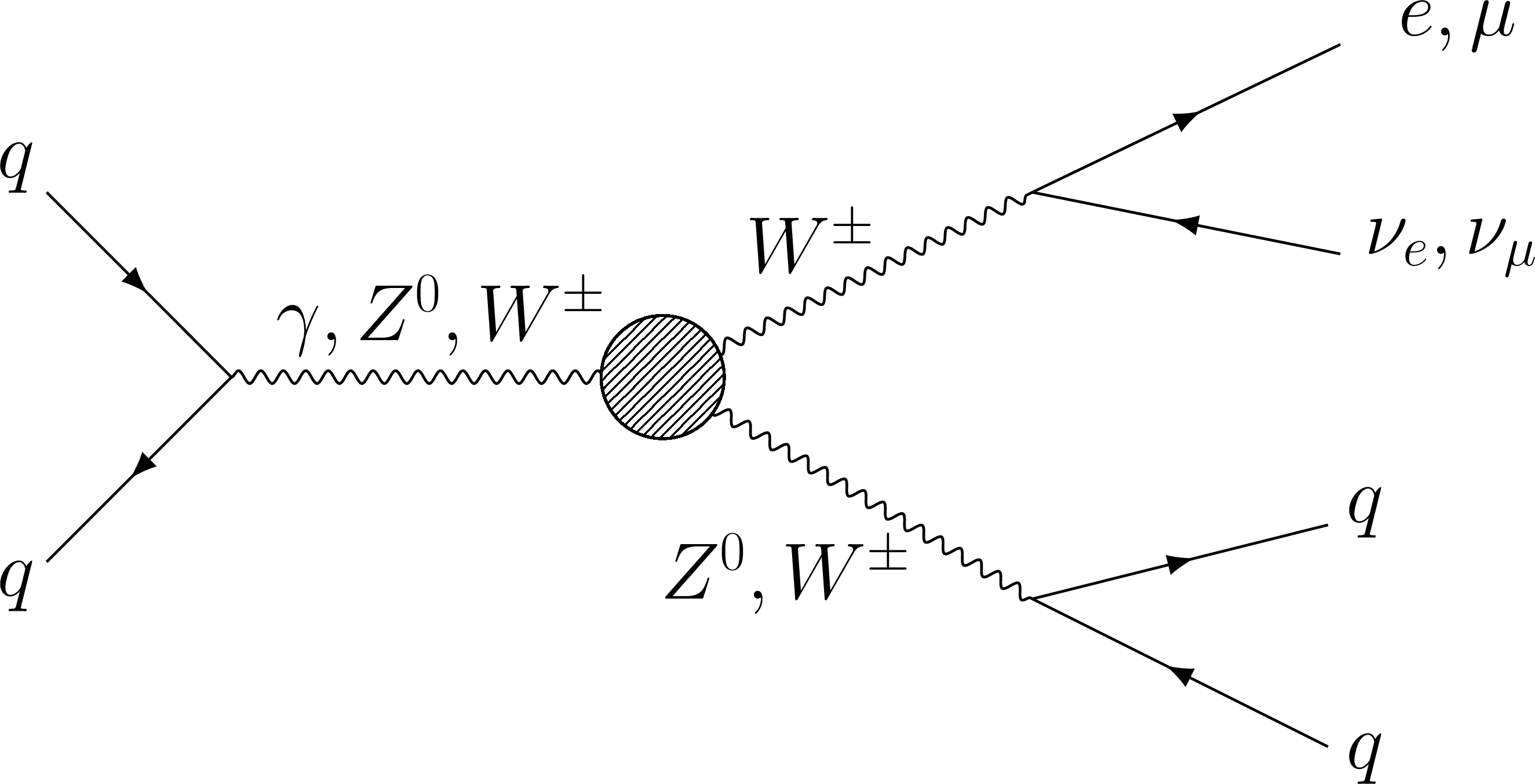
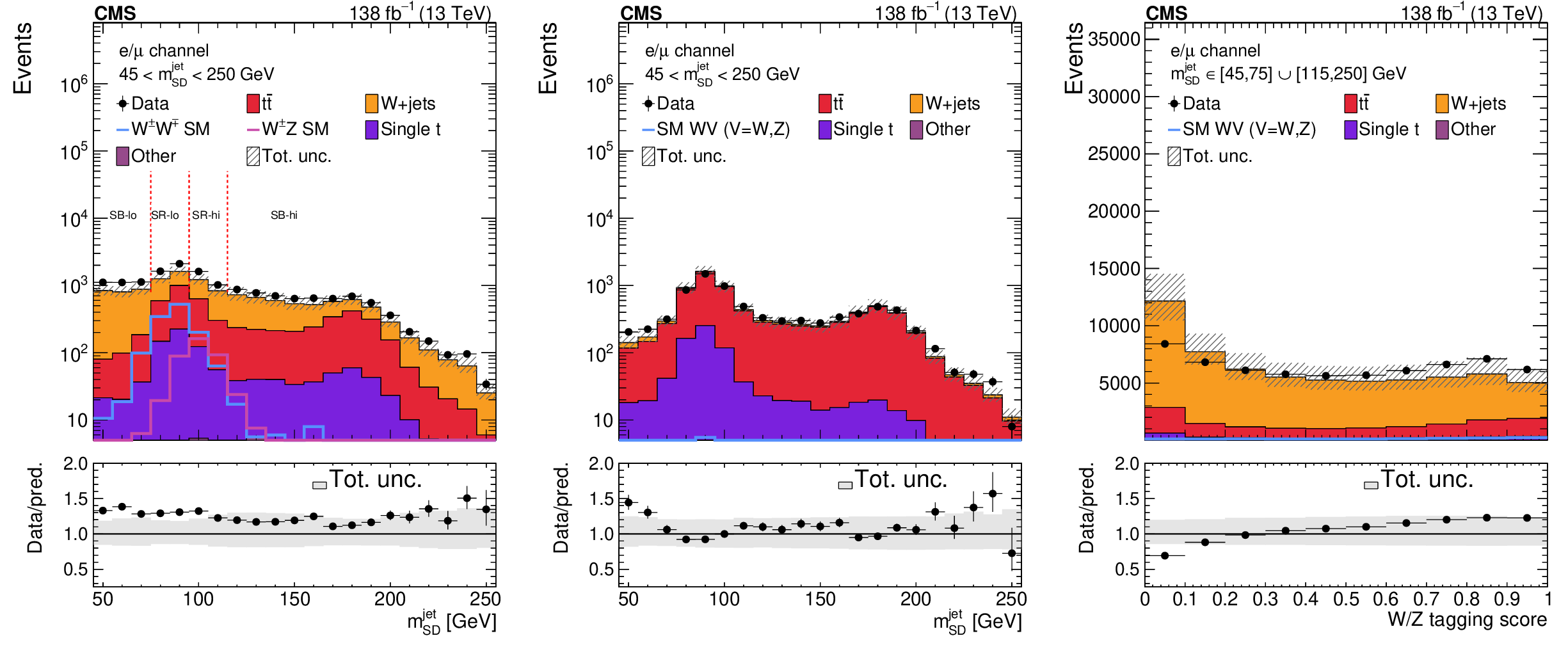
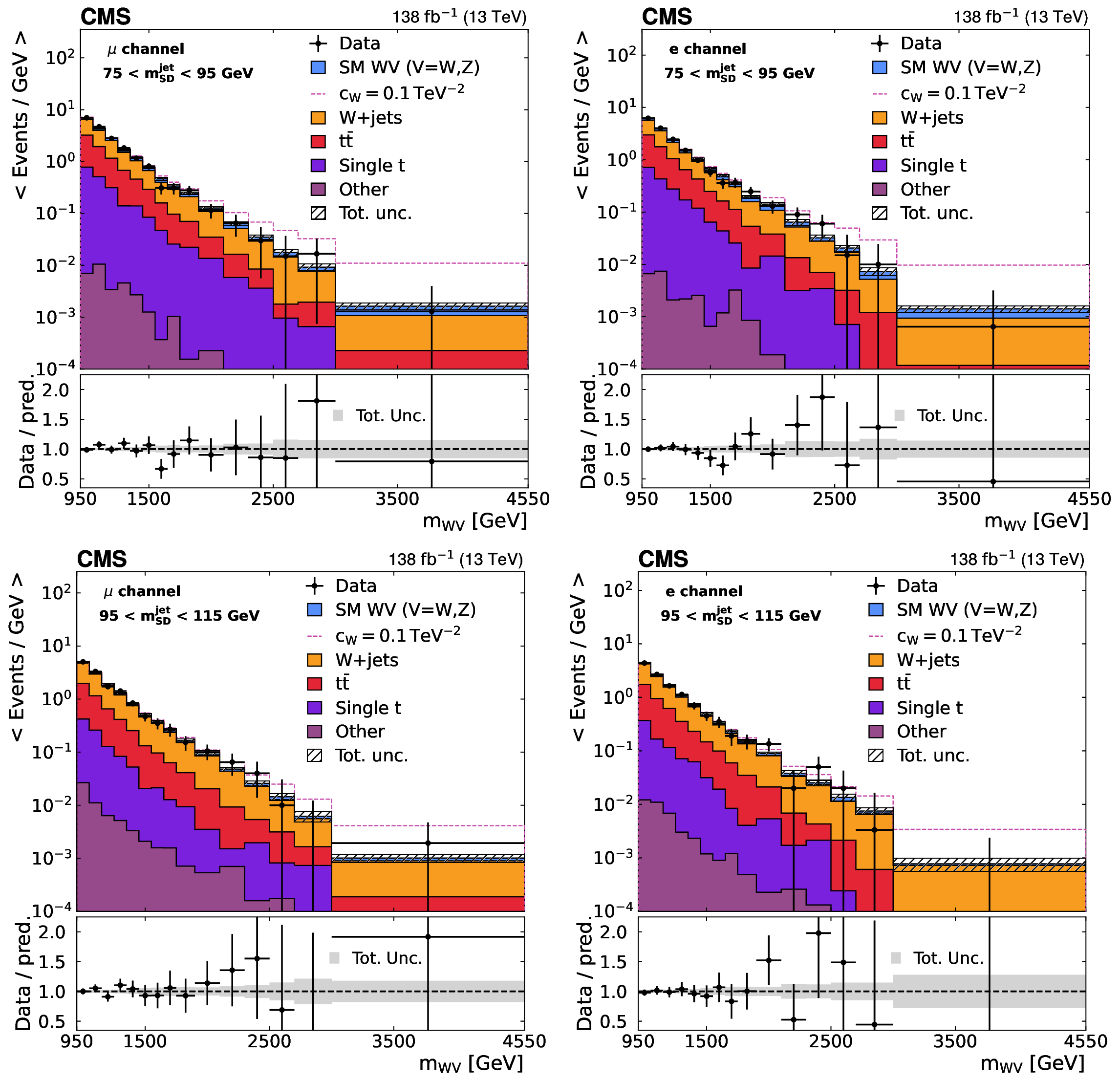
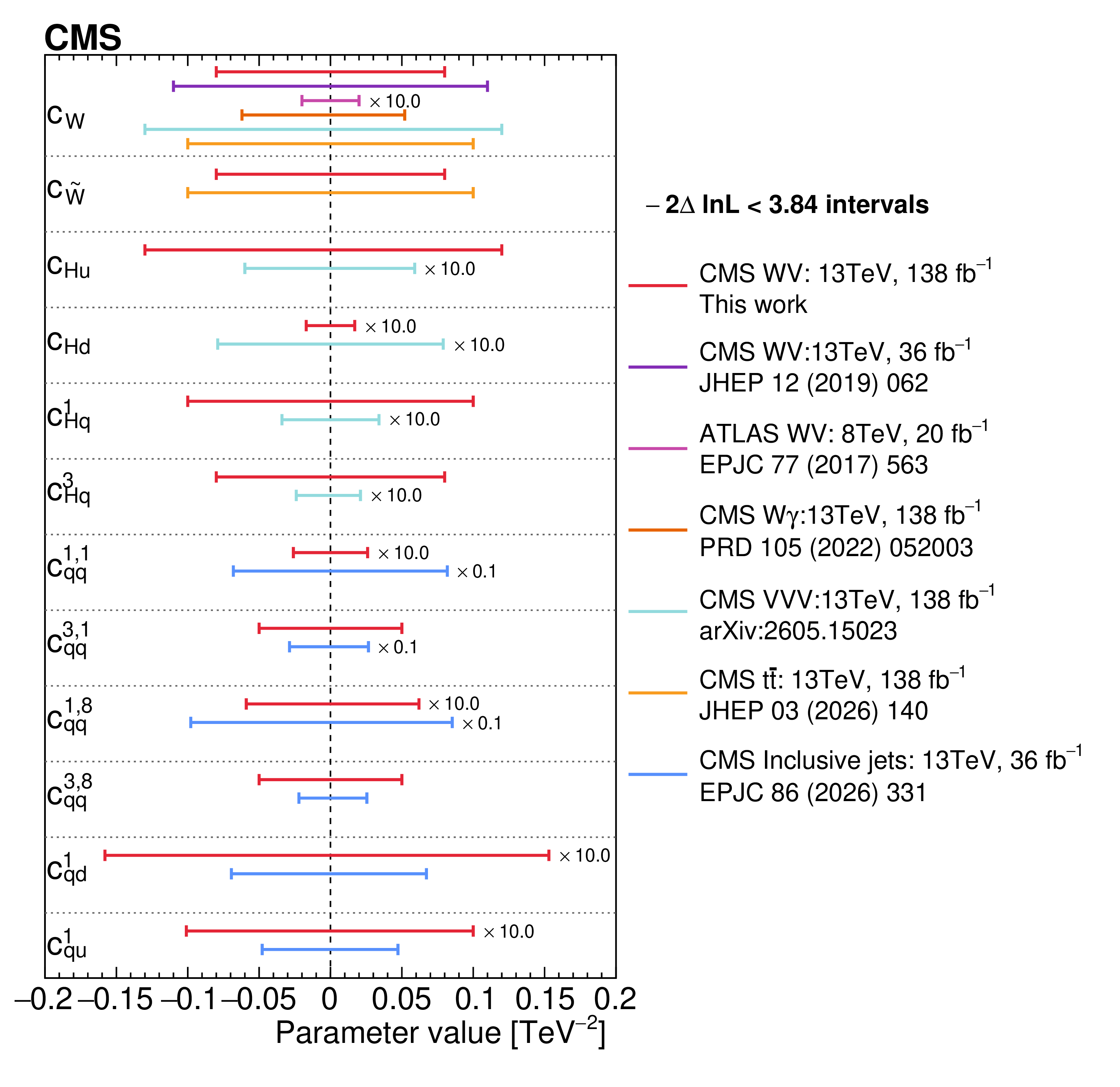
A search for deviations from the standard model using an effective field theory approach is carried out using the proton-proton collision data set recorded by the CMS experiment at the LHC at a center-of-mass energy of 13 TeV, corresponding to an integrated luminosity of 138 fb−1. In this study Wilson coefficients corresponding to dimension-six effective field theory operators that would lead to anomalous gauge boson self-couplings and modified couplings between vector bosons and quarks are constrained. Diboson (WW and WZ) production processes with one W boson decaying to a lepton plus antineutrino or charge conjugate and the second W or Z boson decaying hadronically are considered. Since the contribution from anomalous couplings is expected to be most visible at high energy scales, the focus is on final states where the hadronic decay products of a W or Z boson are merged into a single large-radius jet. A dedicated classifier based on machine learning is employed to separate hadronic W and Z boson decays from background processes. The most stringent constraints to date on the Wilson coefficients of operators corresponding to anomalous triple gauge boson couplings are reported. The bounds set on the couplings between vector bosons and quarks are competitive with those from previous inclusive jet measurements.
Page 13
CMS-SMP-25-001
Page 14
CMS-SMP-25-001
Page 15
CMS-SMP-25-001
Page 16
CMS-BTV-25-002
Performance of heavy-flavour jet identification in the CMS high-level trigger in proton-proton collisions at √s = 13.6 TeV
The CMS trigger system plays a crucial role during data taking, reducing the large collision rate delivered by the LHC to a few kHz for data storage and subsequent offline analysis. The system aims to maintain a high selection efficiency for a wide range of processes, including those involving jets originating from heavy-flavour quarks (b and c), which provide a distinctive signature in many physics analyses. To achieve this while maintaining a sustainable trigger output rate, dedicated jet flavour identification methods are developed and optimized for use in the high-level trigger (HLT). This paper presents the design, commissioning, and performance of deep-learning-based jet identification algorithms deployed in the HLT during 2022−2024, for proton-proton collisions at √s = 13.6 TeV. The new algorithms enabled significant improvements in signal efficiency for a variety of key physics processes, including the non-resonant production of Higgs boson pairs decaying to four b quarks, as well as Higgs boson production via both vector boson fusion and in association with a tt pair, in the H → bb and H → cc decay channels.
Page 17
Contrastive Learning for Interpretable Anomaly Detection at Collider Experiments
H. Jia, S. Addepalli, J. Gonski
Generic event-level anomaly detection for collider physics has two recurring problems: anomaly scores are hard to interpret, and they correlate strongly with energy scale and object multiplicity. We present Organized Representation via Contrastive learning for Anomaly detection (ORCA), a two-stage framework that first learns an embedding space via supervised contrastive learning across a diverse set of physics processes, then runs a standard autoencoder in that space to generate event-level anomaly scores. On a simulated dataset consistent with conditions at the High-Luminosity Large Hadron Collider, ORCA delivers significant gains in both breadth and depth of sensitivity to new physics signals with respect to a baseline autoencoder architecture. Beyond improved sensitivity, the contrastive embedding makes the anomalous sample interpretable: because known processes occupy distinct regions of the space, a maximum-likelihood template fit to the embedding distributions can attribute events in an anomalous sample to template physics processes with quantified uncertainties. We demonstrate that the fit accurately recovers injected signal yields, including for signals excluded from the training of the embedding, and characterizes signals absent from the template library through the known processes they most resemble. These results establish ORCA as a route to interpretable anomaly detection-based searches at colliders, where the embedding geometry carries higher dimensional physics information compared to standard one-dimensional output fits, enhancing downstream statistical analysis.
Page 18
VERaiPHY -- Validation & Evaluation for Robust AI in PHYsics
G. Grosso, R. Winterhalder, L. Brenner, L. Lyons, T. Plehn
Modern machine learning is leading to substantial gains in precision, flexibility, and computational efficiency in fundamental physics. Statistical validation, uncertainty quantification, and robustness assessment are less systematically addressed. The VERaiPHY initiative (Validation & Evaluation for Robust AI in PHYsics) is a series of articles developed within the PHYSTAT programme, aimed at establishing statistical standards for the development, evaluation, and deployment of ML techniques. Each article focuses on a specific methodological domain from a statistics perspective and clarifies statistical questions, tests, and the interpretation of results. This opening article establishes the probabilistic, statistical, and machine learning foundations that the later contributions assume, together with the notation used throughout.
J. Cruz-Martinez, C. Cuesta-Lazaro, A. Held, M. Kagan
Machine learning is now a central tool for solving inverse problems in particle physics and astronomy. Models are trained on simulation and deployed on real data, raising the question not just of whether they fit, but of whether they are wrong in ways we did not anticipate: the unknown unknowns. This challenge of model misspecification is not unique to machine learning. In physics, misspecification is sometimes exactly what we want to find: new discoveries appear as failures of existing models. At other times, we want such effects absorbed into the analysis without biasing the measurement. A robust analysis is one that absorbs the misspecifications we are not interested in, while preserving sensitivity to the ones we are. Machine learning can both amplify misspecification and provide new tools to address it. We discuss the challenges of model misspecification, diagnostics for detecting it, and strategies for mitigation. No single diagnostic can confirm that a model is correctly specified: detection and mitigation are two halves of an iterative loop, in which a battery of complementary diagnostics is applied, the model is updated, and the process repeated. Robustness against unknown unknowns is ultimately less about any single technique than about a disposition: a willingness to suspect one's own model, and to design analyses that can survive being wrong in ways one did not anticipate.
Unknown Unknowns: Model Misspecification in Machine Learning for Physics