Go Back
CMS(1)
Page 2
arXiv:2608.05323
CMS-EXO-24-029
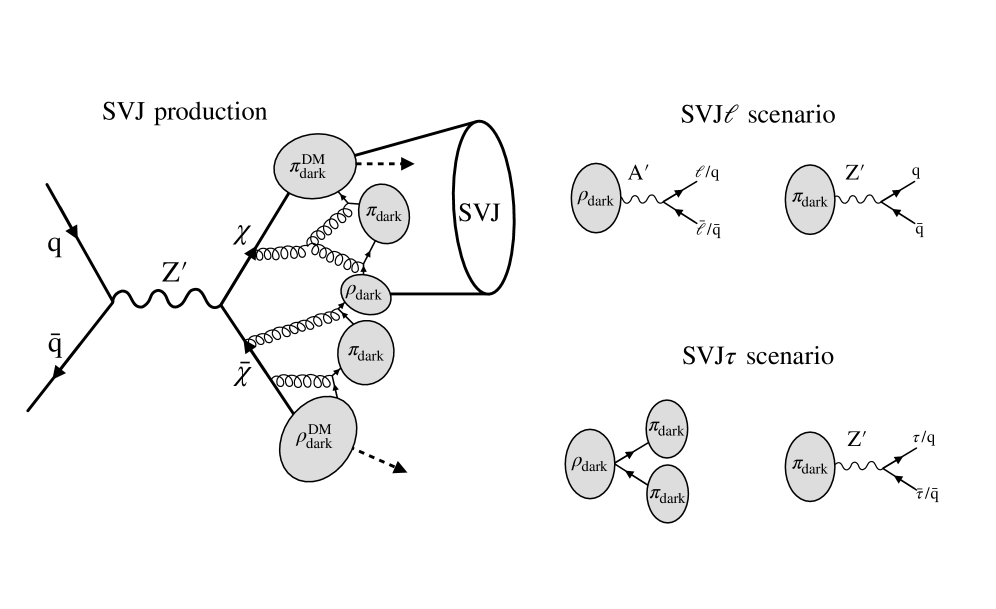
This search targets the resonant production of lepton-enriched semivisible jets (SVJs) from a strongly coupled dark sector, using 138 fb−1 of proton-proton collision data collected with the CMS detector at the CERN LHC at √s = 13 TeV. Two scenarios are investigated: jets enriched in all lepton flavors (SVJℓ signature) and jets predominantly enriched in tau leptons (SVJτ signature). The analysis focuses on final states in which the missing transverse momentum is aligned with jets containing nonisolated leptons. A dual machine-learning strategy is employed, using a graph neural network for jet identification and a fully connected neural network that combines jet- and event-level information to enhance signal sensitivity and background estimation. The signal models assume a heavy Z' mediator with a benchmark coupling of 0.25 to standard model quarks, together with prompt decays of unstable dark hadrons. In the SVJℓ scenario, mediator masses up to 4.7 TeV are excluded at 95% confidence level, while masses between 1.8 and 3.5 TeV are excluded in the SVJτ scenario. These results provide the first experimental constraints on lepton-enriched semivisible jets.
Expt(1)
Page 4
arXiv:2608.06109
Search for the charged lepton flavour violating decay η′→eμ
Based on (8998 ± 40) × 106 J/ψ events collected in e+e− collisions at √s=3.097 GeV with the BESIII detector, we present a search for the charged lepton flavour violating decay η′→eμ with J/ψ→γη′. No significant signal is observed, and an upper limit on its decay branching fraction is set to be 6.3×10⁻⁷ at the 90% confidence level, improving the previous best result by nearly three orders of magnitude.
CMS(2)
Page 5
arXiv:2608.01289
CMS-EXO-24-029
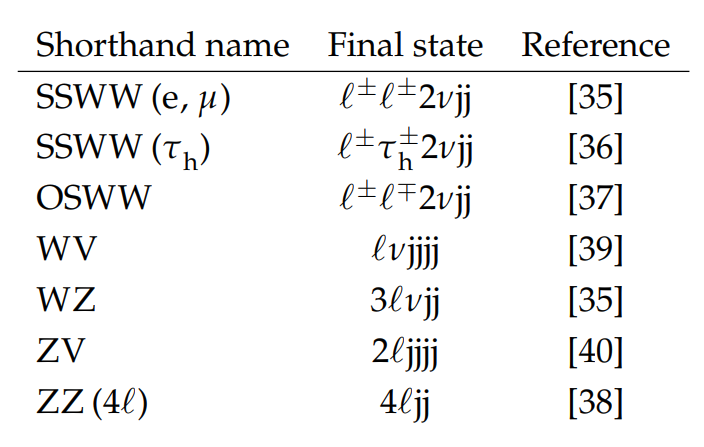
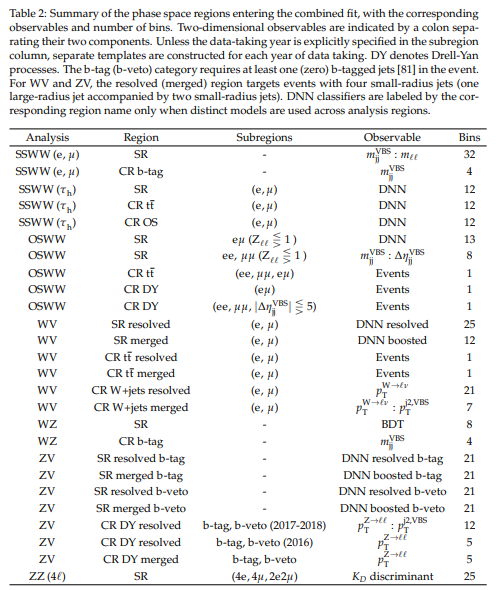
A statistical combination of vector boson scattering measurements in proton-proton collisions at √s = 13 TeV is presented. The analysis is based on a dataset corresponding to an integrated luminosity of 138 fb−1, collected with the CMS detector in 2016−2018. Events are selected to contain two vector bosons, with at least one decaying leptonically, and at least two additional jets with a high invariant mass and a large pseudorapidity separation. Signal rates are extracted for same-sign WW, opposite-sign WW, as well as for WZ and ZZ channels, and are compared with the standard model predictions. The combination provides a global view of vector boson scattering by simultaneously constraining all channels in a coherent framework, improving sensitivity beyond individual inputs, with all results in agreement with the standard model predictions. In addition, a charge-separated measurement is performed in which W bosons are distinguished according to their electric charge, allowing sensitivity to the production charge asymmetry.
Expt(2)
Page 8
arXiv:2608.03369
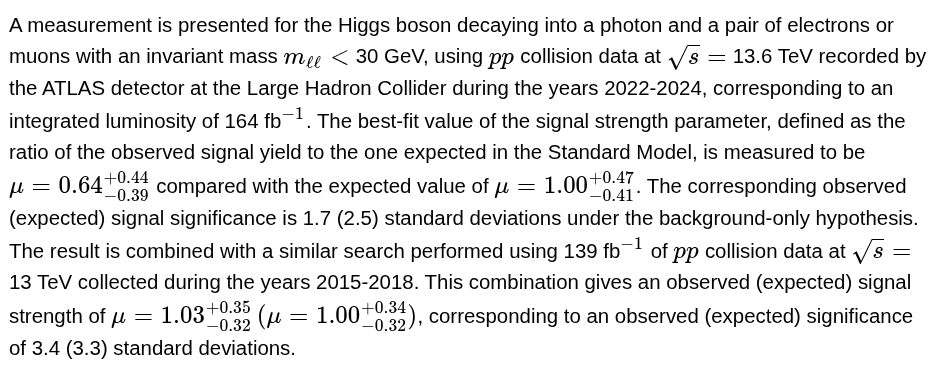
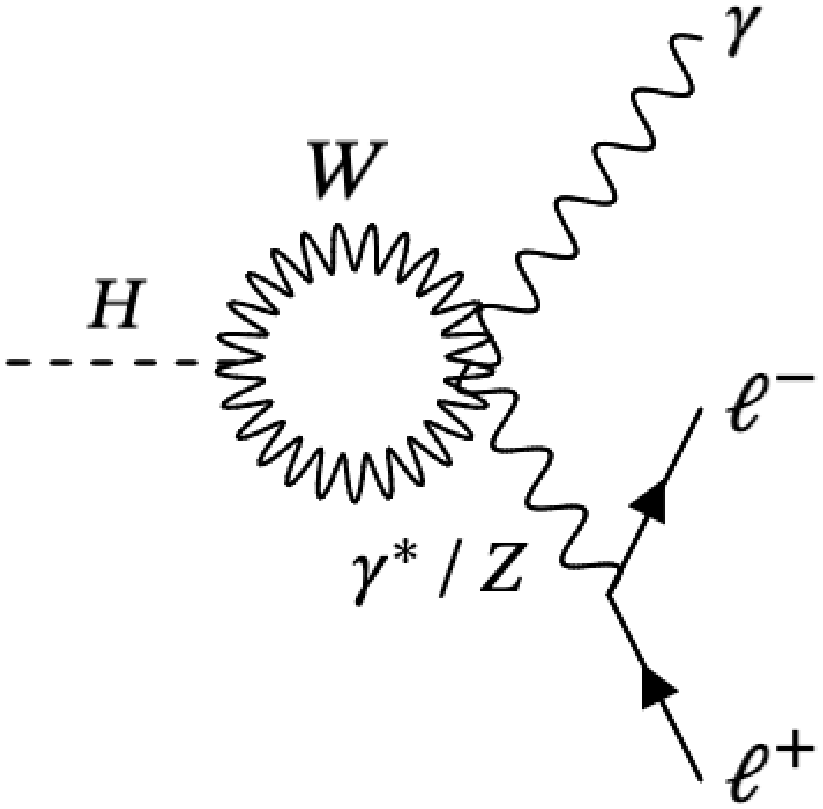
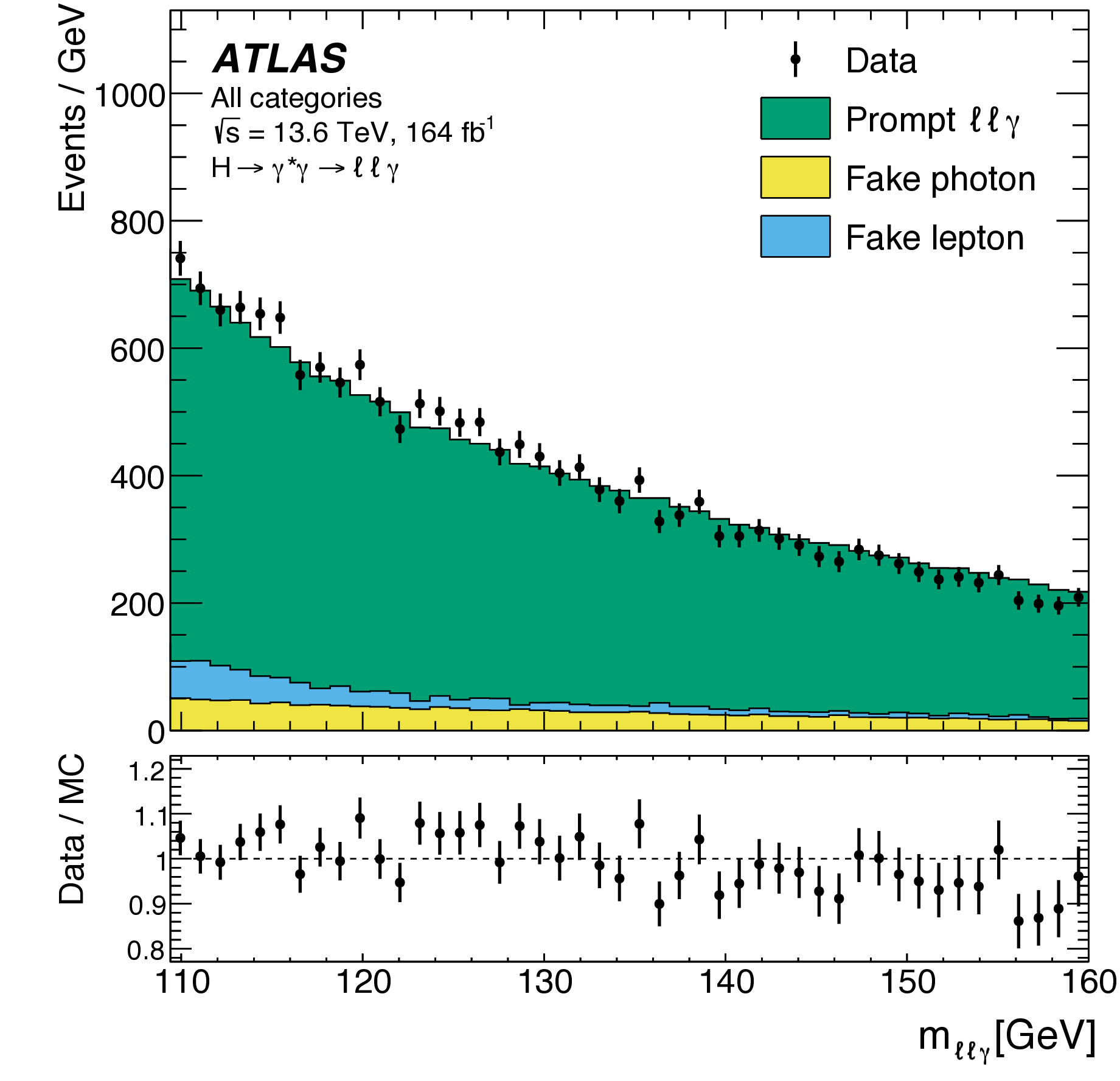
Measurement of the Higgs boson decay to a low-mass dilepton system and a photon in pp collisions at √s= 13 and 13.6 TeV with the ATLAS detector
Page 9
arXiv:2608.03369
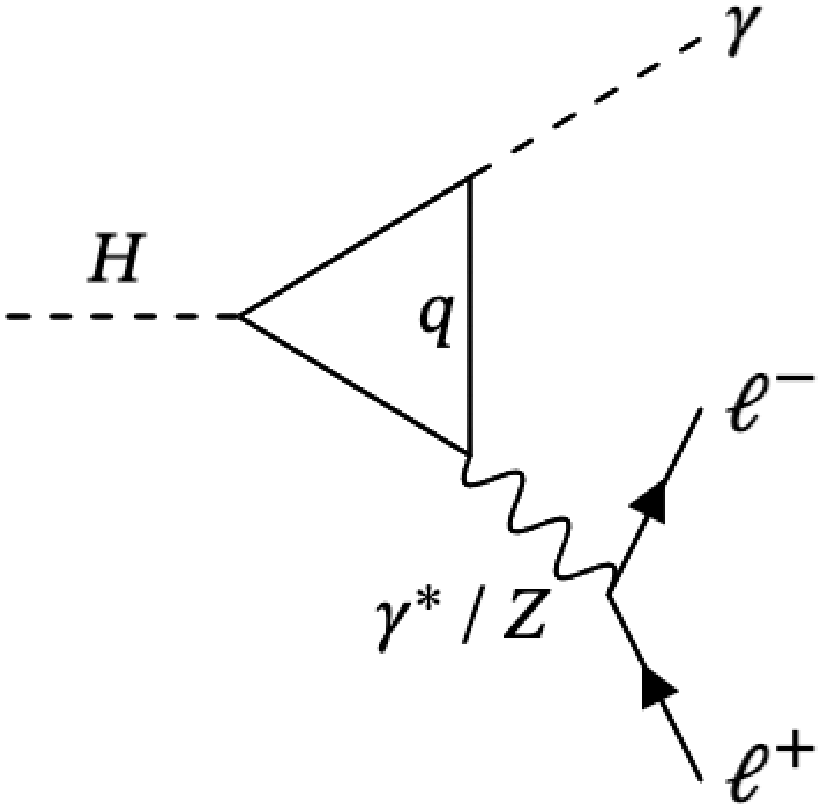
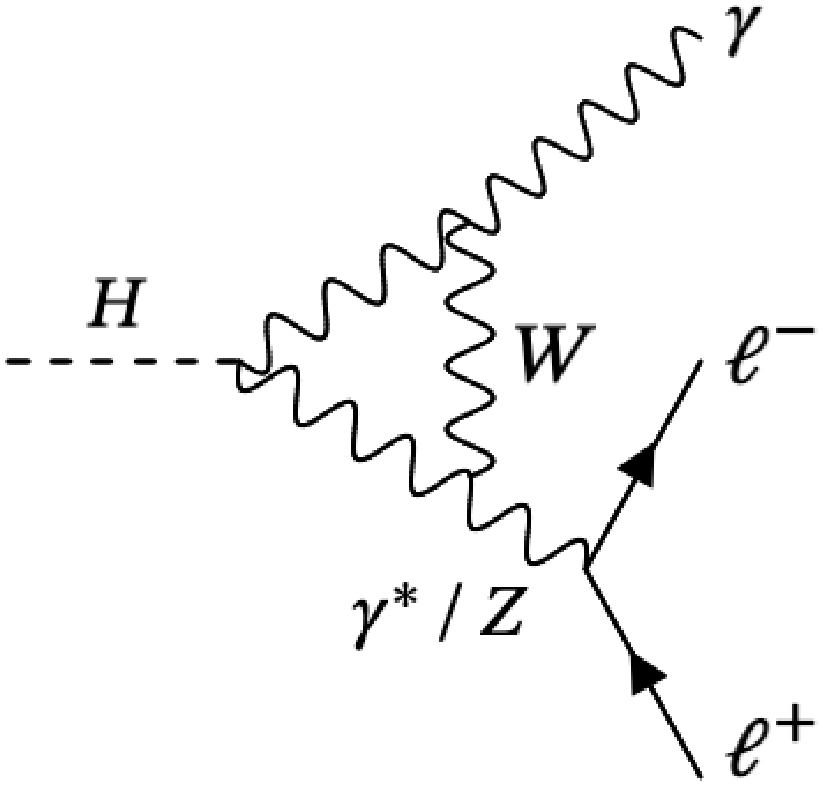
Measurement of the Higgs boson decay to a low-mass dilepton system and a photon in pp collisions at √s= 13 and 13.6 TeV with the ATLAS detector
Page 10
arXiv:2608.03369
Measurement of the Higgs boson decay to a low-mass dilepton system and a photon in pp collisions at √s= 13 and 13.6 TeV with the ATLAS detector
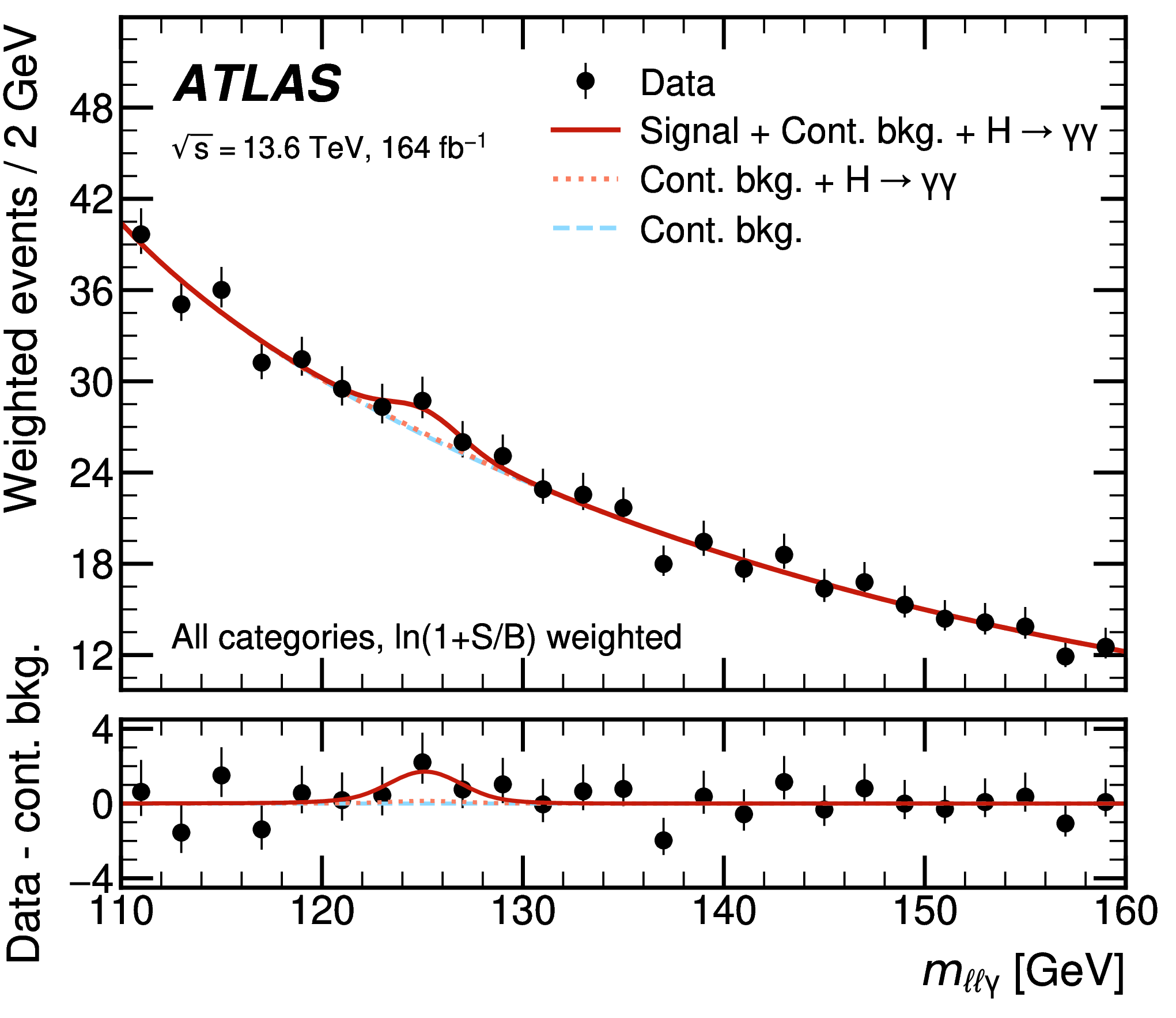
mℓℓγ distribution for the Run-3 data set, with every event reweighted by a category-dependent weight, ln(1+S90/B90), where S90 is the number of signal events in the smallest window containing 90% of the expected signal and B90 is the expected number of background events in the same window, estimated from fits to the data sidebands using the background models. The data points are shown as the black circles with statistical uncertainties. The parameterized signal and backgrounds are also added up with the category-dependent weight. The red curve shows the combined signal-plus-background model when fitting all analysis categories simultaneously, the dashed blue line shows the model of the non-resonant background component and the dotted orange line denotes the sum of the non-resonant background and the resonant H→γγ background.
CMS(3)
Page 11
arXiv:2608.01289
CMS-EXO-24-029
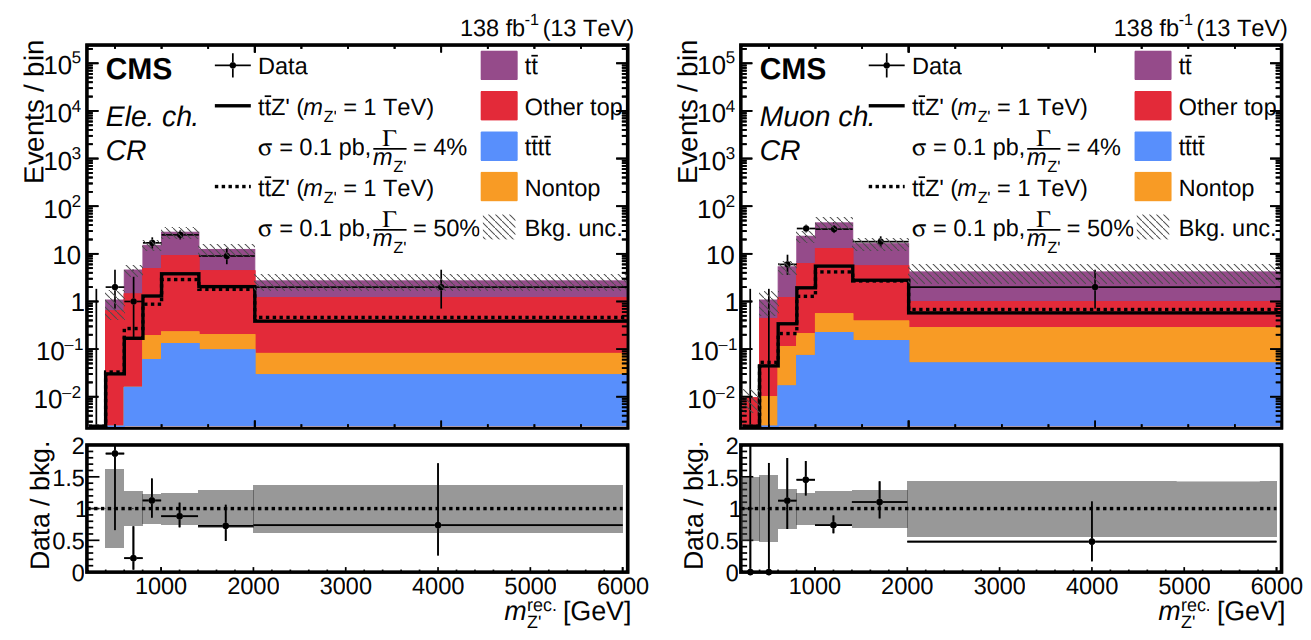
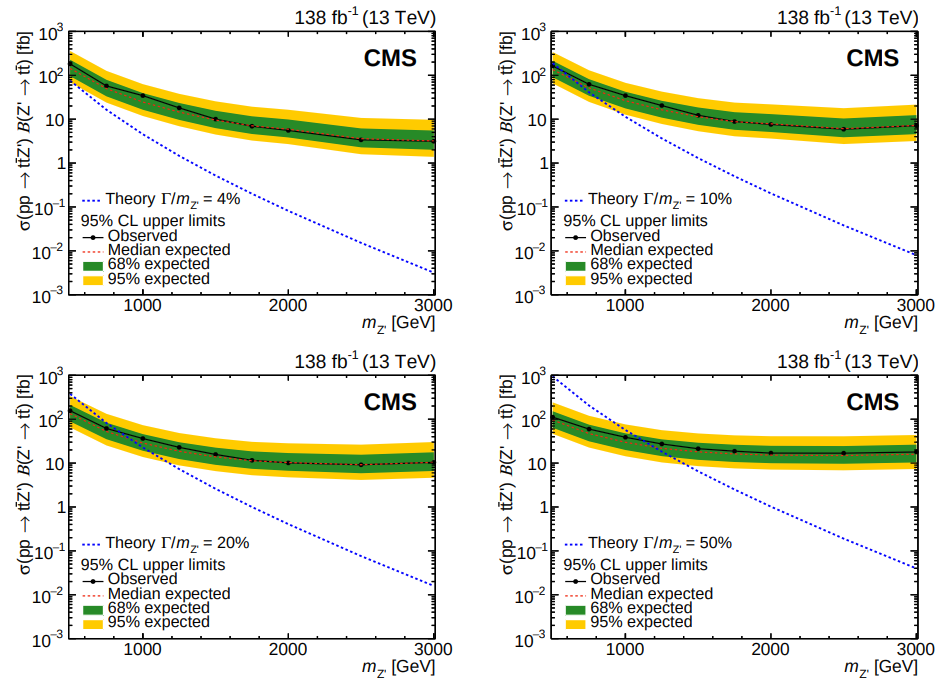
A search for a top-philic Z' boson in a final state with jets and an electron or muon is presented. The search is based on a sample of proton-proton collision data collected at √s = 13 TeV by the CMS experiment at the CERN LHC during 2016−2018, corresponding to an integrated luminosity of 138 fb−1. The top-philic Z' boson is produced in association with a top-antitop quark pair (tt) and decays into a tt pair, as it couples exclusively to top quarks. The analysis aims to identify a heavy Z' boson that produces Lorentz-boosted top quarks, whose hadronic decay products are merged into large-radius jets. A machine-learning algorithm is employed to identify such jets. The distribution of the invariant mass of the two top quark candidates with the highest transverse momentum is used as the discriminant variable in a Z' boson mass range of 0.5−3 TeV, with intrinsic widths of 4, 10, 20, and 50% relative to its mass. The results obtained are found to be in agreement with the standard model background prediction. Upper limits at 95% confidence level are set on the production cross section of the Z' boson, for each of the decay widths as a function of its mass. These results represent the most stringent constraints to date on the existence of a top-philic Z' boson.
Expt(3)
Page 14
arXiv:2607.29138
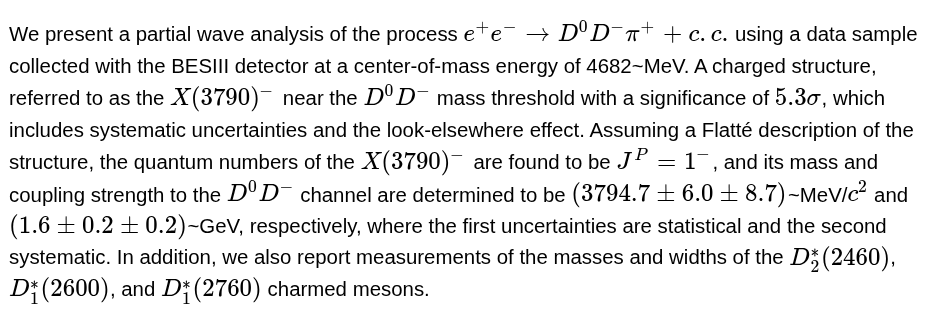
Observation of a Charged Charmoniumlike Structure in e+e−→D0D−π+ + c.c.
Pheno(1)
Page 15
arXiv:2607.28761
LHC measurements now reconstruct all fifteen parameters of the tt two-qubit spin density matrix, which amounts to a full quantum tomography of the pair. We show that this data constrains CP violation in the top-Yukawa coupling. The coupling enters the density matrix at one loop and produces spin correlations that are odd under CP and do not affect the cross section. Using the first complete renormalized one-loop density matrix and the experimental covariance, we obtain complementary constraints comparable to those from direct tree-level ttH and tH production.
E. Erdogan, K. A. Mohan, K. Xie, M. Yanez
Go Back