Page 3
CMS-B2G-25-004
Page 1
July 6th, 2026
Page 2
CMS-B2G-25-004
Study of ZZ and ZH production in the bbττ final state and search for high-mass spin-0 and spin-1 resonances in proton-proton collisions at √s = 13 TeV
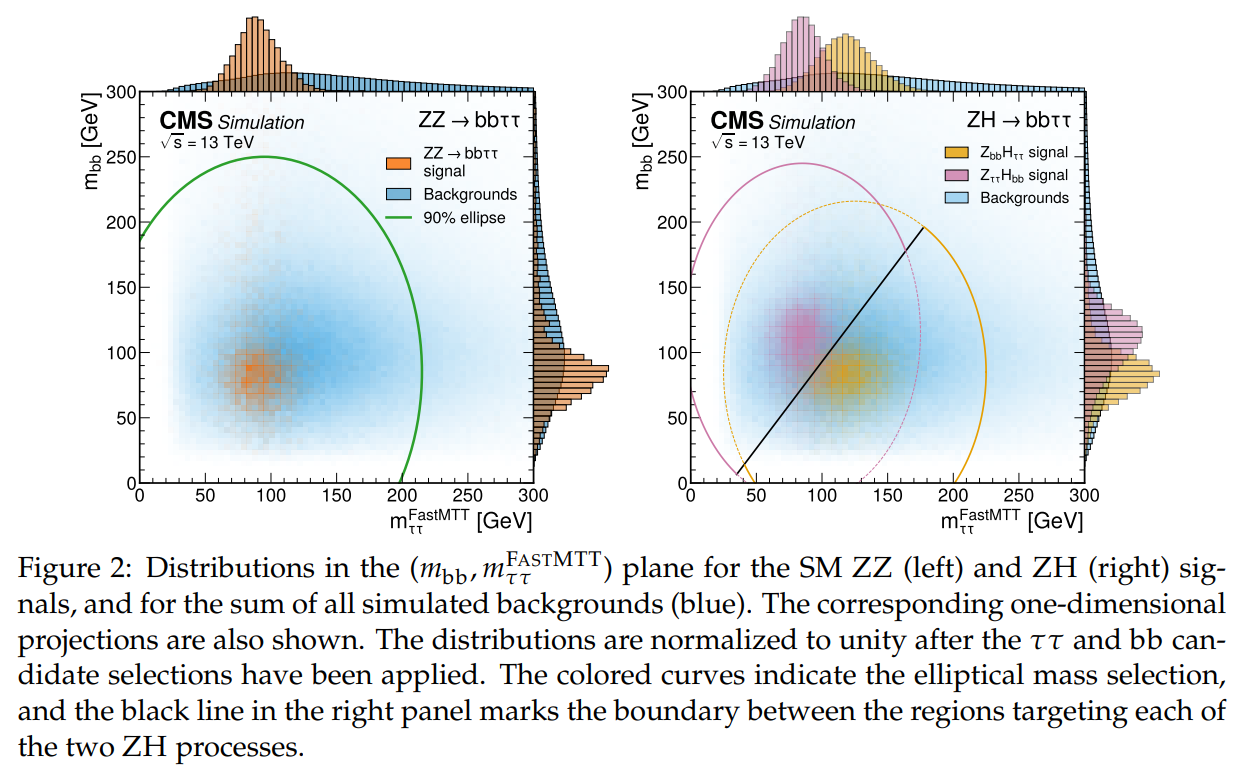
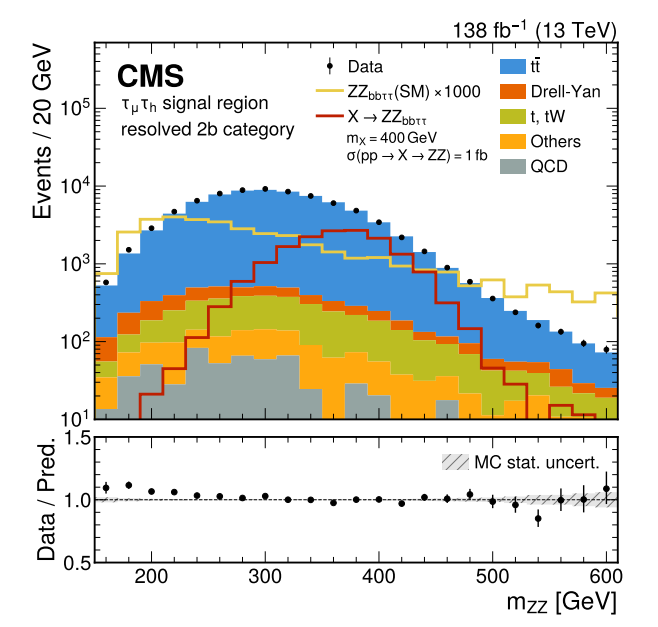
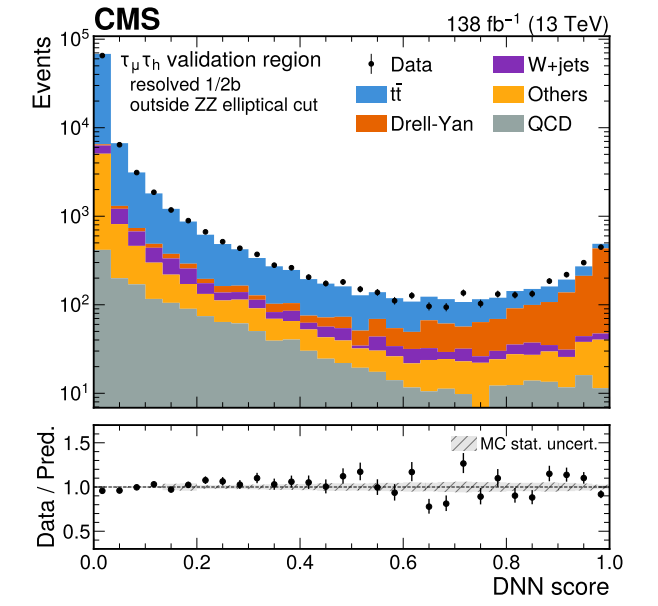
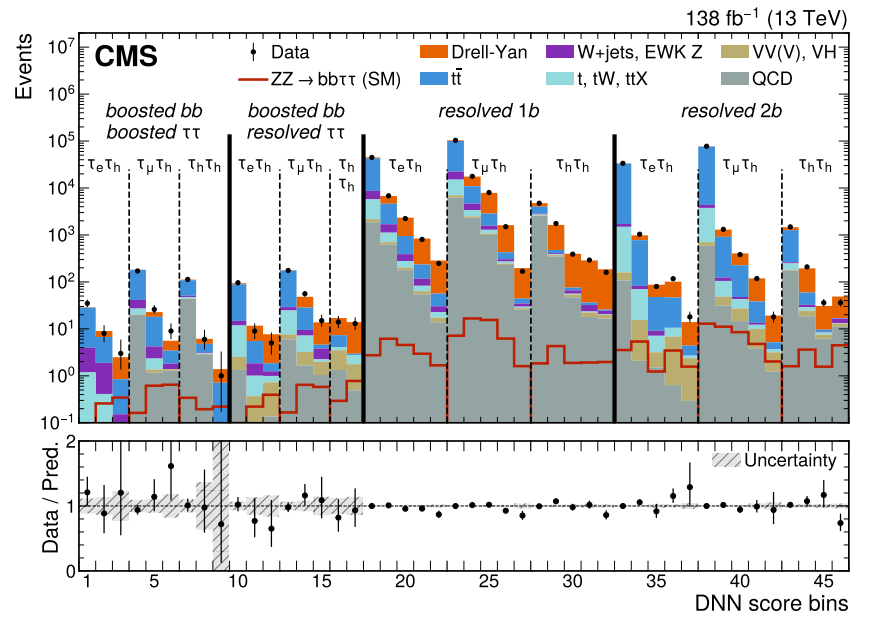
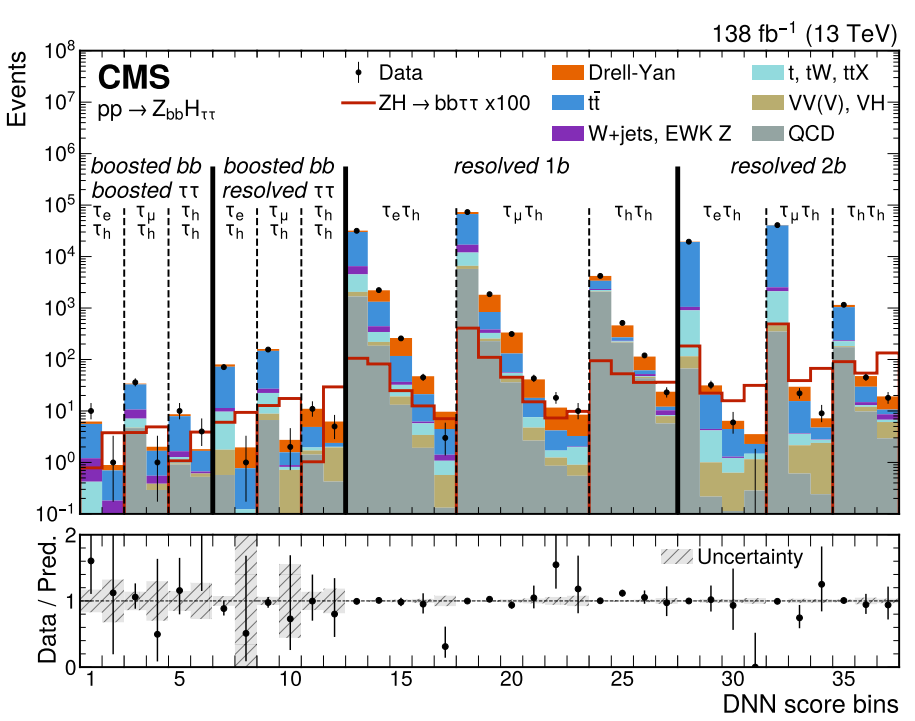
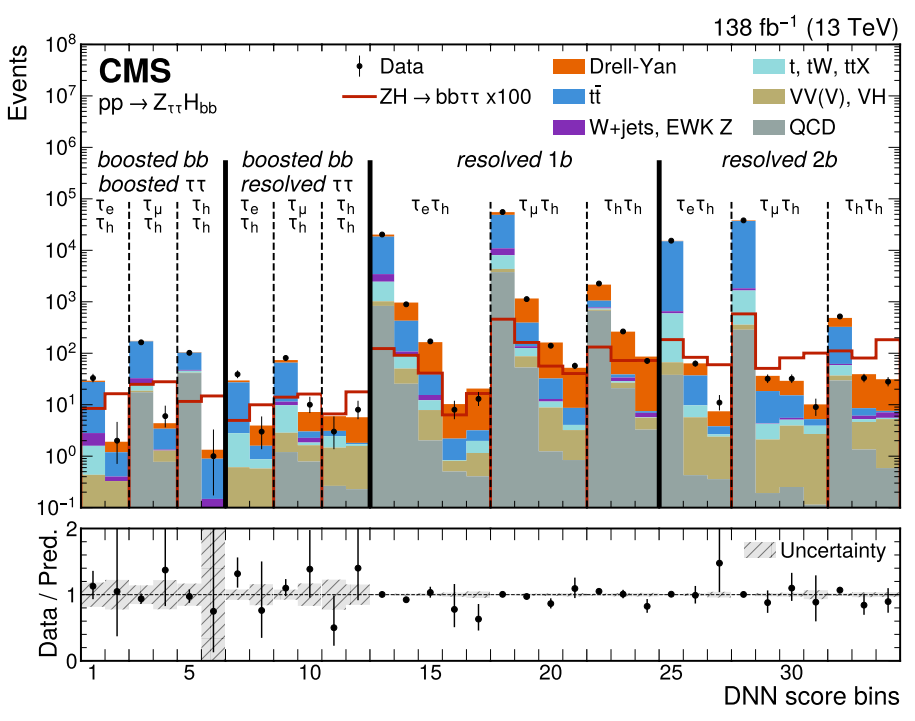
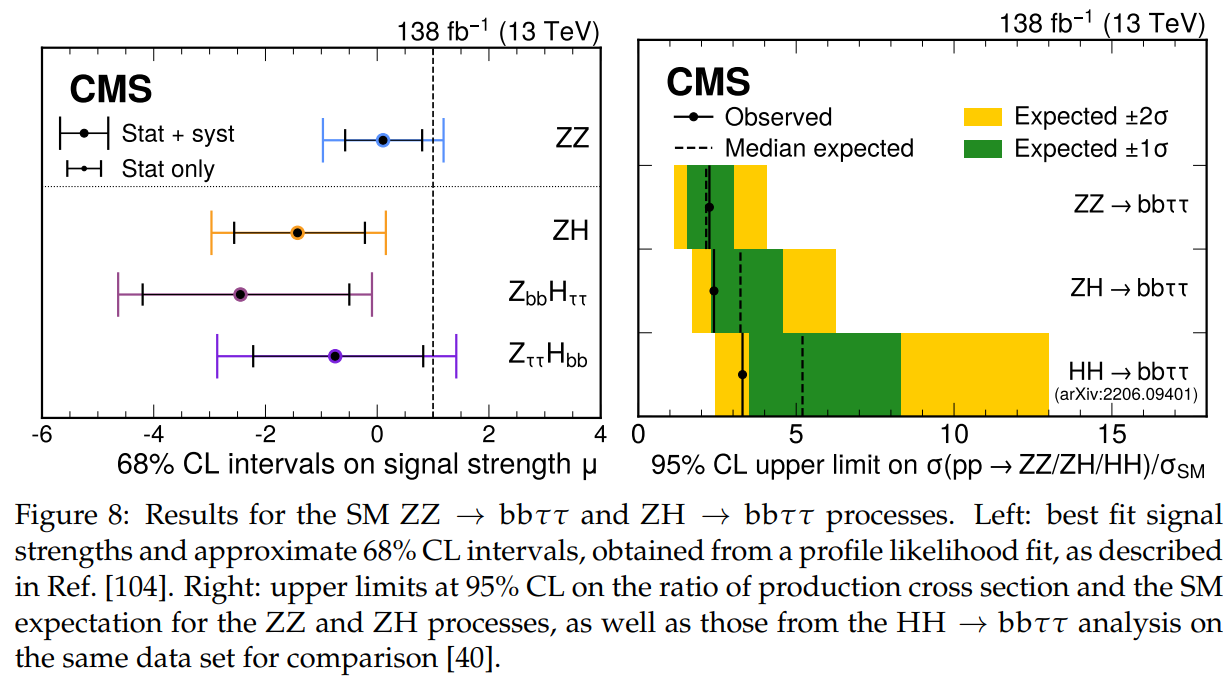
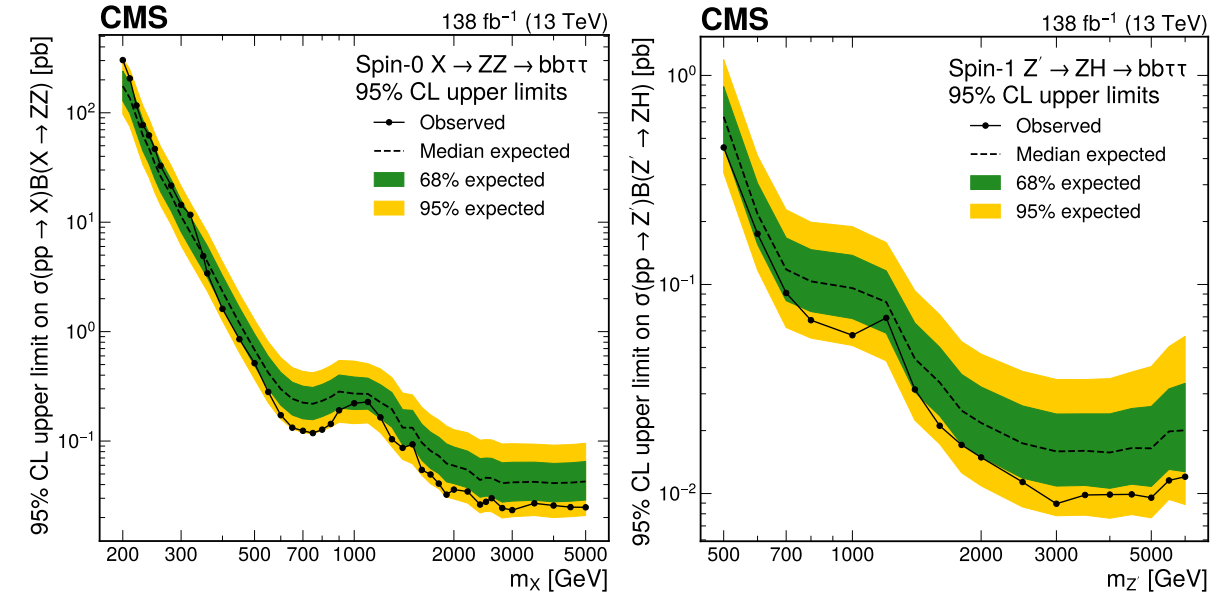
A study of the production of pairs of Z bosons (ZZ) and of the associated production of a Z boson and a Higgs boson (ZH) in final states containing two b quarks and two tau leptons (bbττ) is presented. The analysis is based on proton-proton collisions collected at √s = 13 TeV by the CMS experiment at the LHC, corresponding to an integrated luminosity of 138 fb−1. The nonresonant analysis targets the standard model ZZ and ZH processes in the bbττ final state, motivated by the prominent role of this channel in searches for nonresonant Higgs boson pair production. The resonant searches target physics beyond the standard model, probing heavy spin-0 resonances X that decay into ZZ and spin-1 resonances Z' that decay into ZH, with masses in the 0.2−5 and 0.5−6 TeV ranges, respectively. Upper limits at 95% confidence level are set on the product of production rate and branching fraction σ(X)B(X → ZZ), ranging from 300 pb to 24 fb, and σ(Z')B(Z' → ZH), ranging from 0.4 pb to 12 fb. These are the first measurements to probe the ZZ/ZH → bbττ processes. No deviation from standard model expectations is observed.
Page 3
CMS-B2G-25-004
Page 4
CMS-B2G-25-004
Page 5
CMS-B2G-25-004
Page 6
CMS-B2G-25-004
Page 7
CMS-B2G-25-004
Page 8
CMS-TOP-24-008
Search for physics beyond the standard model in four and three top quark production events using proton-proton collisions at √s = 13 TeV
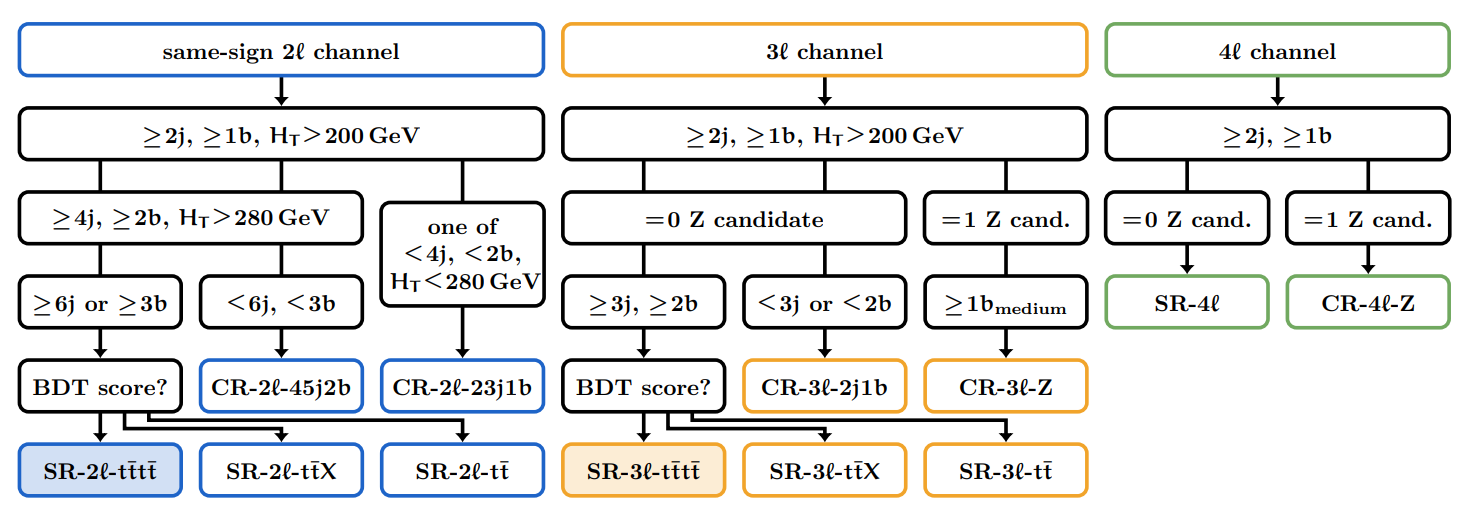
A search for physics beyond the standard model using four and three top quark production events is reported. The analyzed proton-proton collision data were recorded at 13 TeV with the CMS detector at the CERN LHC in 2016−2018 and correspond to an integrated luminosity of 138 fb−1. Events with two same-sign, three, or four leptons (electrons and/or muons) are selected. Constraints on six Wilson coefficients that modify interactions between four third-generation quarks or between top quarks and the Higgs boson in the standard model effective field theory framework are derived. The data are further used to exclude narrow topphilic heavy resonances in the mass ranges between 400 GeV and 1.6 TeV depending on their spin and color states. Finally, the top quark Yukawa coupling is extracted, considering both CP-even and CP-odd contributions.
Page 9
CMS-TOP-24-008
Page 10
Rich Phenomenology from Simple Ingredients: A Review of Confining Dark Sectors
P. Asadi, A. Batz, G.D.Kribs
We review theories with confining dark sectors and their implications for dark matter, cosmology, phenomenology, and unsolved Standard Model puzzles. Models with new strongly-coupled non-Abelian gauge interactions can lead to a variety of dark matter candidates (dark mesons, baryons, glueballs, etc.), as well as mechanisms to generate its abundance and symmetries that explain its stability. There are also many potential discovery channels, including direct detection, indirect detection, astrophysical observables, and colliders, as well as correlations between different experiments. We compile a broad conceptual overview of the literature on this topic, aimed at both theorists looking for which questions remain unanswered and experimentalists looking for novel search opportunities. While the theoretical landscape is vast, there are both unifying features and calculational techniques that apply to various regimes. We particularly highlight applications to explaining the similarity of visible and dark matter energy densities, i.e. the abundance similarity puzzle. We advocate further exploration of this class of theories in the effort to uncover physics beyond the Standard Model.
Page 11
Heavy-Flavor Electron Classification Using Hadronic Environment as Point Cloud
Jingyu Zhang, Wanbing He, Long Ma
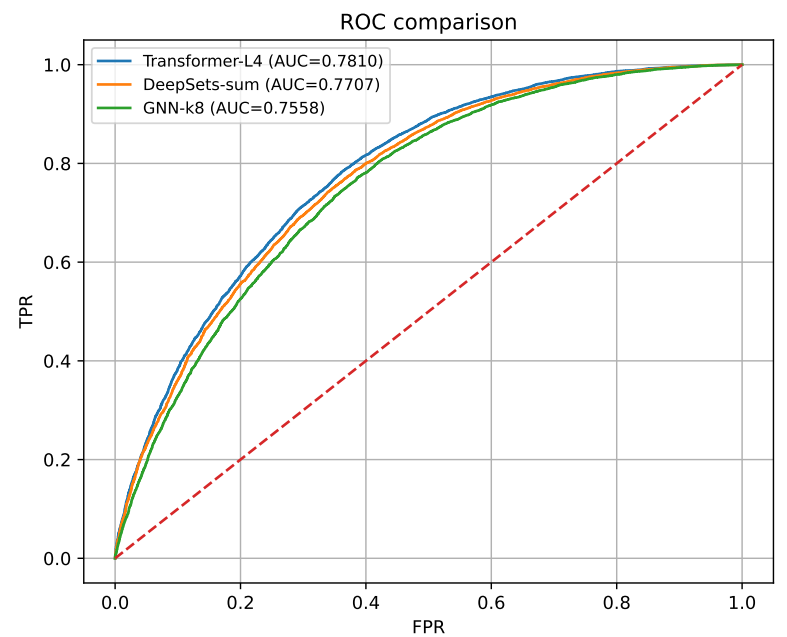
Electrons from semi-leptonic decays of charm (D) and bottom (B) hadrons are important probes in high-energy collisions, while their separation remains challenging due to the similarity of the underlying decay topologies. In this work, we represent the hadronic environment as a point cloud and investigate a hadron-based approach for distinguishing charm- and bottom-origin electrons using several set-based machine learning architectures, including Transformer models. Comparable performance is observed across different architectures, indicating that the dominant limitation originates from the intrinsic similarity between charm- and bottom-related hadronic structures rather than model expressivity. At an experimentally relevant working point corresponding to approximately 40% efficiency, the classifier achieves a purity close to 80% on the test dataset and significantly improves the classification performance relative to a hand-crafted observable BDT baseline. By studying the relation between the model response and physics-motivated observables, together with feature perturbation tests, we find that the learned representation is primarily sensitive to geometric and topological properties of the hadronic environment. Comparisons with high-level observables further suggest that the learned representation captures nontrivial discriminating information beyond a small set of manually constructed variables.
Page 12
Jingyu Zhang, Wanbing He, Long Ma