Go Back
Expt(2)
Page 10
arXiv:2606.26862
arXiv:2606.26856
ANUBIS Collab.
Calibration and Performance of proANUBIS: A proof-of-concept detector for the ANUBIS experiment
CMS(2)
Page 12
arXiv:2606.26832
CMS-LUM-20-001
Discovering new fundamental physics requires spotting subtle deviations between theoretical predictions and experimental data. This delicate comparison hinges on the precise knowledge of the integrated luminosity, the measure of how many particle interactions were actually delivered by the collider. Here, we report a landmark measurement of the integrated luminosity by the Compact Muon Solenoid (CMS) experiment for proton-proton collisions at a center-of-mass energy of 13 TeV at the CERN Large Hadron Collider (LHC). By calibrating multiple independent monitors through specialized beam-separation techniques and rigorously validating their long-term stability against well-understood Z boson production rates, we comprehensively map and minimize systematic uncertainties. Combining the findings yields a total integrated luminosity precision of 0.73% for the entire data set. This marks the most precise luminosity measurement ever achieved at a bunched-beam hadron collider. Crossing the sub-percent precision threshold per data taking year fundamentally sharpens our ability to test the standard model and establishes a vital baseline for the upcoming High-Luminosity LHC era.
Pheno(1)
Page 13
arXiv:2606.26089
We present the public software release of Parnassus, a Python/PyTorch, GPU-compatible framework for fast detector simulation and reconstruction in particle and nuclear physics. Parnassus provides a user-friendly framework with interchangeable detector models: neural models can emulate computationally expensive Geant4-based detector simulation and reconstruction chains, while parametric models provide PyTorch implementations of selected Delphes-style detector responses. This initial release includes two models of the CMS detector: one based on a flow-matching neural network architecture and one based on a PyTorch implementation of the Delphes CMS card (parametric bias and smearing). PyTorch versions of the ATLAS and ALEPH Delphes cards are also available, together with a flow-matching neural model of the ALEPH detector that extends the framework to the e+e- LEP environment. All detector-specific backends share the same process-agnostic and detector-agnostic API: users select a detector card - analogous to choosing a detector card in Delphes - and the same tool can be applied to new physics processes without retraining the released detector model. There are native interfaces to the event generator Pythia and the event clustering package FastJet. Unlike previous C++/ROOT-based tools, Parnassus provides GPU-capable PyTorch detector-response backends and requires no ROOT installation. We describe the installation, command-line and Python API, configuration system, and demonstrate the framework on Standard Model and BSM processes.
CMS(3)
Page 14
arXiv:2606.25840
CMS-EXO-24-016
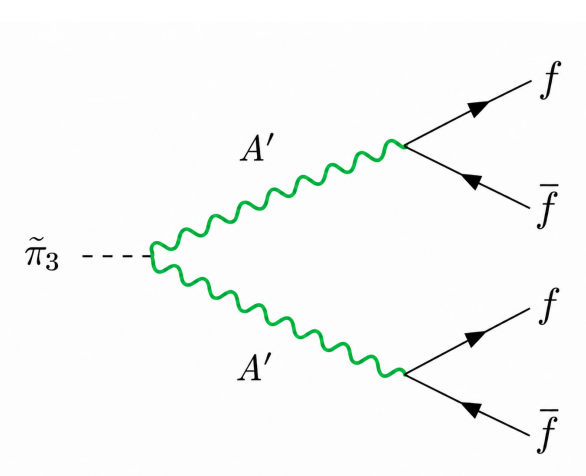
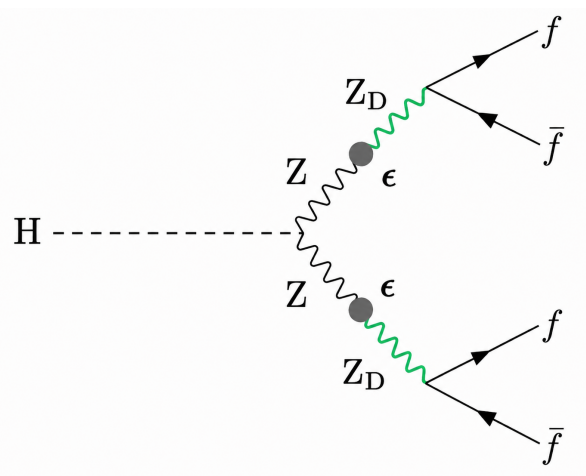
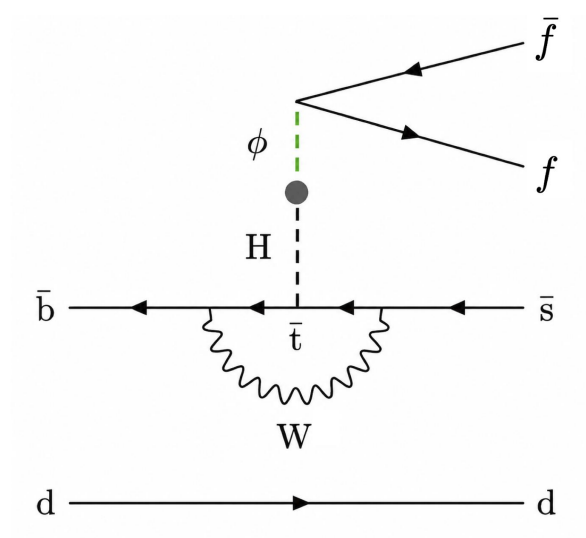
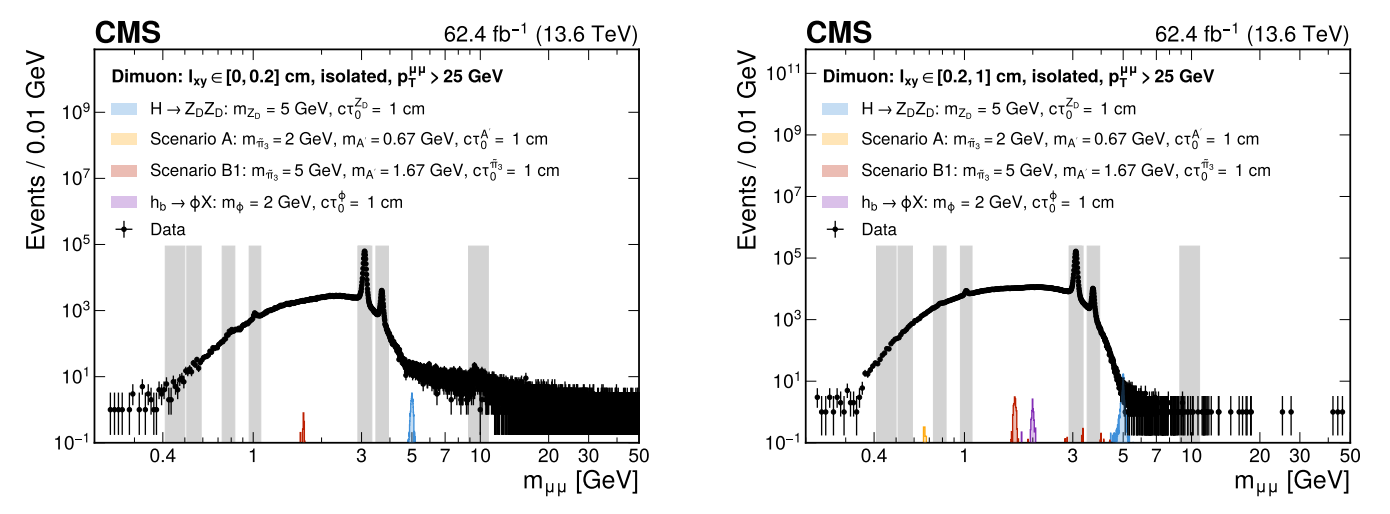
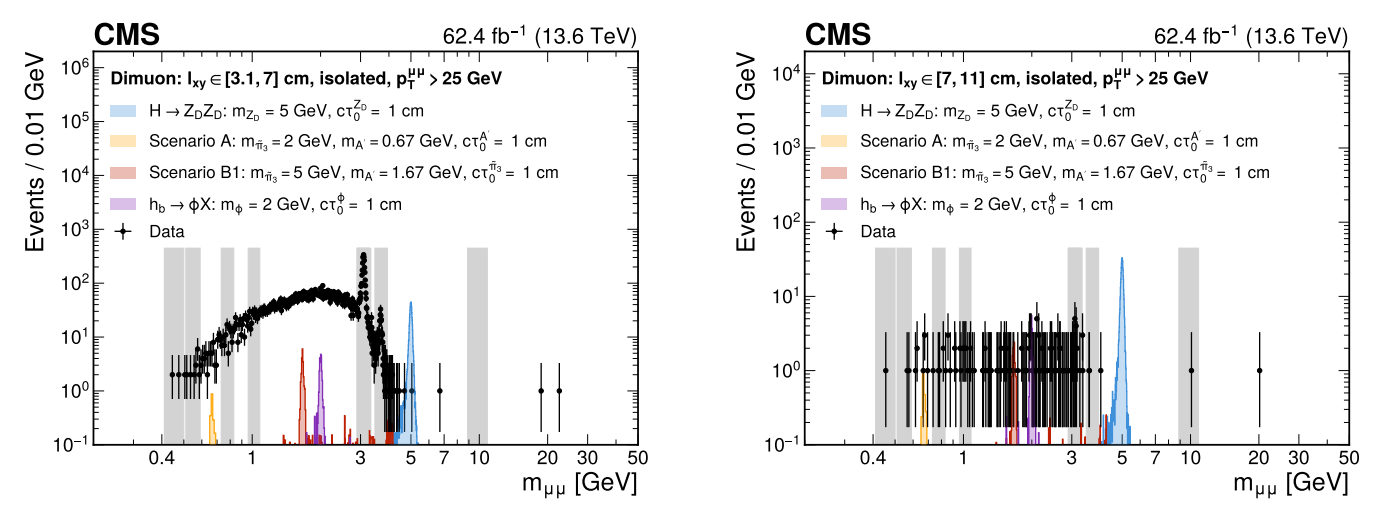
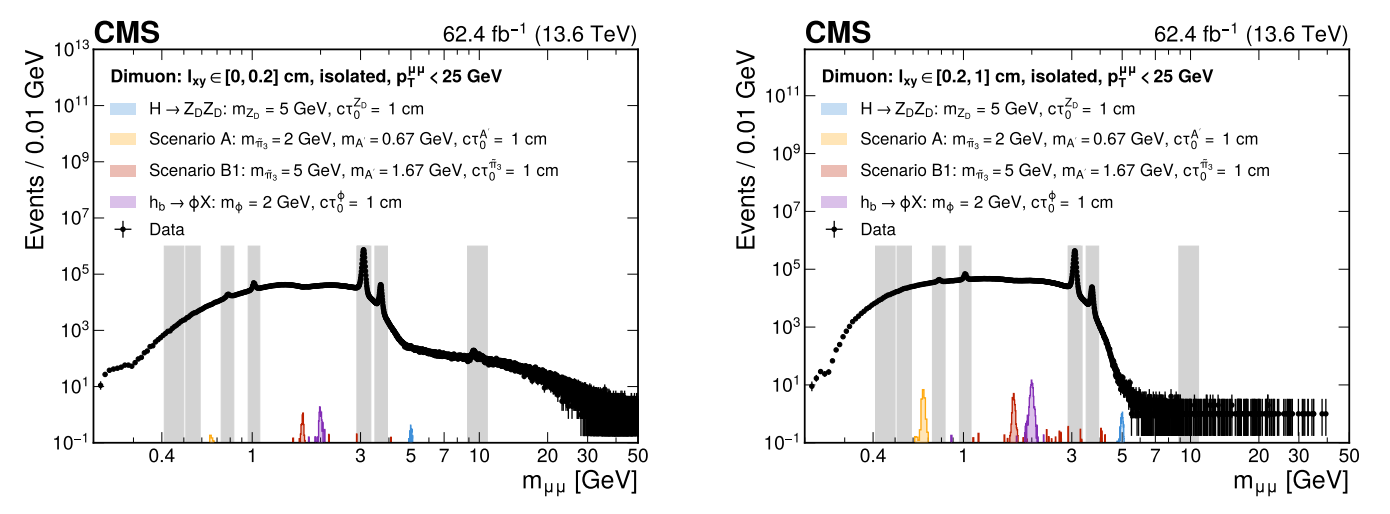
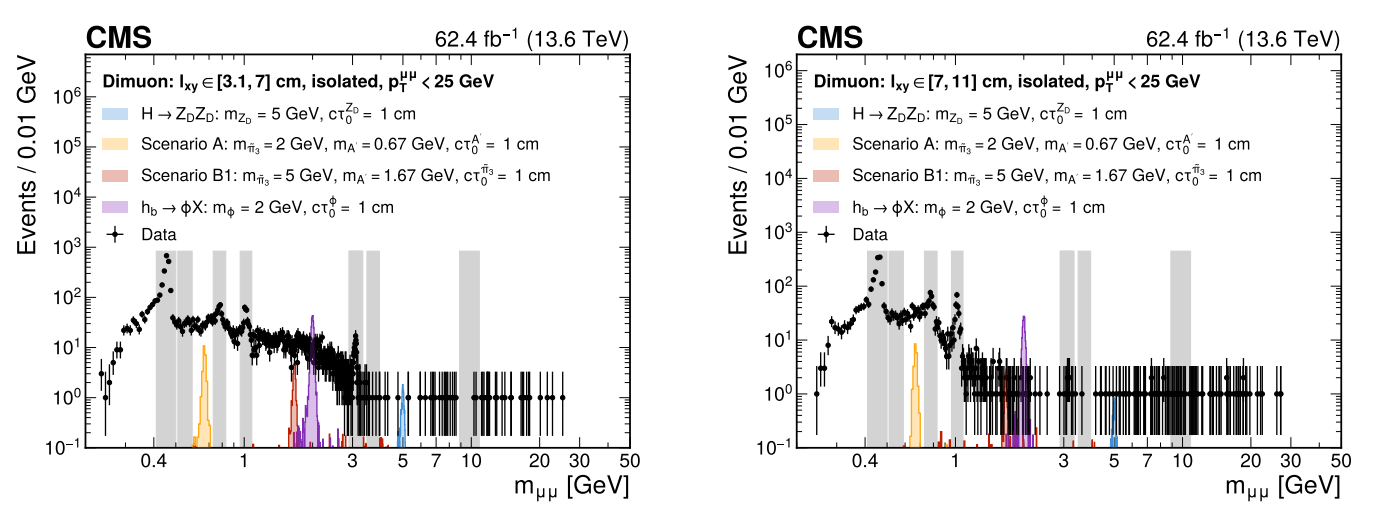
A search for long-lived particles decaying into muons is performed using proton-proton collisions at √s = 13.6 TeV, collected by the CMS experiment at the LHC in 2022 and 2023, corresponding to an integrated luminosity of 62.4 fb-1. The data were collected using dedicated dimuon triggers with low transverse momentum thresholds, recorded with a high-rate data scouting trigger stream. This data stream retains a reduced amount of information at the high-level trigger, to explore otherwise inaccessible phase space at low multimuon invariant mass and nonzero displacement from the primary interaction vertex. No significant excess of events above the standard model prediction is found. Upper limits on branching fractions at 95% confidence level are set for a wide range of mass and lifetime hypotheses in several beyond the standard model frameworks, where the Higgs boson decays into long-lived dark photons or into dark partons that produce showers containing long-lived particles, or where a long-lived scalar resonance is produced from the decay of a b hadron. The resulting constraints improve and extend existing ones in large regions of the parameter space.
Go Back