Page 3
CMS-SUS-21-005
Page 1
June 15th, 2026
Page 2
CMS-SUS-21-005
Search for new physics using single-lepton events with high multiplicities of jets and b jets in proton-proton collisions at √s = 13 TeV
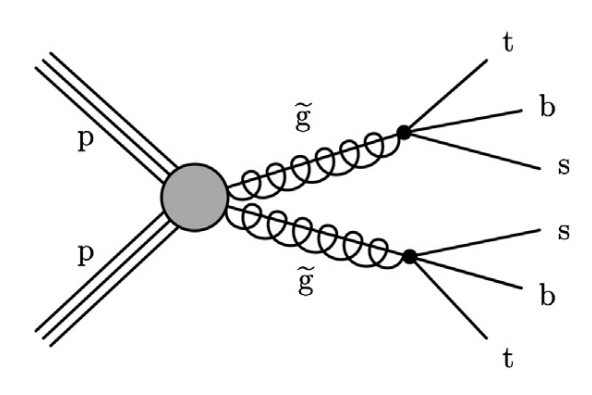
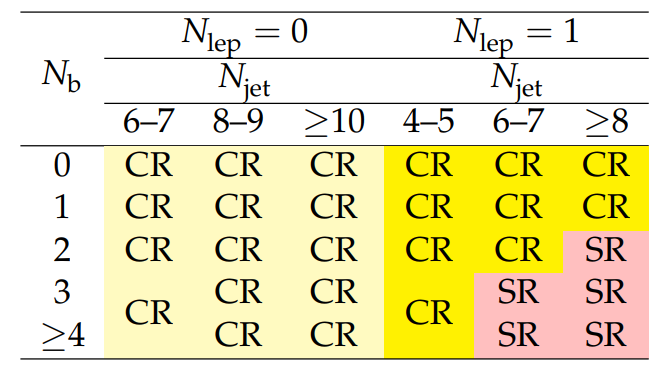
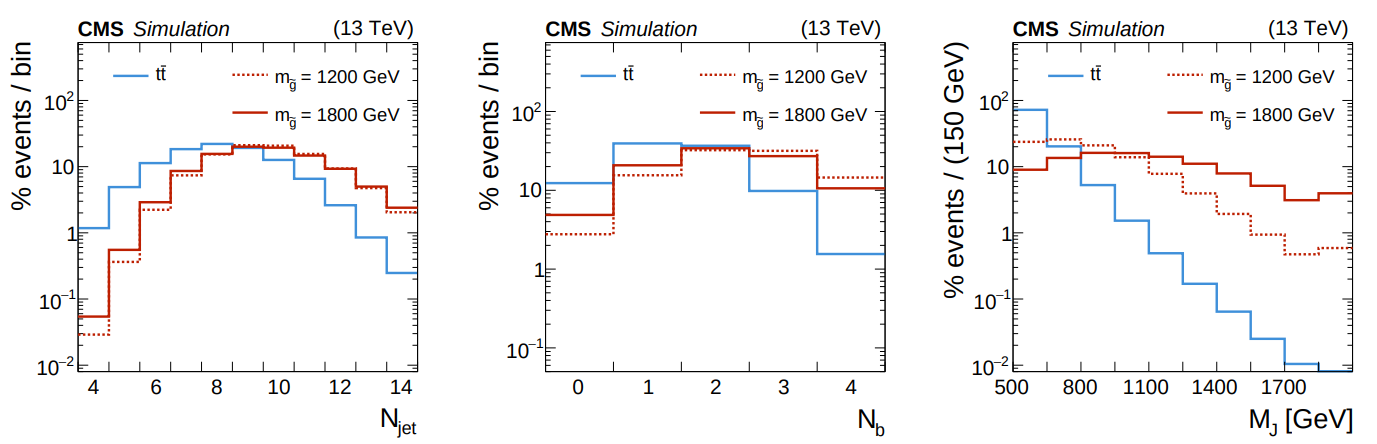
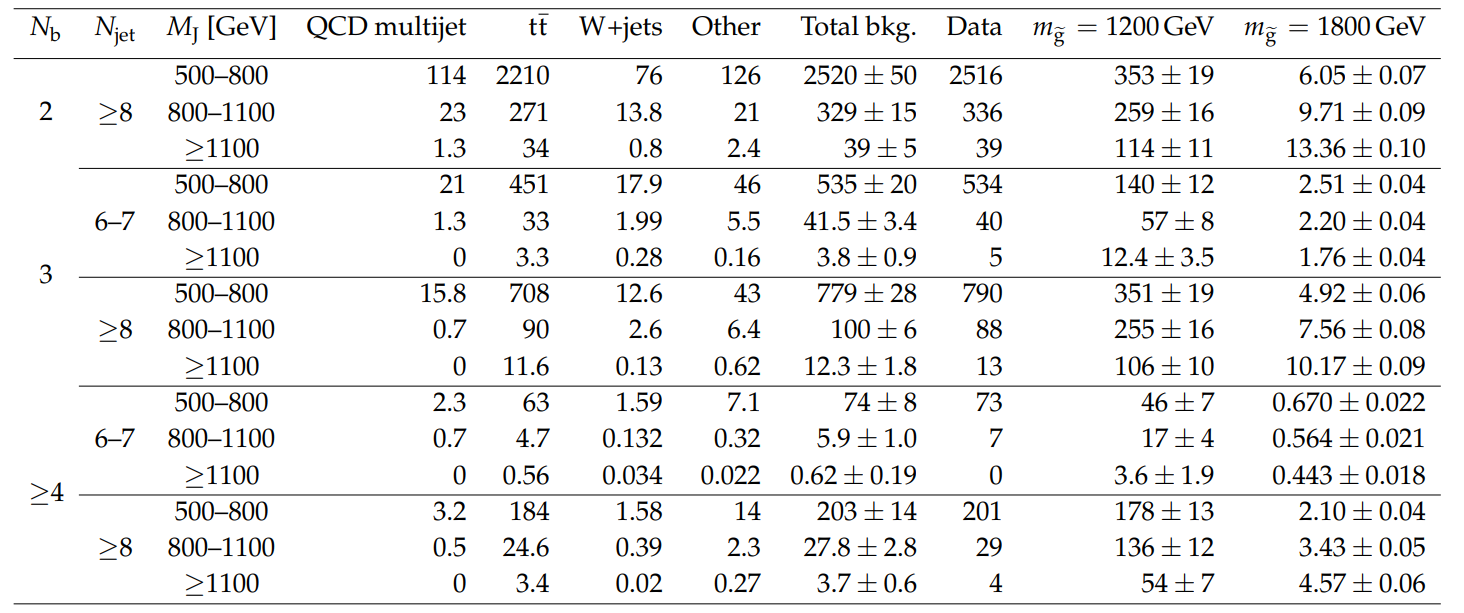
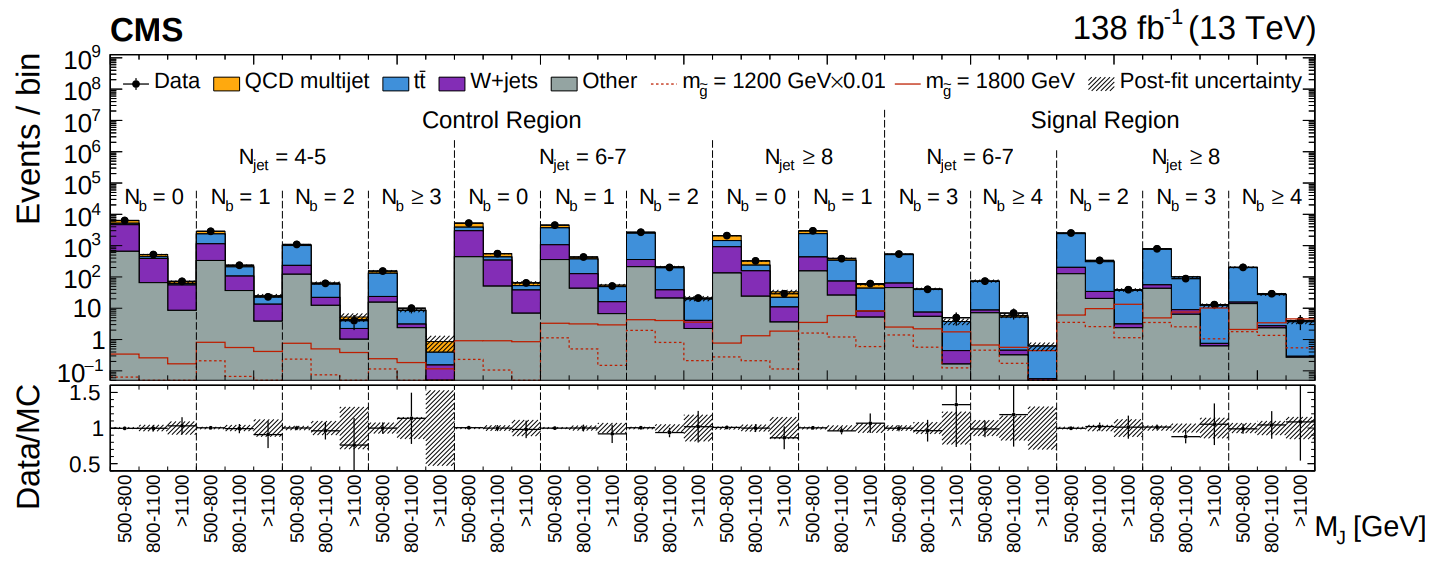
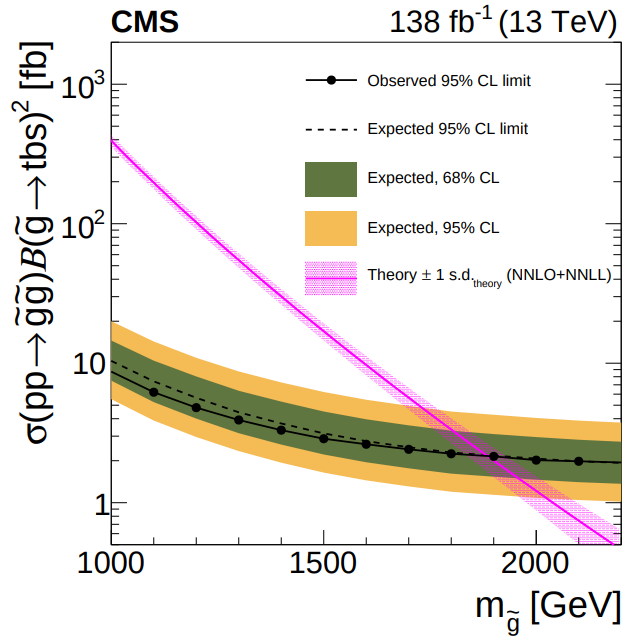
This paper presents a search for beyond the standard model physics using single-lepton events with a high multiplicity of jets, including those identified as bottom quark jets, without a requirement on missing transverse momentum. The analysis is based on proton-proton collision data collected with the CMS detector at the CERN LHC at a center-of-mass energy of 13 TeV, corresponding to an integrated luminosity of 138 fb-1. This search is sensitive to R-parity violating supersymmetry models, where supersymmetric particles can decay into standard-model particles through interactions that violate baryon number conservation. In particular, the signal model considered is gluino pair production, where each gluino decays into top, bottom, and strange quarks. The sum of large-radius jet masses is used to distinguish the signal from background, as it effectively captures the features of high jet multiplicity and high interaction energy. No significant excess of data over the background predictions is observed. Gluinos in this model have been excluded for masses below 1890 GeV at 95% confidence level.
Page 3
CMS-SUS-21-005
Page 4
CMS-SUS-21-005
Page 5
CMS-SUS-21-005
Page 6
CMS-SUS-21-005
Page 7
BESIII Collab
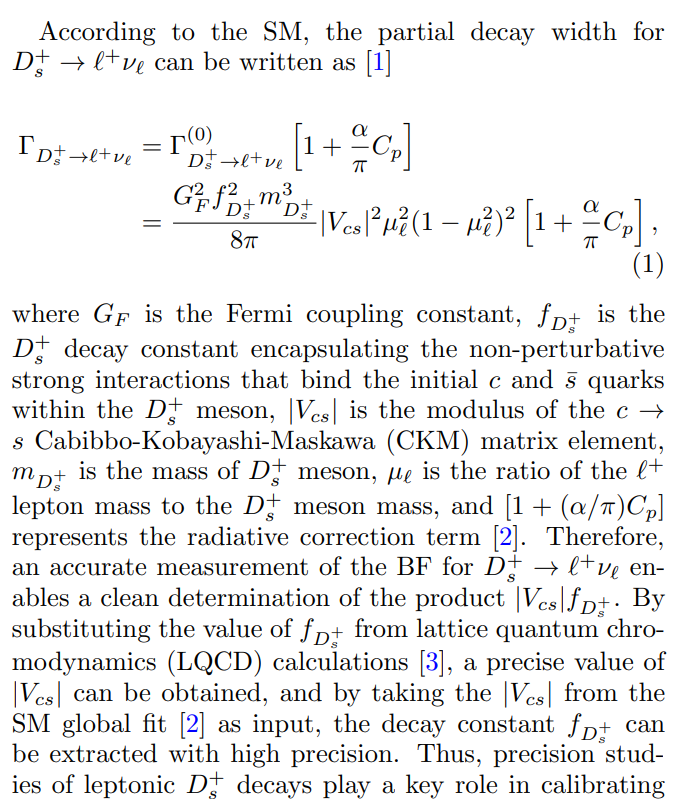
Updated measurement of the branching fraction of Ds+ →τ+υτ
Page 8
Updated measurement of the branching fraction of Ds+ →τ+υτ
Page 9
LHCb Collab
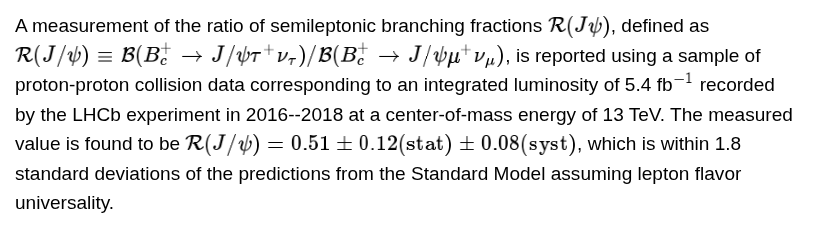
Measurement of the ratio of branching fractions B (Bc+→J/ψ τ+ ντ)/B (Bc+→J/ψ μ+ νμ)
Page 10
REDTOP Collab
Hidden-sectors search and probe of discrete symmetries at the REDTOP experiment
The η and η′ mesons are nearly unique in the particle universe since they are nearly Goldstone bosons, and their decay dynamics are strongly constrained. While earlier experiments collected samples of order ∼109 η, the proposed REDTOP (Rare Eta Decays To Observe Physics Beyond the Standard Model) facility targets O(1014) η and O(1012) η′, enabling broad searches for physics beyond the Standard Model. In this work, we present studies evaluating REDTOP sensitivity to processes that couple the Standard Model to New Physics through four portals: the Vector (dark photon), the Scalar (Higgs-mixing), the Axion-like, and the Heavy Lepton. In parallel, the proposed statistics allow precise tests of CPCP and TT invariance and lepton universality and improve determinations of the η/η′ transition form factors, which are crucial inputs to the hadronic light-by-light contribution to the muon anomalous magnetic moment (g−2)μ
Page 11
Towards imaging Earth's large-scale structures by directional geoneutrino detection with Ocean Bottom Detector
Z. Xu et al
Geoneutrinos, electron antineutrinos produced by radioactive decays of heat-producing elements (HPEs) within the Earth, provide unique insights into Earth's interior and heat budget since their first detection in 2005 by KamLAND. Conventional geoneutrino detectors currently provide integrated global information and lack the capability to spatially resolve structures deep within the Earth. Here, we evaluate the ability of angular-sensitive geoneutrino detectors to distinguish between homogeneous and heterogeneous mantle models, focusing on Large Low Shear Velocity Provinces (LLSVPs). Our results show that LLSVPs enriched in Th and U yield a distinct flux of geoneutrinos with distinctive angular patterns. An oceanic site above the Pacific LLSVP is considered a particularly favorable detector location. The Ocean Bottom Detector (OBD) project aims to leverage this spatial resolving advantage by deploying a kiloton-scale liquid scintillator detector directly on the ocean floor, enabling unprecedented sensitivity for mantle geoneutrino detection. These findings demonstrate the critical role of combining geophysical and geochemical data to guide detector site selection, ultimately improving constraints on Earth's internal heat and the HPE distribution.
Page 12
AgentRivet: an automated system for producing Rivet routines from journal publications
A. J. Costa et al
Particle physics collider experiments provide Rivet routines as part of the analysis preservation strategy for model-independent measurements. Rivet is a C++ toolkit that allow new theoretical models to be compared to the measurements, thus aiding the development and tuning of Monte Carlo event generators as well as searches for physics beyond the Standard Model. However, analysis coverage is known to be incomplete, with only 39% of measurements having documented and publicly available Rivet routines. In this article, we design and implement an automated workflow based on Large Language Models with the goal of providing the missing routines. This multi-step workflow, referred to as AgentRivet, extracts the physics analysis information from published papers and writes the missing Rivet routines, with intermediate code- and physics- reviews as part of an autonomous quality control. We report the results obtained using commercial Large Language Models, provided by OpenAI, Anthropic, and Google, for two recent measurements from the ATLAS and CMS experiments. We find that AgentRivet produces competent Rivet routines with few syntax errors. The physics fidelity of the routines is reasonable and follows the explanations given in the relevant publications. Nevertheless, physics-implementation issues do arise and are investigated using the artefacts produced by AgentRivet. The majority of physics implementation issues arise from subtle-but-ambiguous definitions in the given publication, although some models struggle to implement complex observables even when clear definitions are given.