Go Back
CMS(1)
Page 2
arXiv:2604.05996
CMS-EXO-25-007
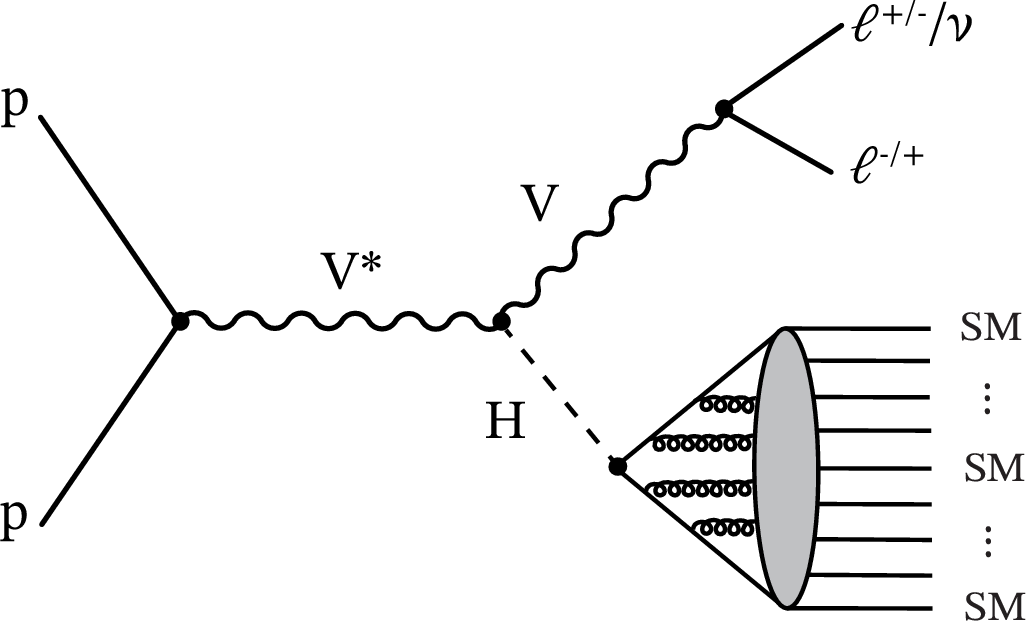
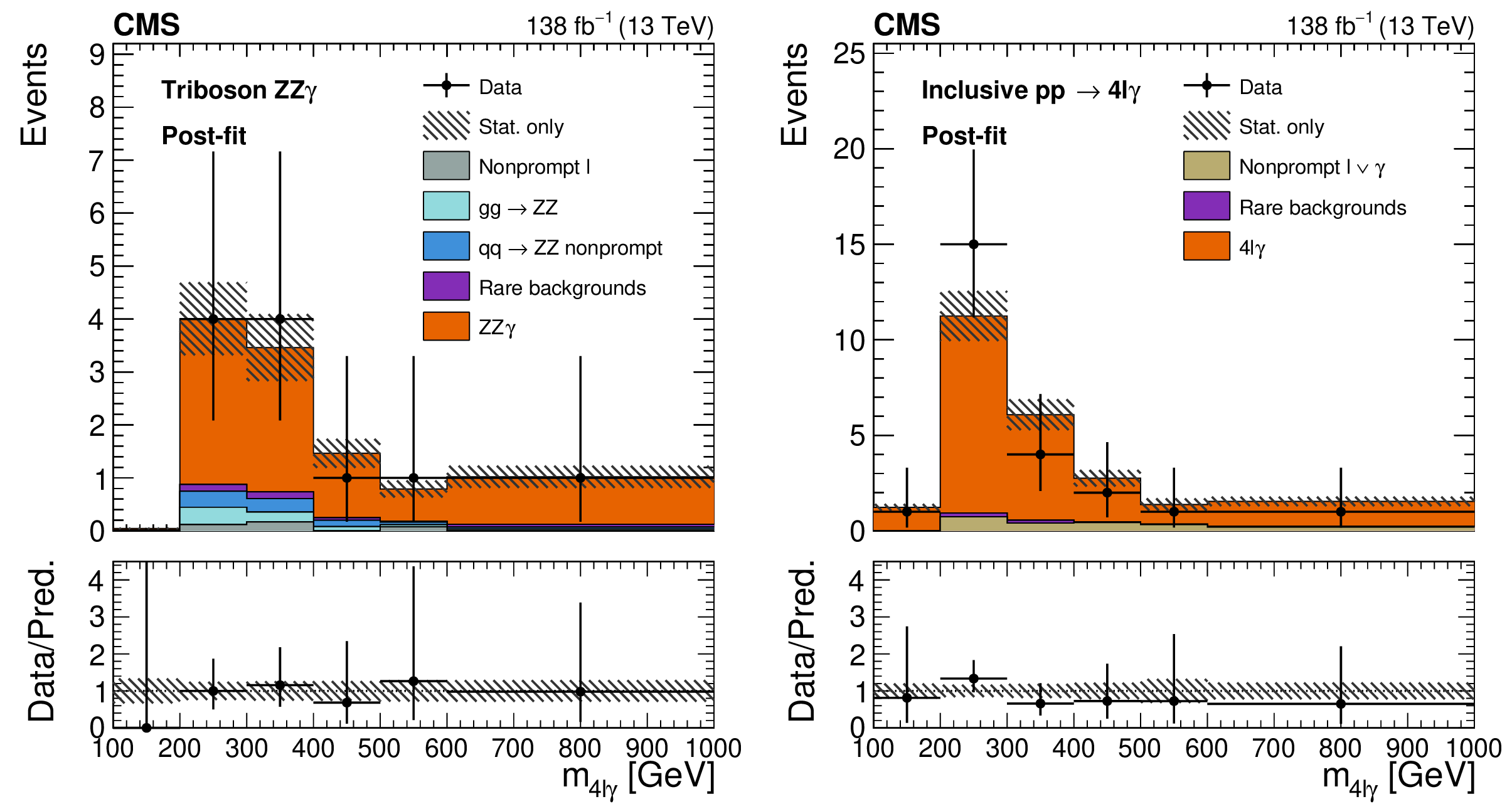
A search for a Higgs boson produced in association with a W or Z boson and decaying via a soft unclustered energy pattern (SUEP) is presented. The analysis is based on proton-proton collision data corresponding to an integrated luminosity of 138 fb-1 collected between 2016 and 2018 at the LHC. Final states with a leptonic W or Z boson decay associated with a high multiplicity of low-momentum charged particles are explored for the first time. The results show no significant excess over the standard model background expectation. Limits are set on the production cross section of a Higgs boson that decays to a SUEP, for a range of parameters of the SUEP model. Material is provided to facilitate further interpretation of the results.
Expt(1)
Page 4
arXiv:2604.08396
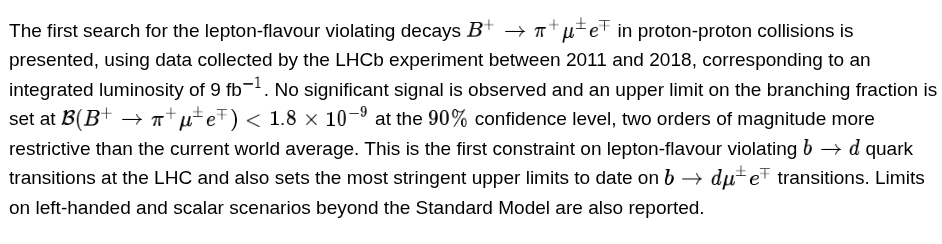
Search for the lepton-flavour violating decays B+ → π+ µ± e∓
Page 5
arXiv:2603.26463
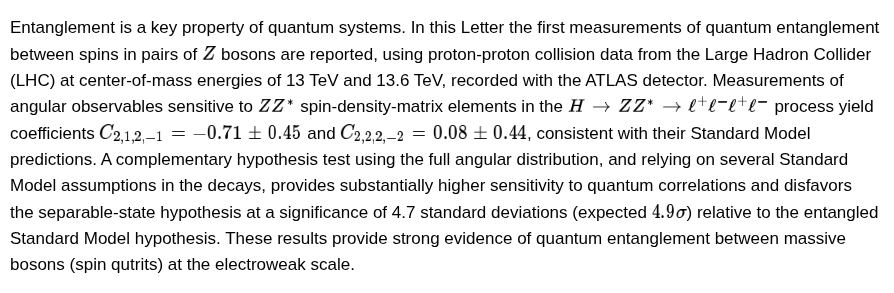
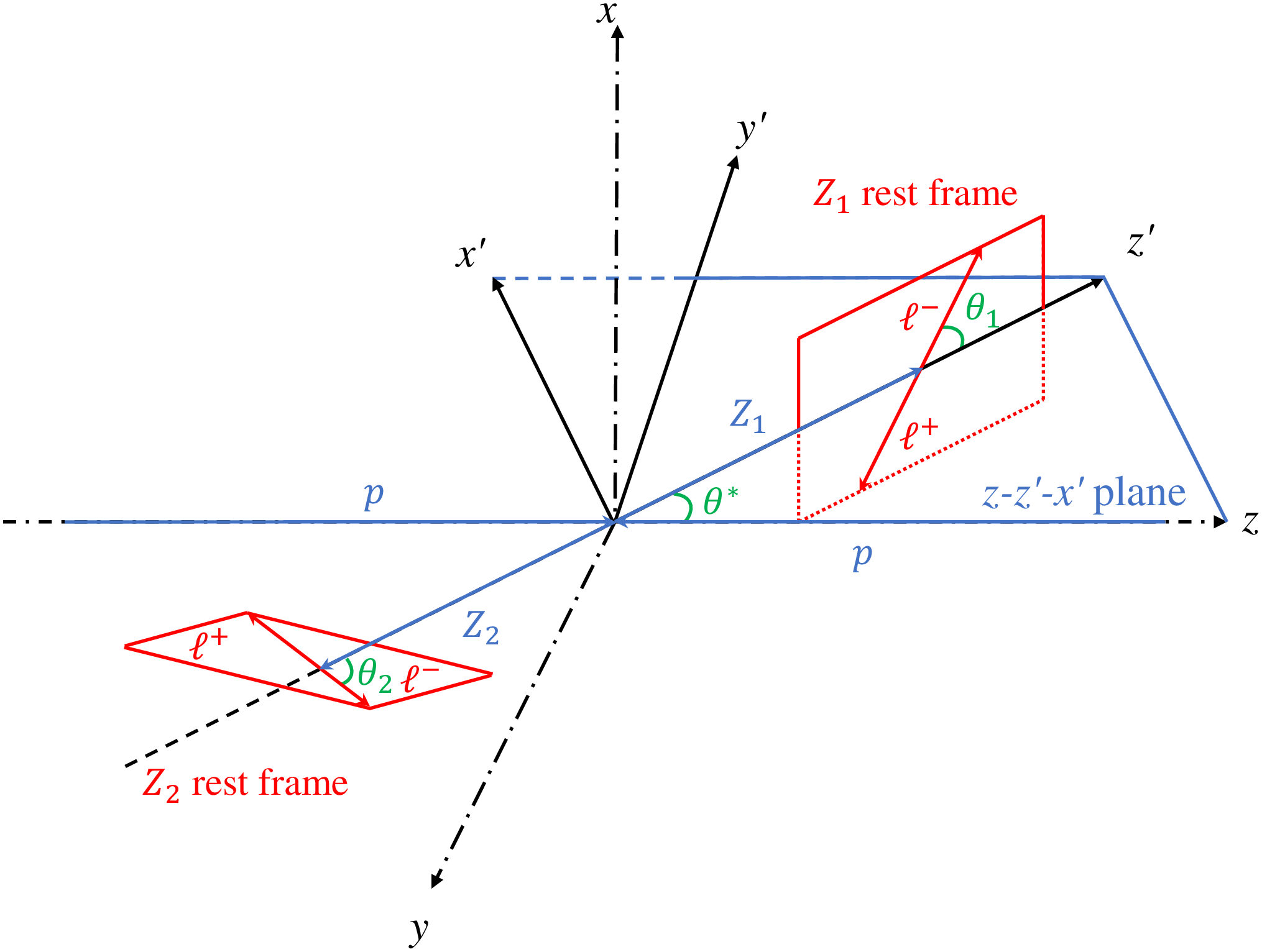
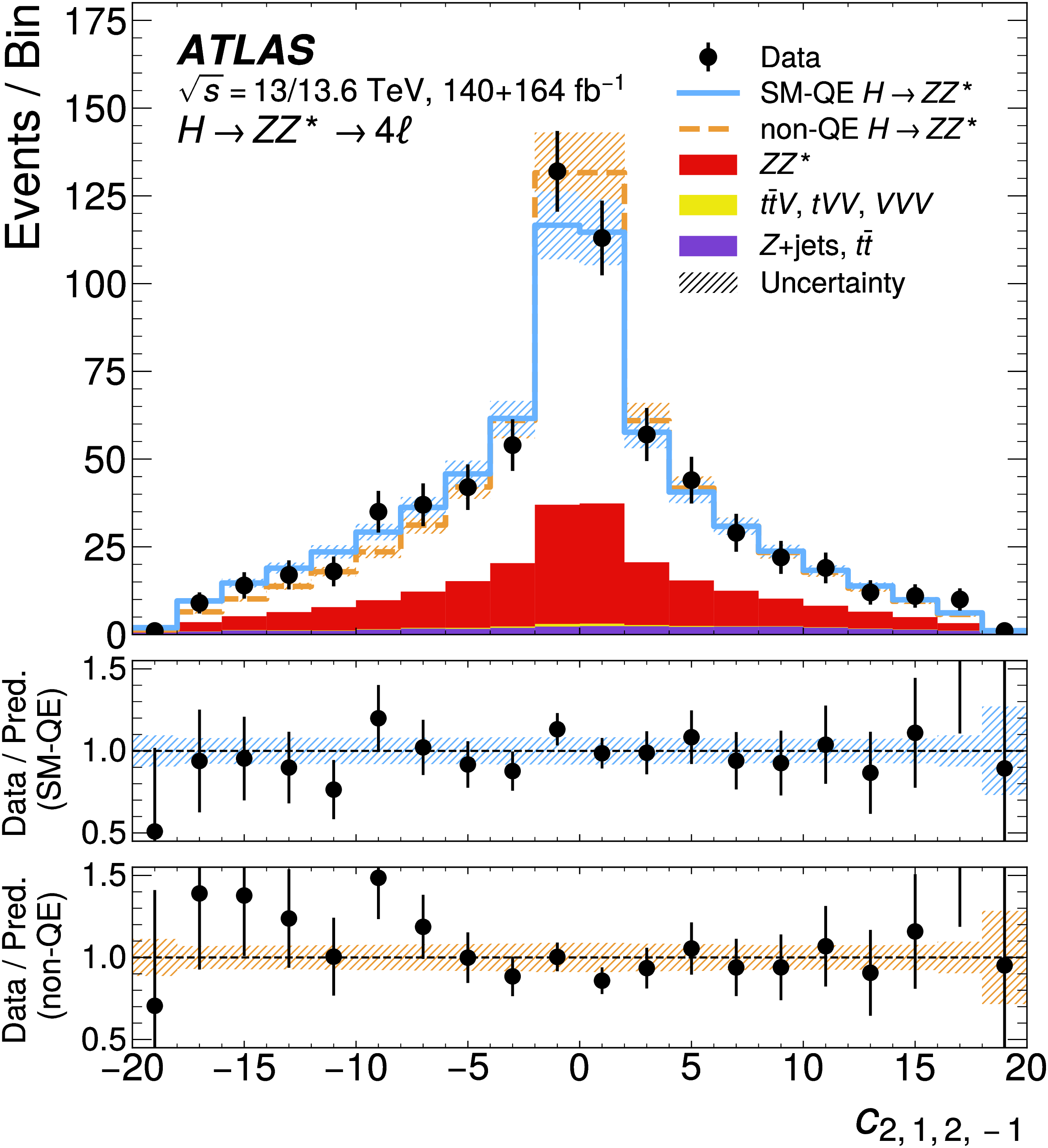
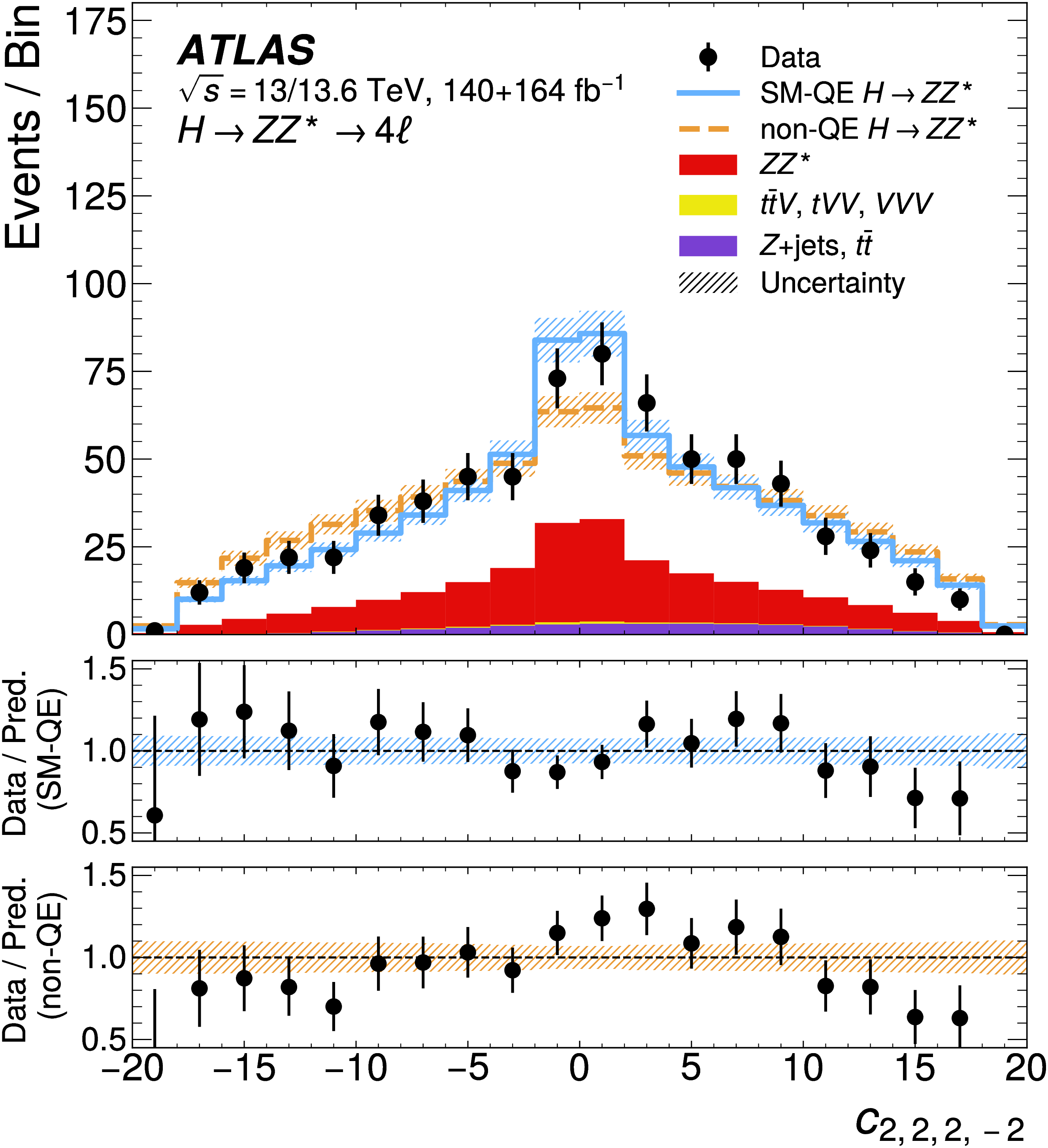
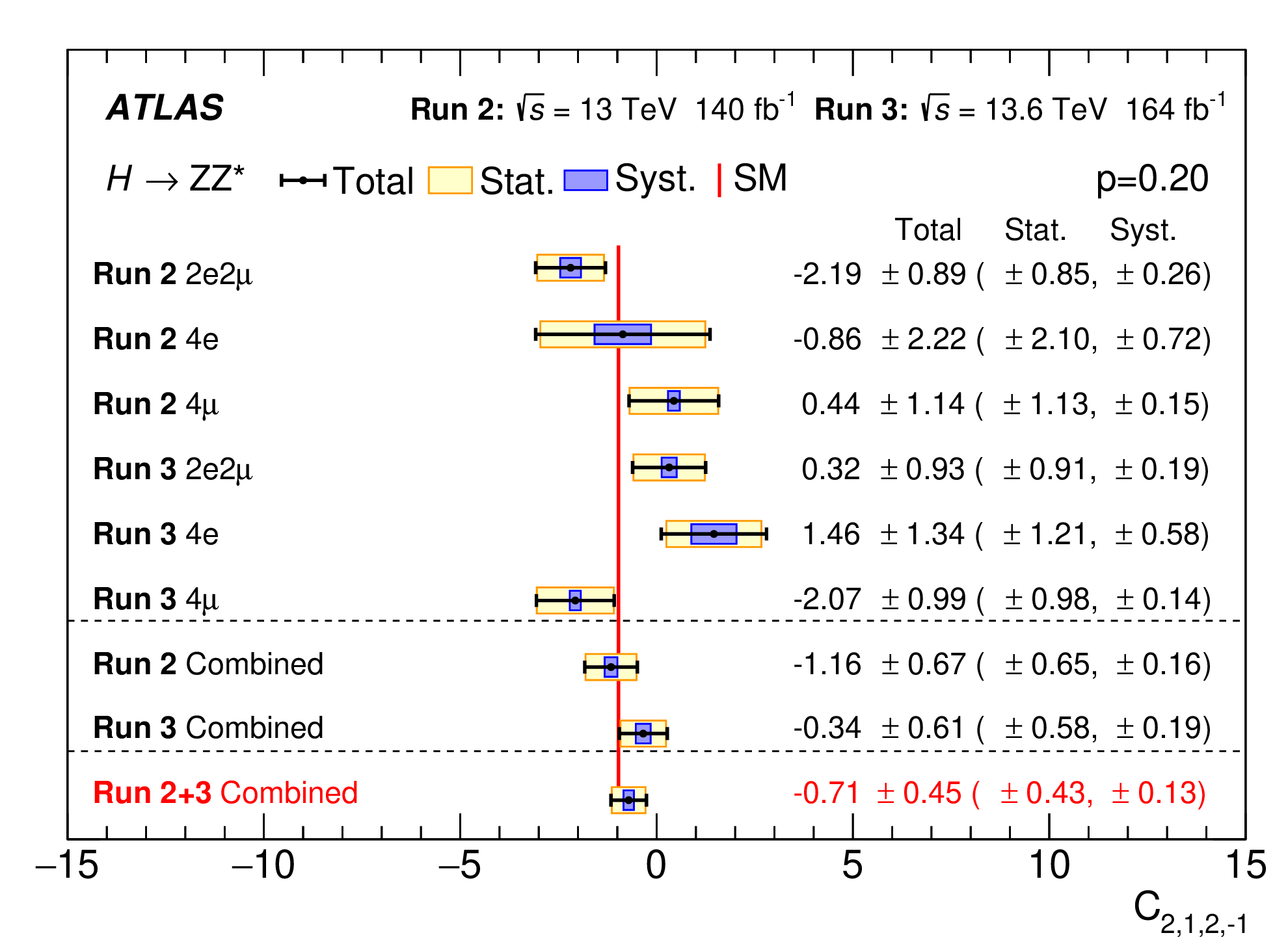
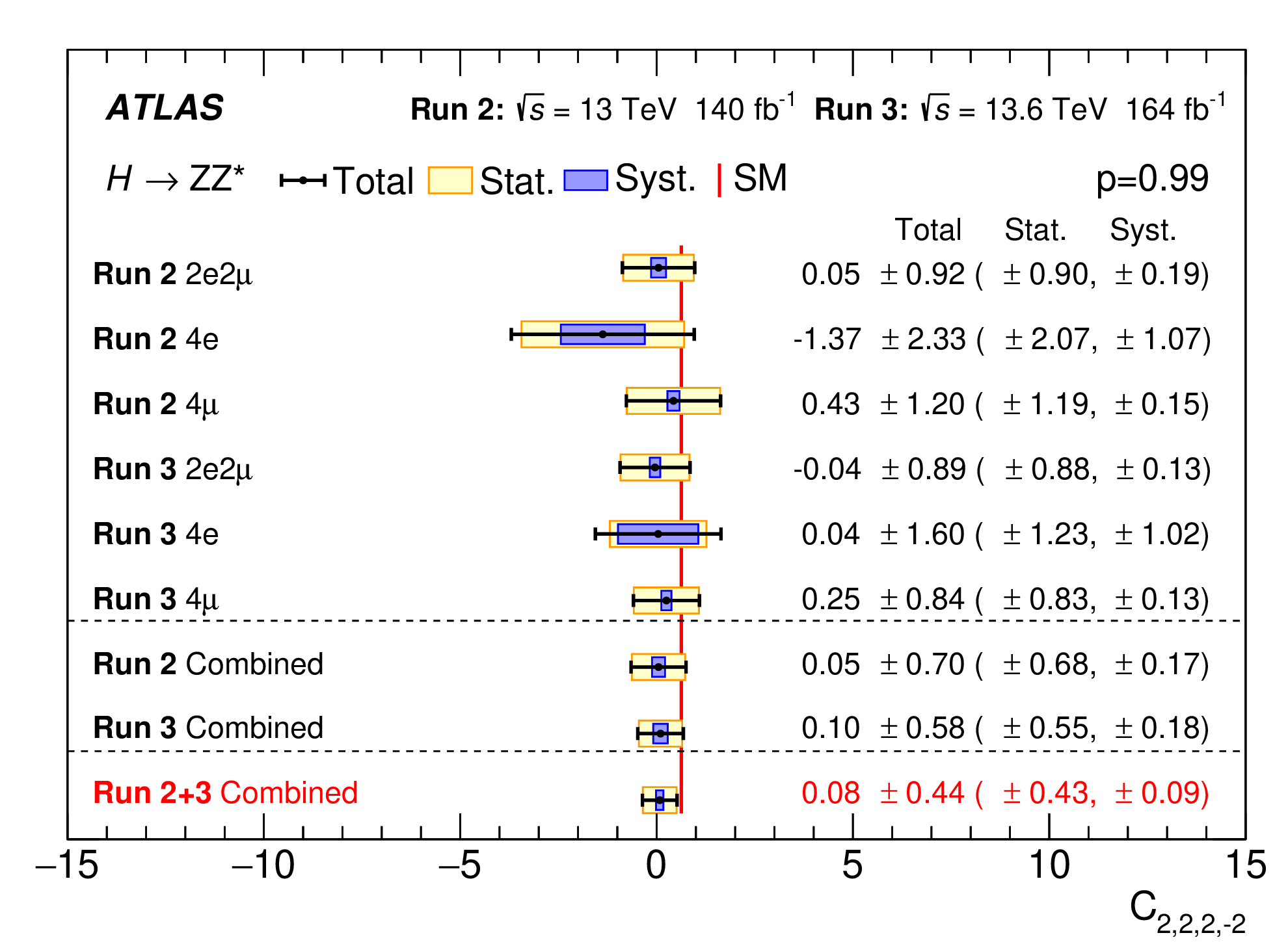
Measurements of Z-boson pair entanglement in decays of Higgs bosons at the ATLAS experiment
Page 6
arXiv:2603.26463
Measurements of Z-boson pair entanglement in decays of Higgs bosons at the ATLAS experiment
Aguilar-Saavedra et al.
Phys.Rev.D 107 (2023) 1, 016012
Page 7
arXiv:2603.26463
Measurements of Z-boson pair entanglement in decays of Higgs bosons at the ATLAS experiment
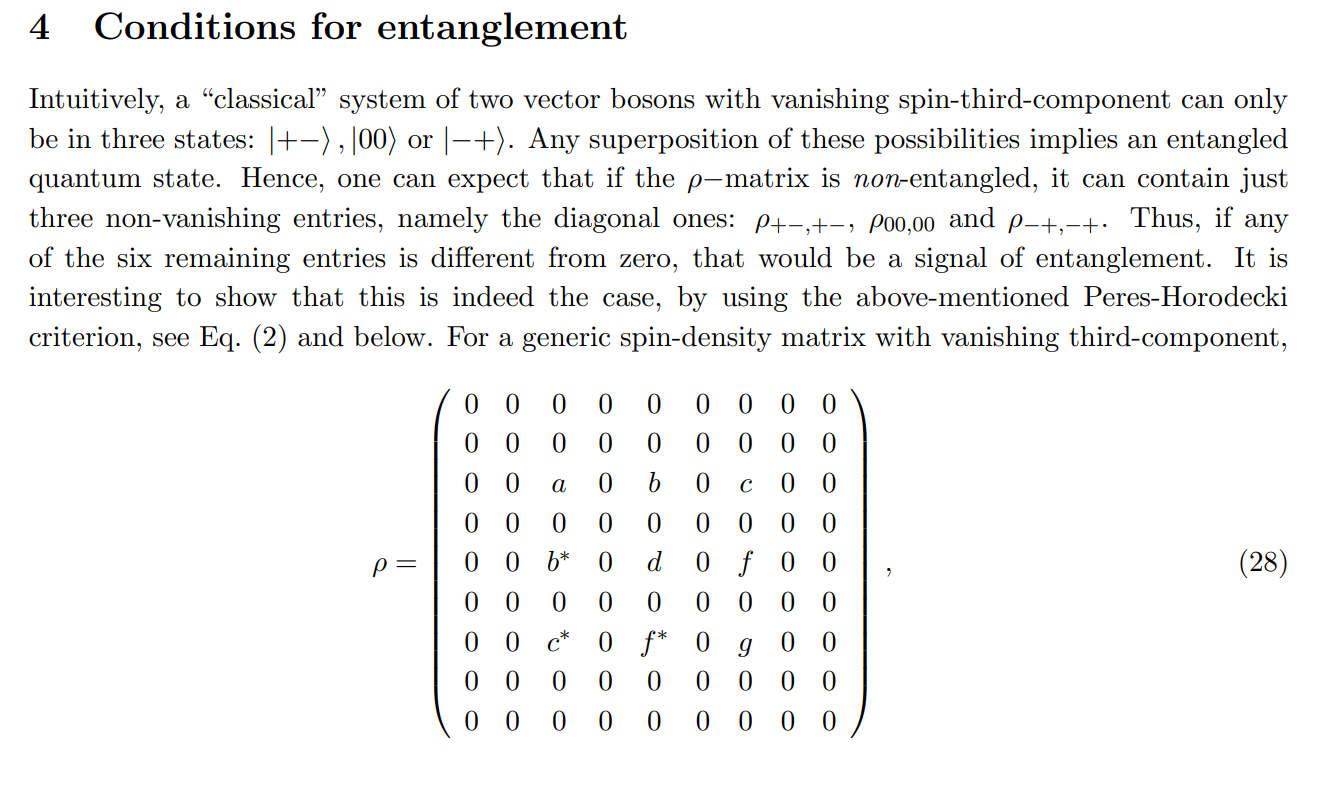
Angular information of daughters gives information about spin state of mother.
Page 8
arXiv:2603.26463
Measurements of Z-boson pair entanglement in decays of Higgs bosons at the ATLAS experiment
Page 9
arXiv:2603.26463
Measurements of Z-boson pair entanglement in decays of Higgs bosons at the ATLAS experiment
Pheno(1)
Page 10
arXiv:2604.07333
A. Wojnar
We propose a novel laboratory test of gravity combining seismic-wave measurements with cosmic-ray muon detections. Quantum-gravity corrections to the anharmonic Debye model are derived, yielding a modified bulk modulus that encodes deviations from standard gravity. The usual dependence on density, a dominant source of uncertainty, is removed via muon tomography and seismic velocities measurement. We show that this setup can constrain gravity parameters at a level comparable to current laboratory experiments. Prospects for further improvements are briefly discussed.
Pheno(2)
Page 11
arXiv:2604.06315
Hsin-Chia Cheng, Xu-Hui Jiang, Lingfeng Li, Ennio Salvioni
We present a scenario for GeV-scale thermal dark matter that can only be tested with accelerator experiments. Dark matter is composed of dark pions arising from a confining strong interaction in the dark sector. The thermal relic density is obtained through the interplay of up-scatterings of dark pions to heavier dark mesons (the dark counterparts of the kaons and η), and decays of the unstable η dark to Standard Model particles. This mechanism is analogous to a playground slide, where one climbs up first and then slides down with a release of energy. We illustrate the scenario with a minimal model based on the SU(3)/SO(3) coset, where dark matter is stabilized by a U(1) flavor symmetry. The correct relic density is obtained with dark meson mass splittings of 10% to 50% and a dark-η lifetime shorter than 103 m/c. Direct and indirect dark matter searches are mostly ineffective, as a consequence of the charge conjugation symmetry of the stabilizing U(1). The most striking signals arise at the LHC, from the production of dark showers containing long-lived dark η's that decay to visible final states. These signatures crucially depend on the portal interaction connecting the dark sector to the Standard Model. We show that several well-known portals can complete the scenario above the weak scale, and outline the expected signals in each case.
Pheno(3)
Page 12
arXiv:2604.04023
S. Elgammal
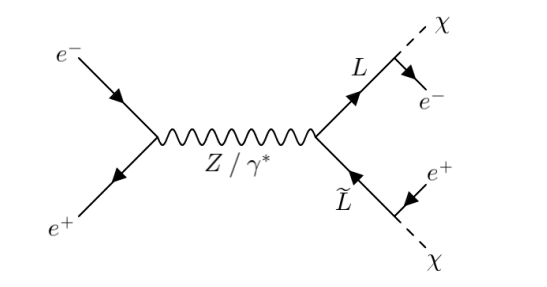
This analysis delves into the lepton portal dark matter by utilizing Monte Carlo simulated samples from electron-positron collisions at the Future Circular Collider (FCC-ee), operating at a center of mass energy of 240 GeV and an integrated luminosity of 10.8 ab-1. The study explores a specific benchmark scenario in which dark matter is represented as a scalar particle produced as a byproduct of a vector-like lepton. The key signal signature features missing transverse energy alongside dilepton events. Should new physics not be detected, this study establishes 95\% confidence level exclusion limits on the mass of the vector-like leptons and the Yukawa coupling.
 Go Back