Page 3
CMS-HIG-25-018
Page 1
April 6th, 2026
Page 2
CMS-HIG-25-018
Search for Higgs boson pair production in the bbWW decay channel with two leptons in the final state using proton-proton collision data at √s = 13.6 TeV
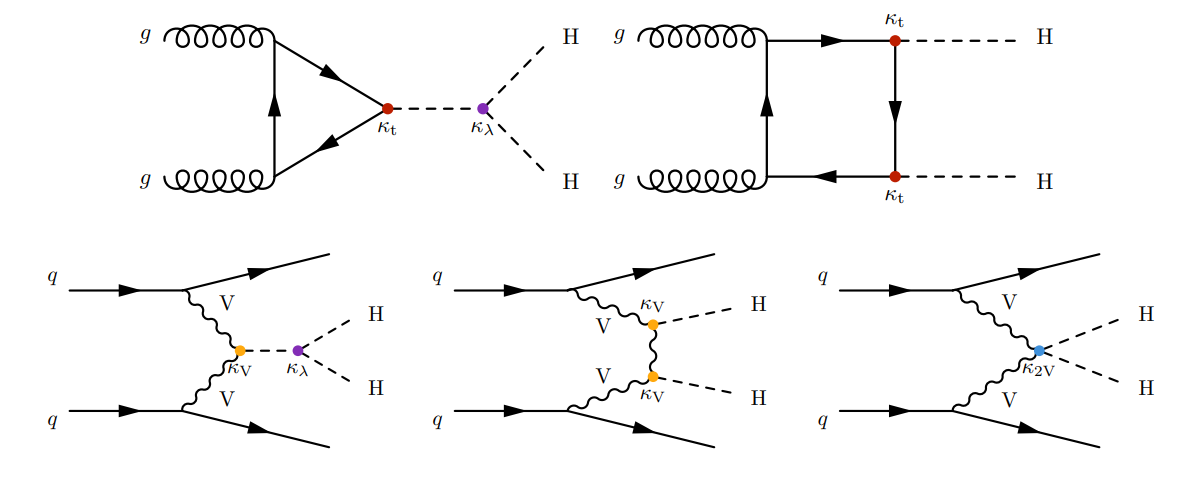
A search for Higgs boson pair production is presented, targeting final states where one Higgs boson decays to a pair of bottom quarks and the other Higgs boson decays to two W bosons, both of which decay leptonically, to an electron or a muon, and a neutrino. For the first time, the search is conducted with proton-proton collision data from the LHC at √s = 13.6 TeV, recorded with the CMS detector in 2022 and 2023 and corresponding to an integrated luminosity of 62 fb-1. The results are consistent with the standard model predictions. An upper limit of 12.0 times the standard model prediction at 95% confidence level is set on the Higgs boson pair production cross section, with an expected limit of 18.5. The results are also used to constrain the strength of the trilinear self-coupling of the Higgs boson, as well as of the quartic coupling between two Higgs bosons and two vector bosons.
Page 3
CMS-HIG-25-018
Page 4
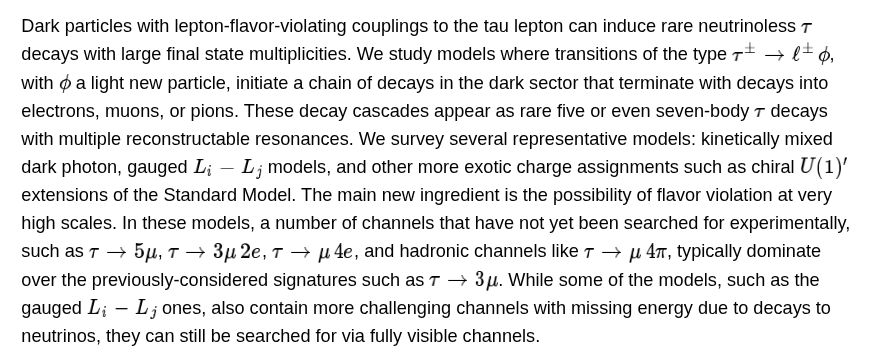
New physics in multi-lepton tau decays
Y. Ema et al.
Page 5
Signatures of Long-Lived Heavy Neutral Leptons from Neutrinophilic Charged Higgs Pair Production at the LHC
N. Okada, P. Sanyal, R. Verma
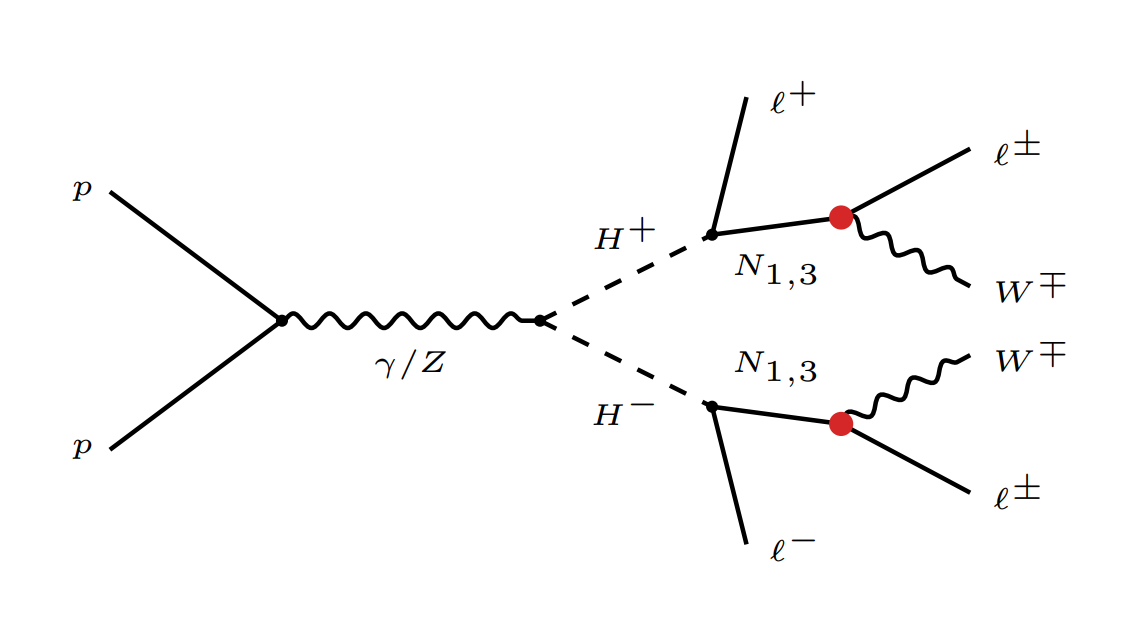
In the neutrinophilic Higgs doublet framework, the neutrino Dirac Yukawa couplings can be sizable because of the small vacuum expection value of the extra Higgs doublet, even for a low seesaw scale. Due to this structure, the neutrinophilic charged Higgs bosons, once created, decay dominantly into heavy neutral leptons (HNLs) and charged leptons. This is a new mechanism to produce a gauge singlet HNL without suppressed cross sections. In the standard seesaw, one HNL can be long-lived, when the lightest neutrino is sufficiently light. We investigate displaced vertex signatures of the long-lived HNLs produced from the decays of the charged Higgs pair at the high luminosity LHC. We consider one displaced vertex as well as two displaced vertices signatures and perform a dedicated simulation to identify the displaced leptons. We find that high statistical significance can be achieved for the observation of one displaced vertex for charged Higgs pair production cross section > O(1) fb. On the other hand, the observation of two displaced vertices is challenging even for charged Higgs pair production cross section of O(10) fb.
Page 6
N. Okada, P. Sanyal, R. Verma
Page 7
Motivation and design of a yotta-eV τ+τ- collider
M. Bellis et al
Two significant goals of the particle physics community is the precision study of the Higgs boson and the search for new particles. The Large Hadron Collider (LHC) is the current high-energy collider, soon to be superseded by the High-Luminosity LHC (HL-LHC). Much of the community has rallied around a muon-collider, though that is most likely 25 years in the future. In this paper, we argue for a bolder approach: a tau-collider, in which oppositely-charged τ-leptons are collided with energies on the yotta-eV scale and a potential radius that places it in the Oort cloud. Given the long time-scale and significant construction challenges, we strongly suggest the focus of the community shift to this discovery machine. We acknowledge that the technology necessary may require humanity to evolve to a Kardashev Level-I or Level-II civilization, which is all the more reason to begin R&D now.
Page 8
Cooking Carbon Dots -- Making an Instant Neutrino Detector in Your Kitchen
D.W.King et al.
Liquid scintillators underpin a wide range of radiation detectors, including those used in neutrino physics, but typically rely on organic fluors dissolved in hazardous and costly solvents. Here, we show that carbon dots - nanoscale fluorescent carbon materials - synthesised from simple household ingredients using a microwave can function as water-based liquid scintillators. These carbon dots dispersed in water produce light yields up to 70 ± 20 photons per MeV and enable the detection of atmospheric muons. This yield is sufficient to detect low-energy protons in water Cherenkov neutrino detectors, expanding their programs in both particle physics and astrophysics. These results establish an accessible, low-cost and environmentally benign route to scintillator development, opening new opportunities for large-scale radiation detection.
Page 9
Autonomous Discovery of Particle Physics Theories from Experimental Data
S. Alexander et al.
The search for physics beyond the Standard Model is hindered by a combinatorial explosion of possible theories. We introduce Albert, a neuro-symbolic artificial intelligence framework to systematically navigate this vast theory space. By encoding particle physics as a formal language, Albert generates tokenized sequences representing symmetries, particles, and interactions under a rule-based grammar, eliminating the hallucinations common in large language models. The reinforcement learning environment enforces first-principle theoretical constraints, computes observables with radiative corrections, and evaluates statistical likelihood via χ2 analysis against experimental data. As a proof of concept, we train a 25-million-parameter transformer model using only legacy data from the Large Electron-Positron Collider, which contains no direct evidence of the top quark. Remarkably, Albert successfully rediscovered the Standard Model and autonomously inferred necessity and properties of the top quark, predicting its mass at 178.9±5.0 GeV, consistent with its modern measurement at the Large Hadron Collider. These results demonstrate the potential of AI-driven theory exploration as a rigorous, hallucination-free, and scalable paradigm for autonomous discovery of new physics.
Page 10
Signal-Aware Contrastive Latent Spaces for Anomaly Detection
R. Li, B. Nachman, D. Noll
High-dimensional feature spaces in particle physics events pose a fundamental challenge to density-estimation-based weakly supervised anomaly detection, whose fidelity degrades rapidly with an increasing number of dimensions. We propose a signal-aware latent space construction using supervised contrastive learning trained on simulated Standard Model backgrounds and a diverse set of hypothesized Beyond the Standard Model (BSM) signals. The resulting latent space is low-dimensional, regularized, and signal-sensitive, enabling high-fidelity density estimation for downstream weakly supervised anomaly detection. We demonstrate the approach in a diphoton final state, testing sensitivity across a broad range of BSM scenarios including supersymmetry models, extended Higgs sectors, heavy neutral resonances, and flavor-changing neutral currents. For signals represented in the contrastive training data, the method can elevate discovery sensitivity from previously inaccessible levels to the discovery regime. Critically, the approach retains sensitivity to BSM models not present during training: interpolation and extrapolation to unseen signal topologies yield substantial improvements in expected significance compared to a background-only baseline. By bridging supervised latent space embedding with weakly supervised anomaly detection, this strategy offers a viable path toward anomaly detection in high-dimensional feature spaces at the LHC and beyond.
Page 11
Applying Self-organizing Maps to the Inverse Problem
V. Tikhe, N.Kirutheeka, S. Dube
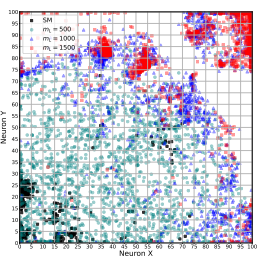
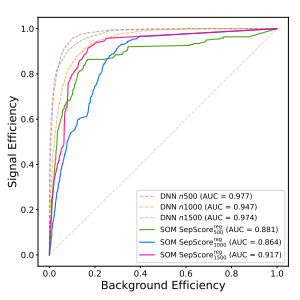
In the inverse problem in particle physics, given an unexpected observation, one aims to identify a unique choice from amongst several competing hypotheses. We explore a novel approach of applying self-organizing maps to the inverse problem in a search for vector-like leptons in a trilepton final state. We define an approach combining the inherent clustering of these maps and elements of supervised learning. We compare the performance of this approach with a multiclassfying neural network. We find that the method using self-organizing maps competes well (despite not using any standard model processes in the training), and provides additional tools that would help characterize any observed excesses in searches.
Page 12
The atomic bomb: its history and the struggles of scientists
S. Nagamiya
In this article, I trace the early historical developments that ultimately led to the creation of the atomic bomb. Even after the completion of weapons, many scientists continued to argue that nuclear armaments were indispensable for maintaining the global balance of political power [1]. This study focuses on several scientists who confronted profound moral dilemmas concerning the use of bombs against Japan. Some openly opposed its deployment. Others sought to warn a Japanese physicist in the hope of averting further devastation. Still, others expressed deep remorse in its aftermath. In addition, the experience of an individual directly affected by the bombing is discussed. By examining these episodes, this article aims to contribute to the ongoing discourse on how scientific research should be guided by ethical principles in the future.
[1] A. Nevala-Lee, Collisions: A Physicist’s Journey from Hiroshima to the Death of the Dinosaurs (W. W. Norton & Company, New York, 2025)