Page 3
CMS-SUS-23-006
Page 1
Mar 16th, 2026
Page 2
CMS-SUS-23-006
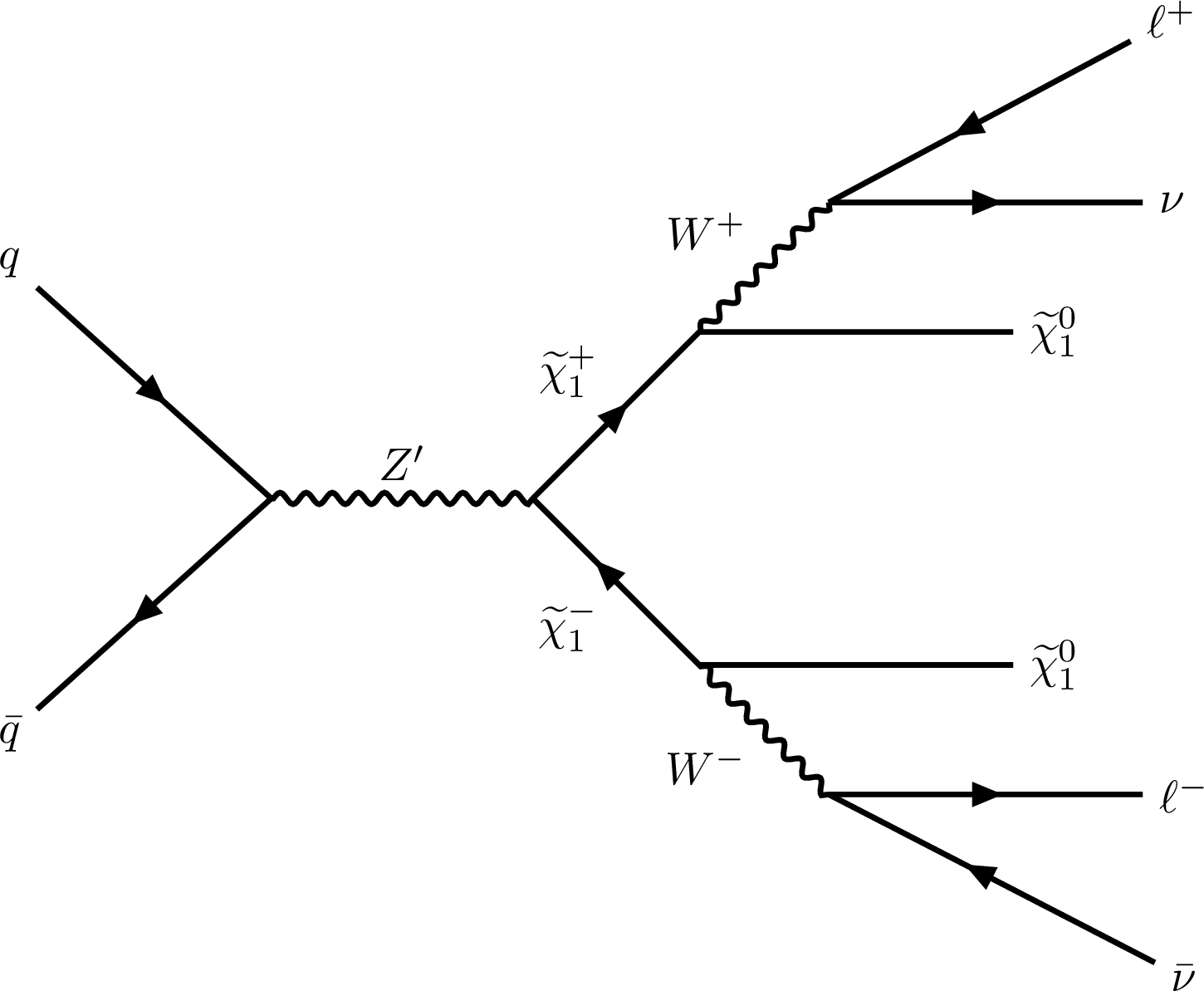
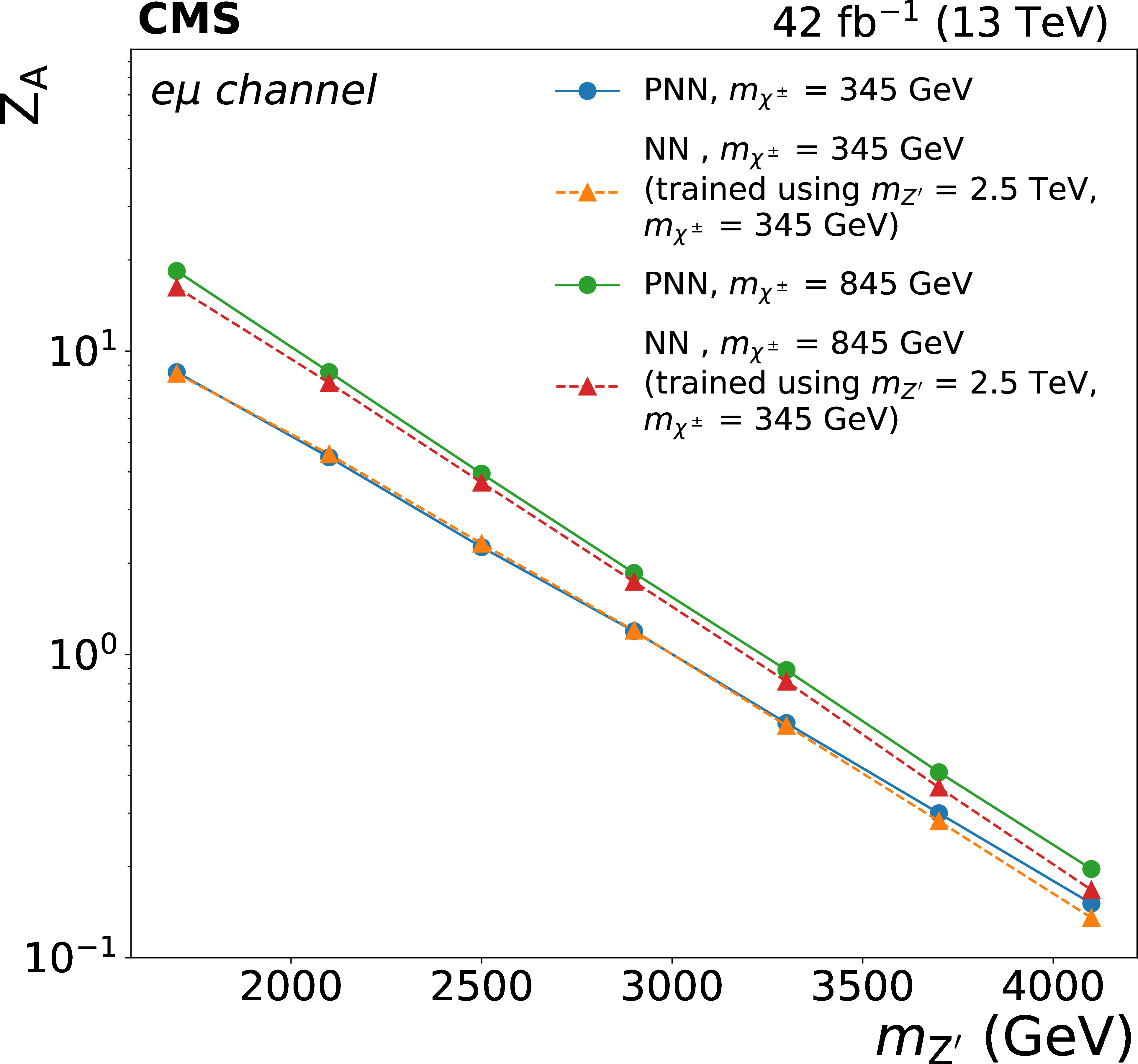
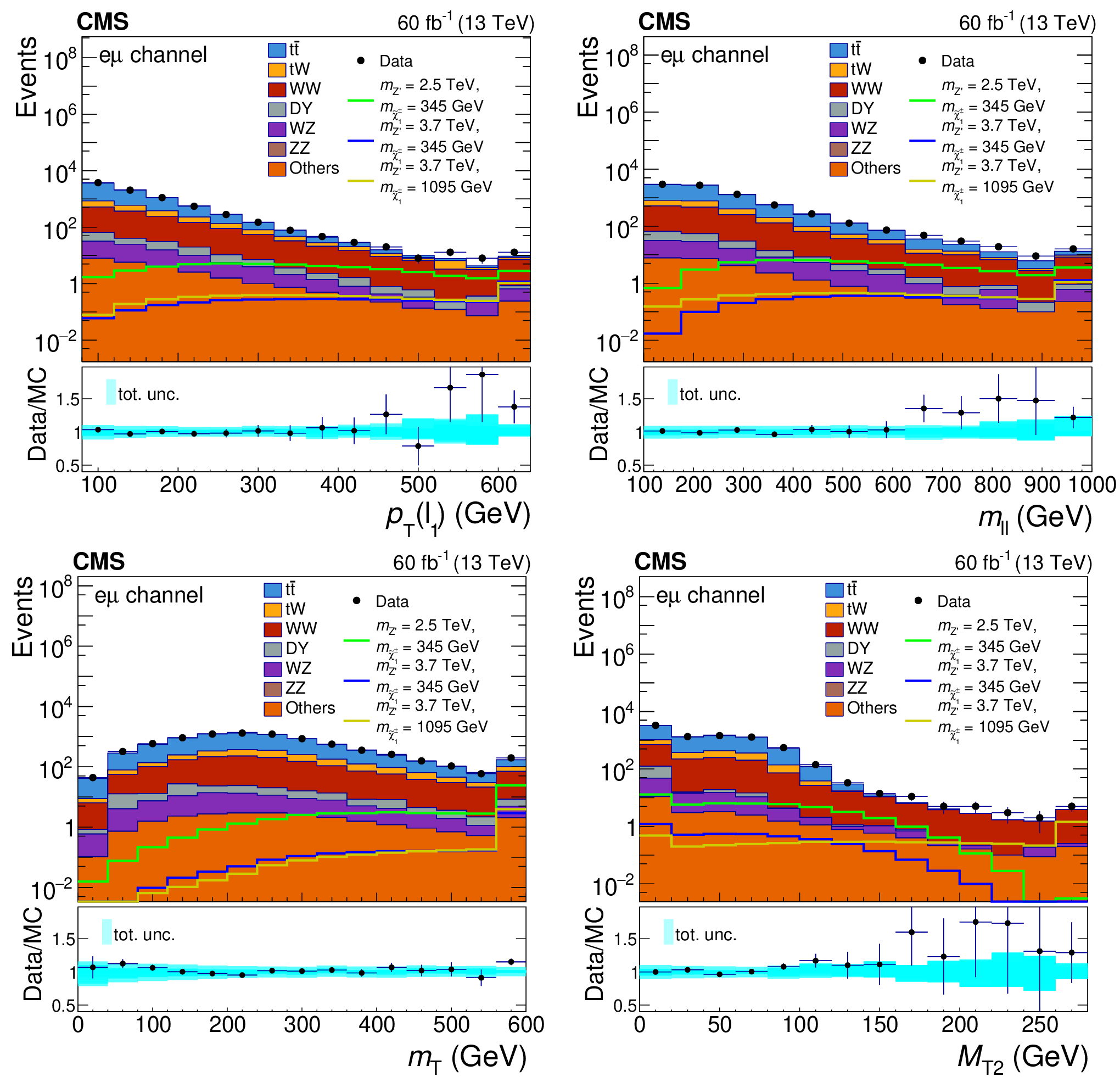
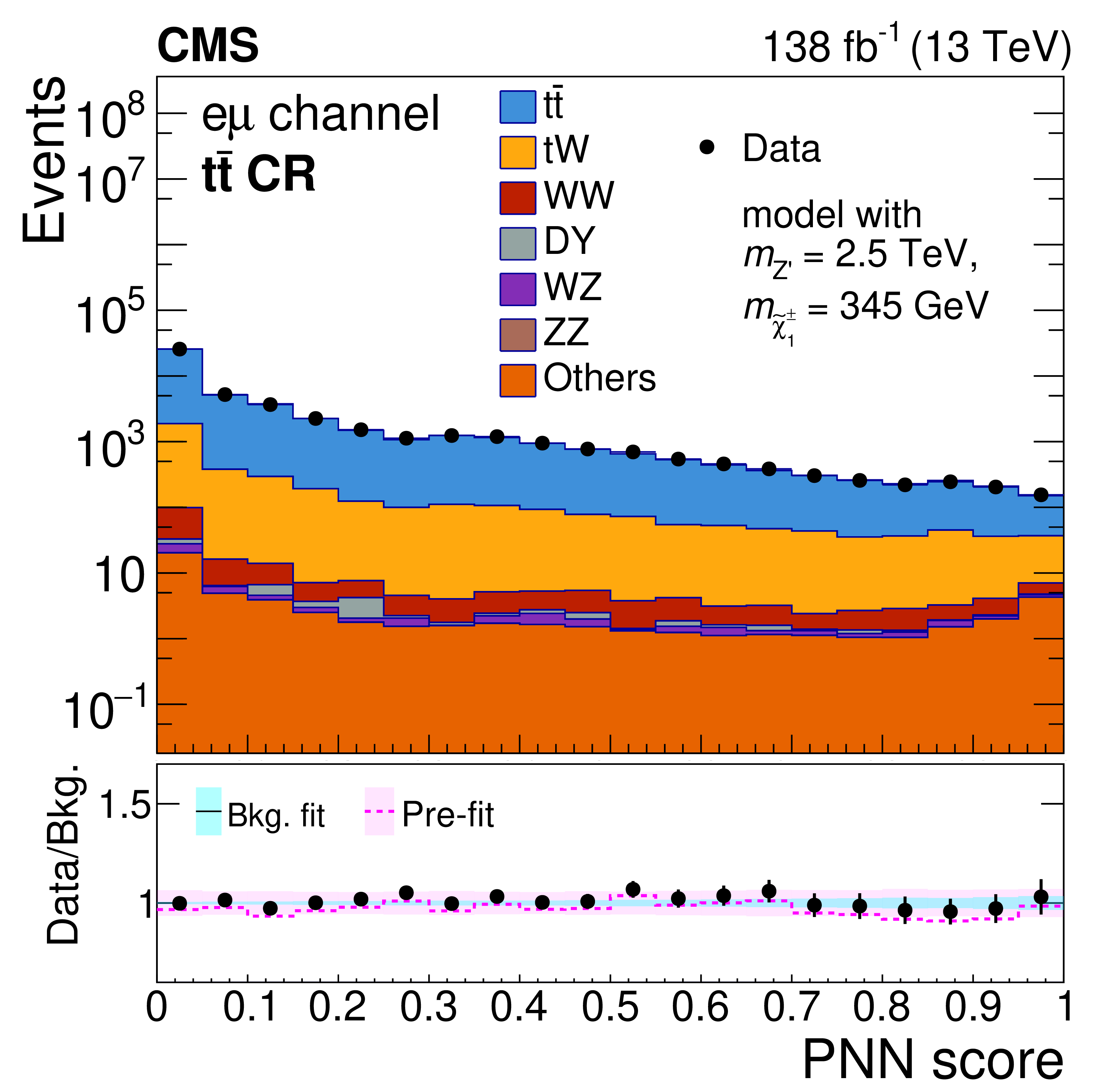
Search for Z' bosons decaying into charginos in final states with two oppositely charged leptons and missing transverse momentum in pp collisions at √s = 13 TeV
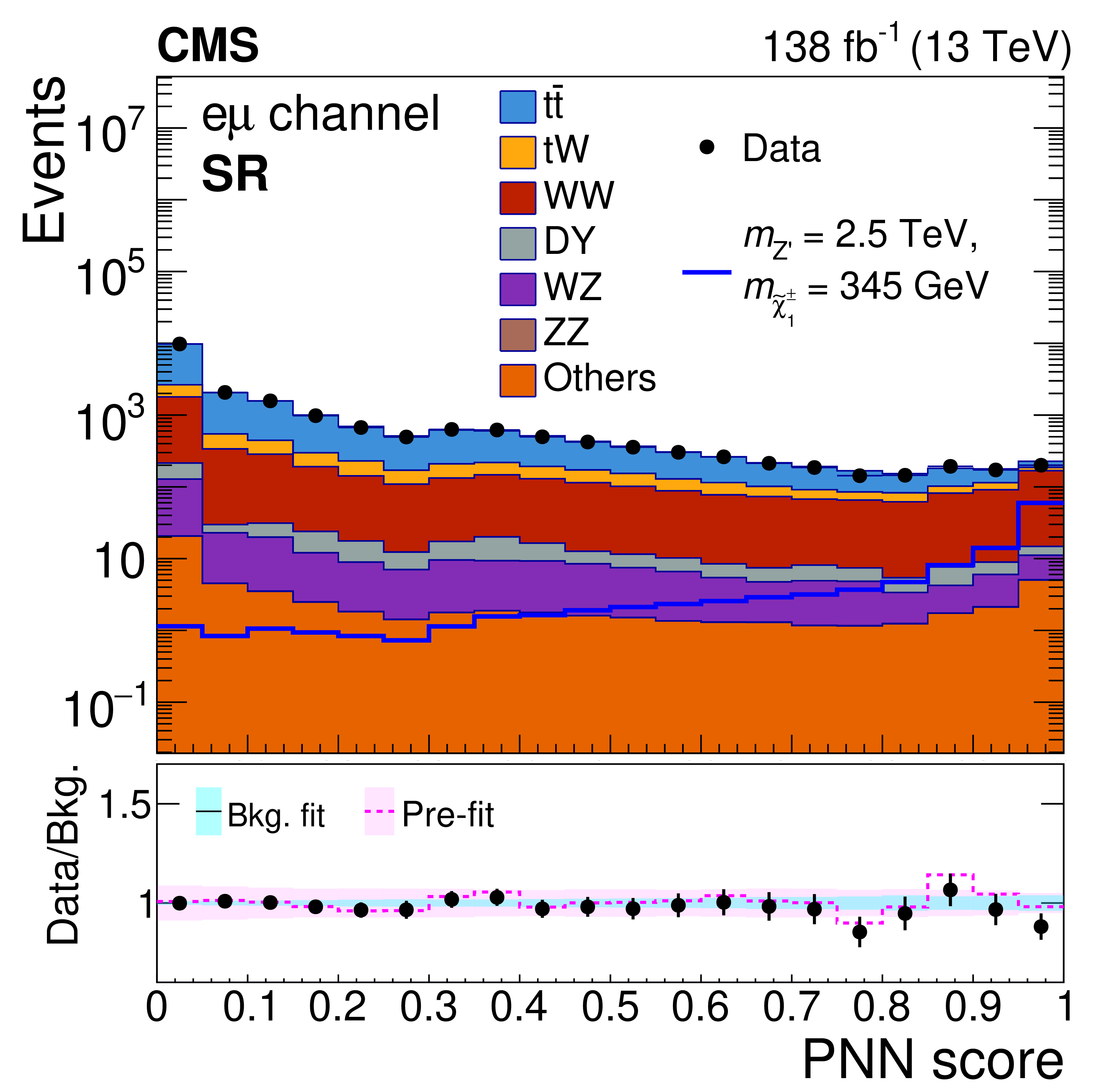
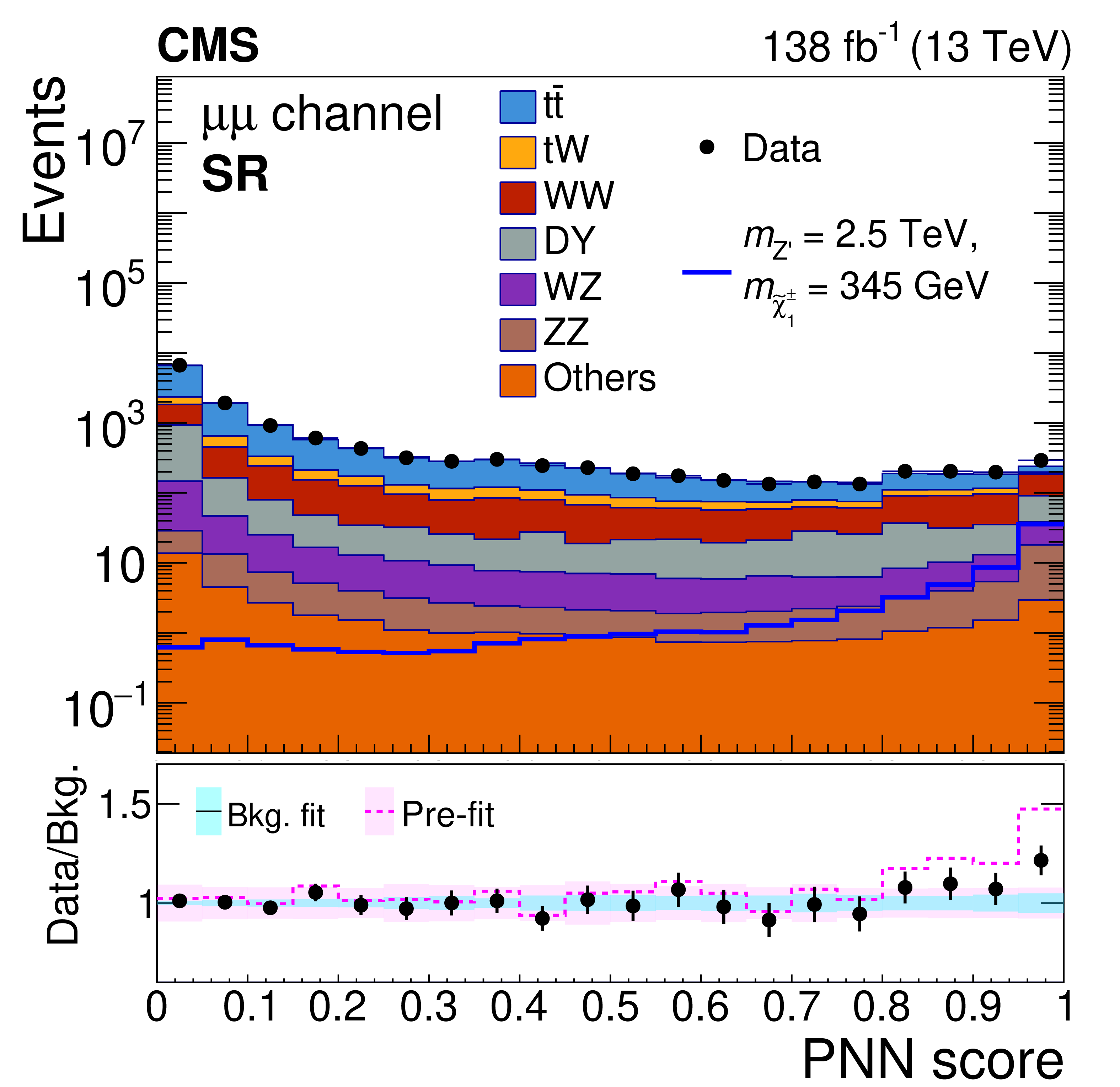
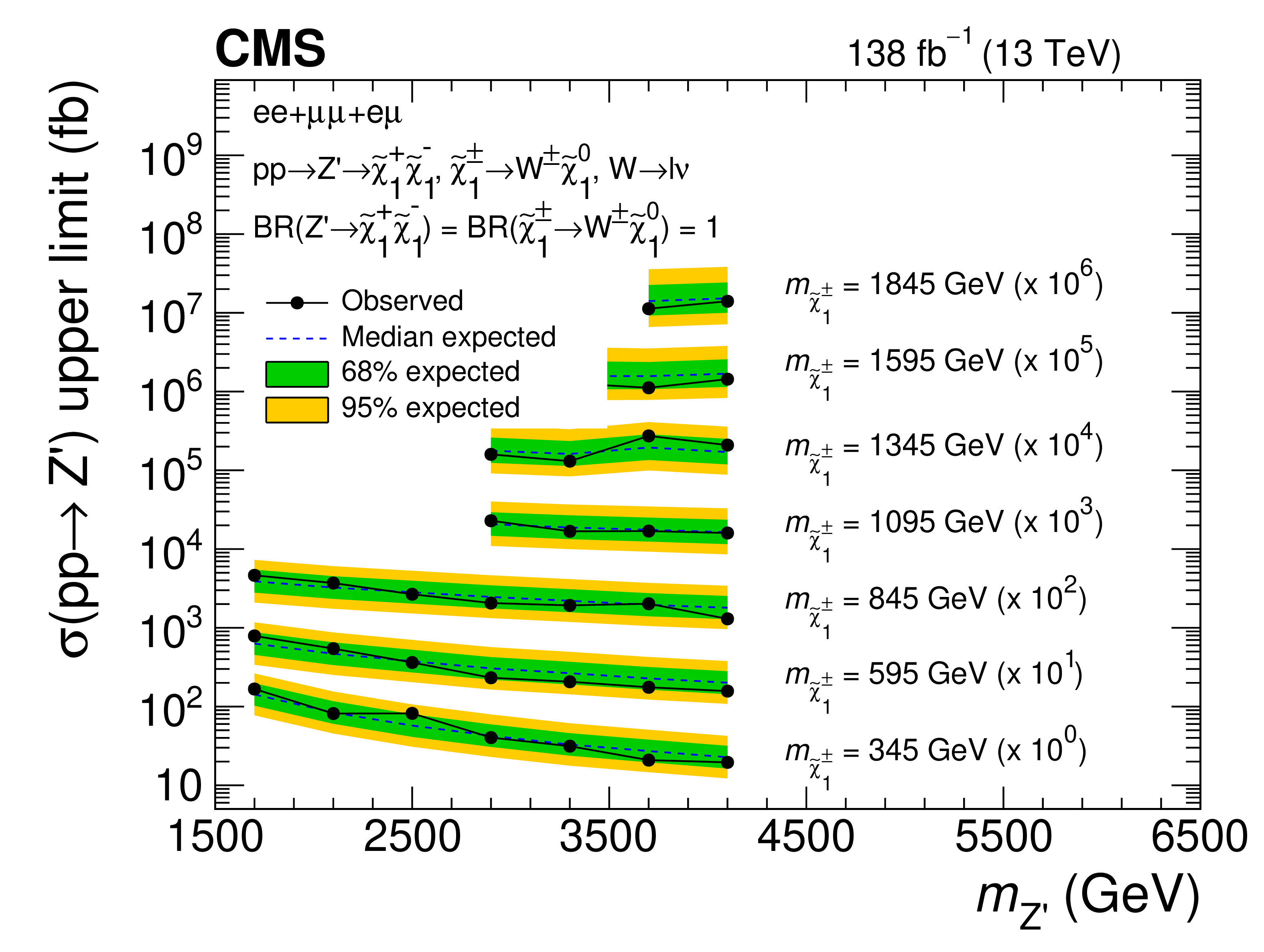
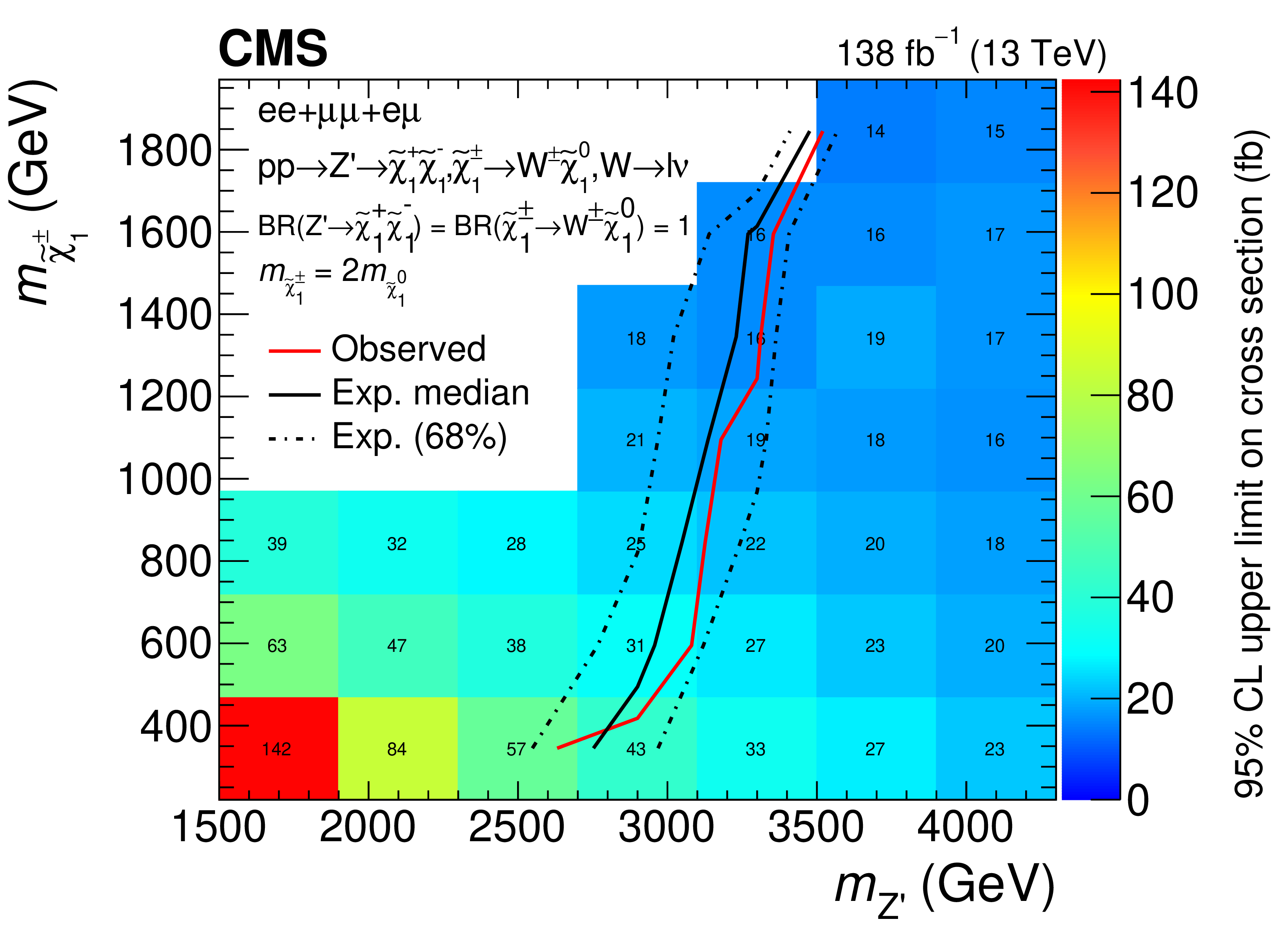
Massive leptophobic Z' bosons decaying to a pair of charginos are searched for in proton-proton collisions at √s = 13 TeV, using data samples collected by the CMS experiment in 2016, 2017, and 2018, corresponding to a total integrated luminosity of 138 fb-1. The Z' bosons originate from an additional U(1)' gauge symmetry extended to the minimal supersymmetric standard model. The final state consists of two oppositely charged leptons and missing transverse momentum. The signal extraction is performed with a parametrized neural network. The measurements are found to be consistent with the standard model expectations. Upper limits are set on the Z' boson production cross sections as a function of the Z' and chargino masses. The analysis excludes Z' boson masses up to about 3.5 TeV for the specific case of Z' bosons decaying exclusively to charginos, with the charginos decaying to W bosons and neutralinos.
Page 3
CMS-SUS-23-006
Page 4
CMS-SUS-23-006
Page 5
CMS-SUS-23-006
Page 6
CMS-SUS-23-006
Page 7
Study of quark and gluon jet identification in photoproduction at EIC
S. N. Singh, R. Aggarwal, M. Kaur
We investigate the substructure of jets produced in photoproduction events with center-of-mass energies √s = 30--140 GeV at the proposed Electron-Ion Collider (EIC). Events are generated using PYTHIA and contributions from direct and resolved photoproduction subprocesses are analyzed at different center-of-mass energies. Jets are reconstructed using longitudinally invariant algorithm within the FastJet framework. Substructure of quark- and gluon-initiated jets in the selected di-jet photoproduction sample is studied in detail by using jet-shape variables. Predictions for subjet multiplicities and integrated jet shapes are presented in the gluon-initiated and quark-initiated jets. These results demonstrate the feasibility of distinguishing quark and gluon jets in the photo-production events at the EIC and provide a baseline for further QCD studies.
Page 8
ATLAS Collab.
Search for displaced decays of long-lived particles in events with missing transverse momentum in √s = 13.6 TeV pp collisions with the ATLAS detector
A search for long-lived particles in events with significant missing transverse momentum and at least one displaced vertex is presented. This analysis is performed using 137 pb-1 of collision data collected between 2016-2018 during Run 2 of the Large Hadron Collider by the ATLAS detector. Displaced vertices are identified using two different secondary vertexing algorithms, including a novel “fuzzy” vertexing algorithm optimized for identifying displaced decays of heavy quarks. Separate searches are performed using each algorithm, and the expected Standard Model background is independently estimated for each search using a data-driven procedure. No significant excess is observed over the background in either case. The results are used to set 95% confidence-level limits on potential beyond-the-Standard Model physics that could produce this final state. Results are interpreted in the context of four models: long-lived gluinos that form R-hadrons before decaying, neutralinos decaying via Higgs-mediated channels in the Bino-Wino coannihilation model, long-lived Higgsinos decaying to axinos, and an exotic Higgs portal model predicting displaced decays of light pseudoscalars.
Page 9
ATLAS Collab.
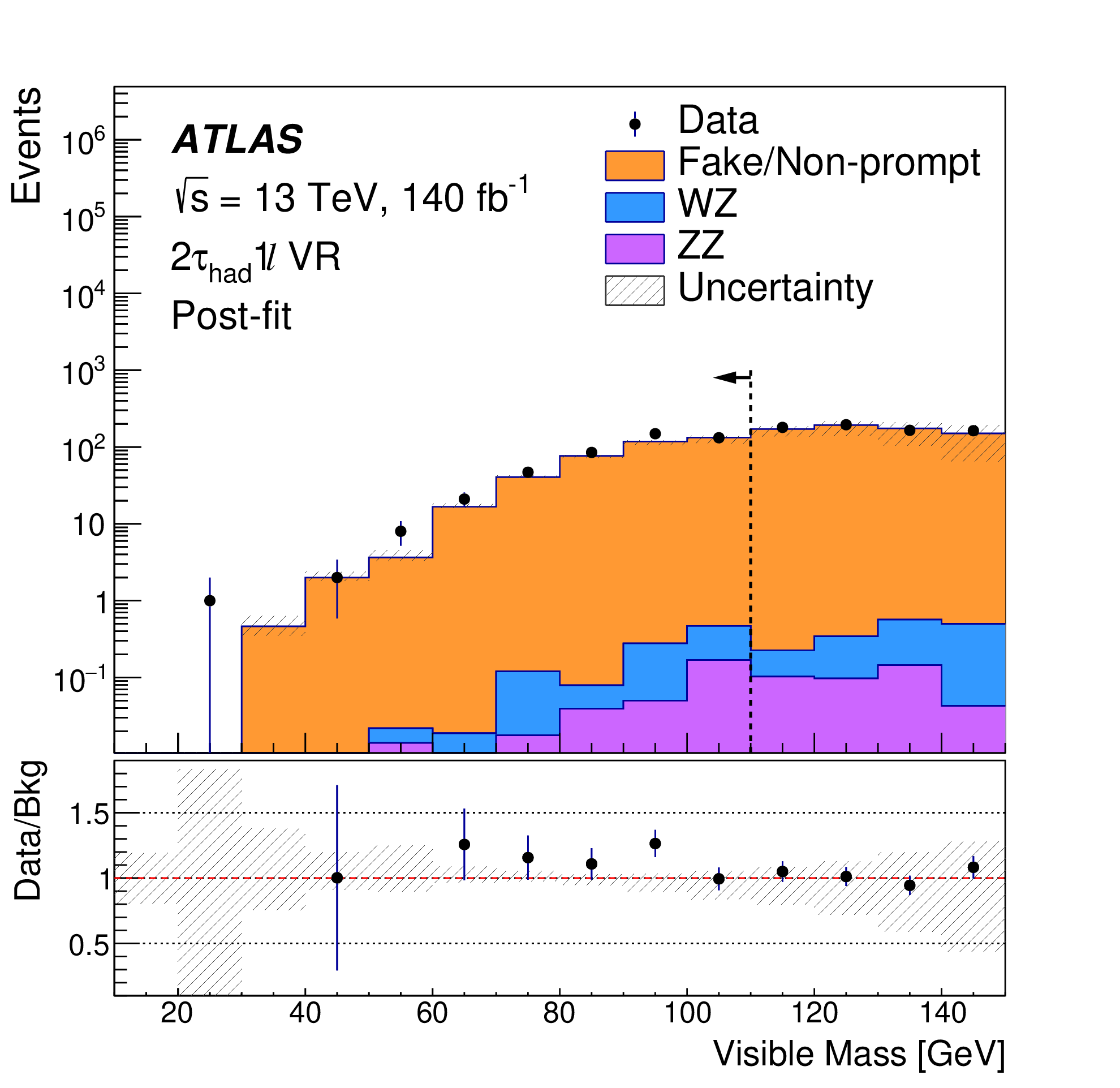
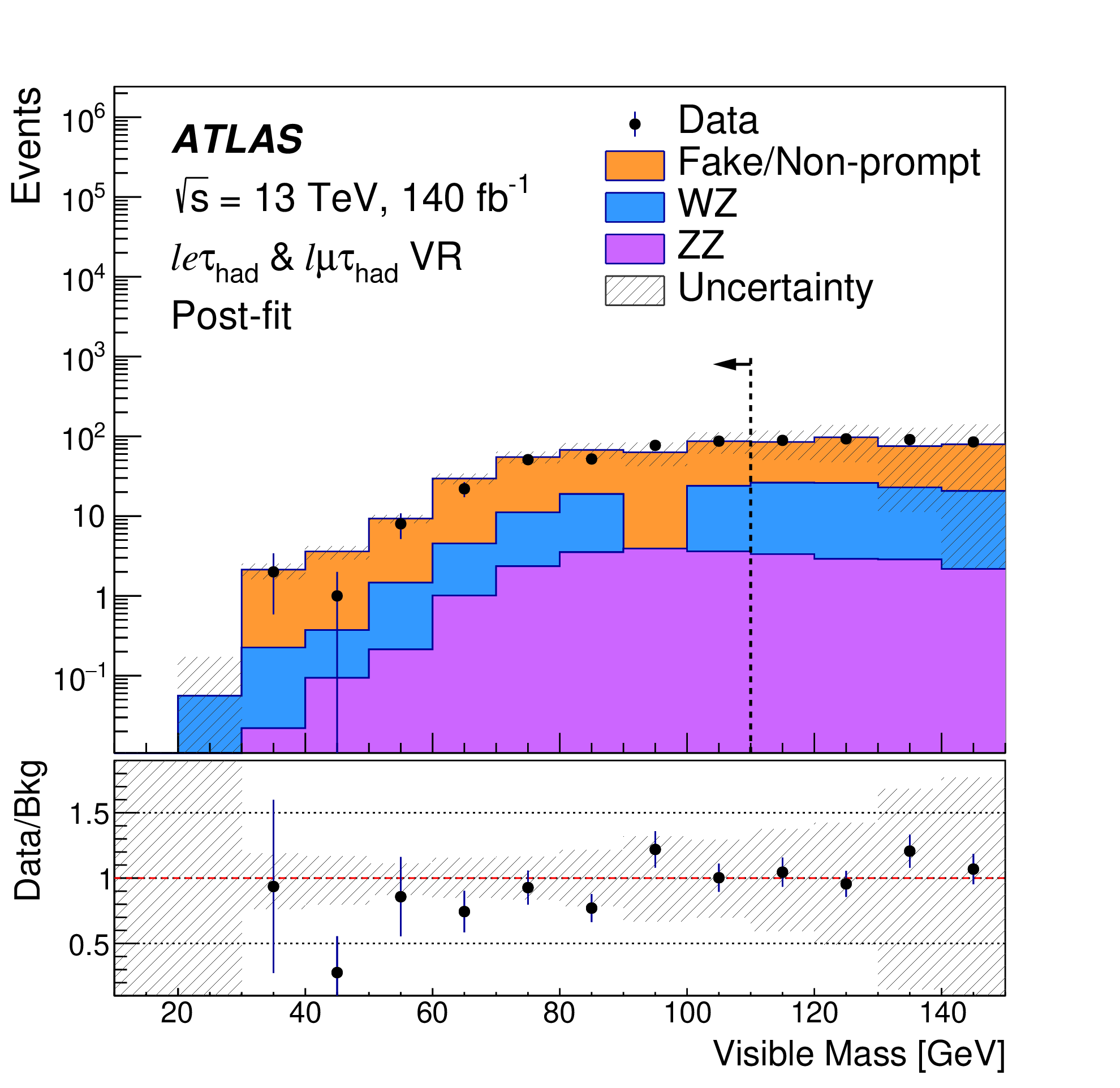
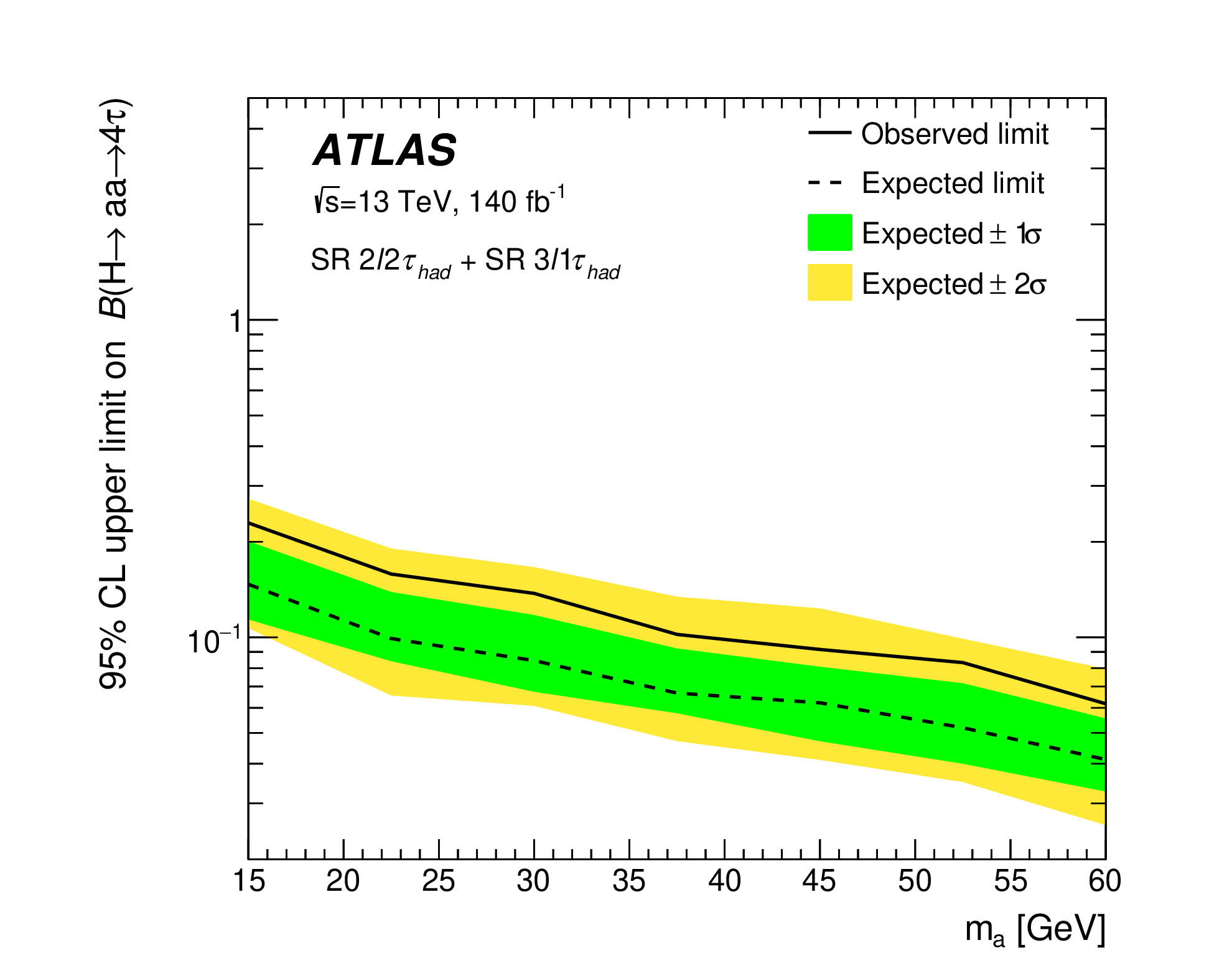
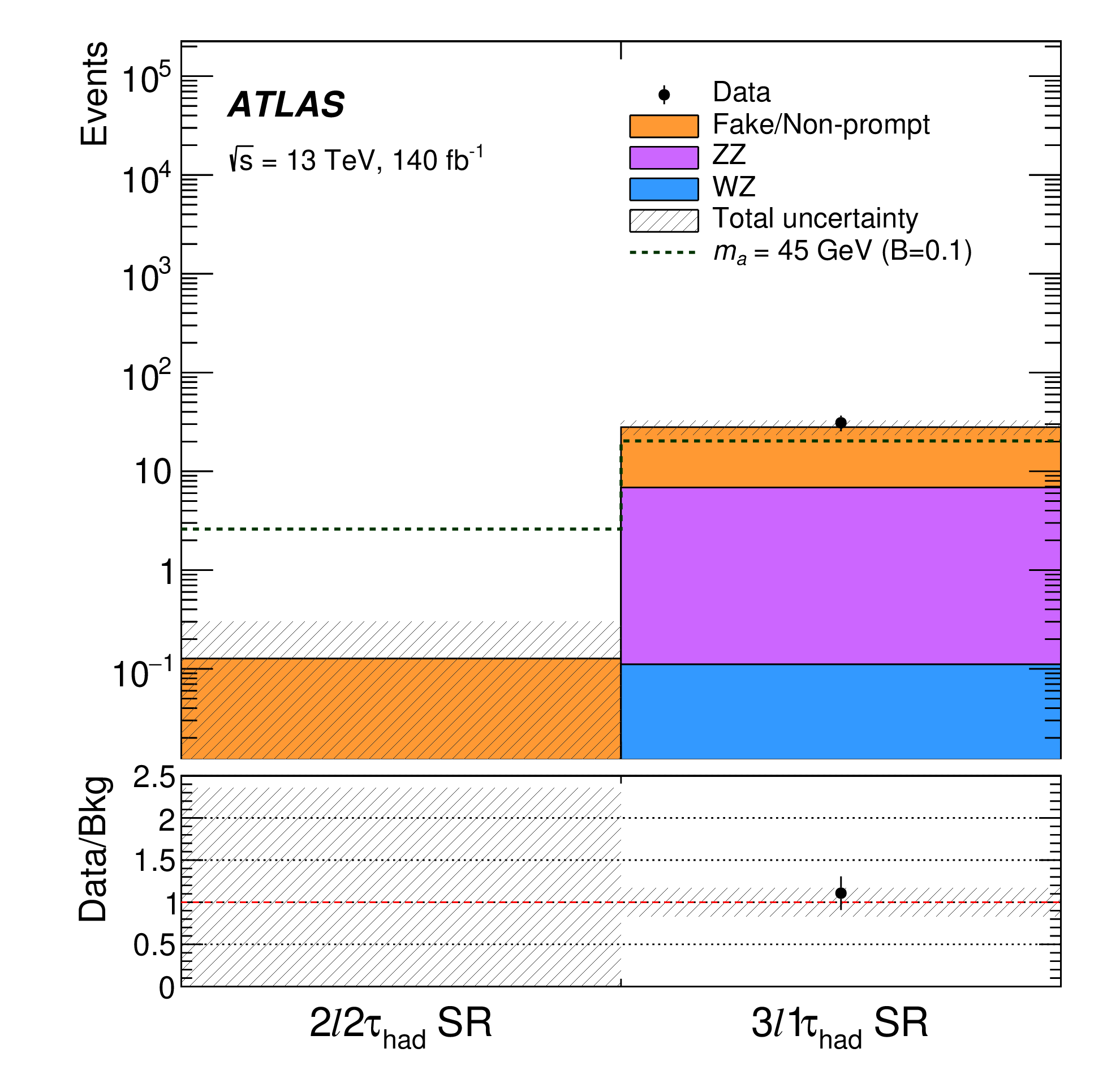
Search for decays of the Higgs boson into pair-produced pseudoscalar particles decaying into τ+τ-τ+τ- using collisions at √s = 13.6 TeV with the ATLAS detector
A search for a pair of low-mass pseudoscalars a that promptly decay into τ-leptons is presented using 140 fb-1 of proton-proton collision data at TeV centre-of-mass energy recorded with the ATLAS detector at the Large Hadron Collider. The result is used to place constraints on exotic decays of the Higgs boson into four τ-leptons, H → aa → ττττ . This search focuses on events with either one or two τ-leptons decaying into hadrons and neutrinos, and the remaining three or two -leptons decaying into either electron or muon and neutrinos. No significant excess is observed above the expected Standard Model background and upper limits at the 95% confidence level on B(H→ aa→ ττττ) are set ranging from 0.06 to 0.23, depending on the mass ranging from 15 to 60 GeV.
Page 10
ATLAS Collab.
Page 11
ATLAS Collab.
Page 12
ATLAS Collab.
Search for long-lived charginos and τ-sleptons using final states with a disappearing track in pp collisions at √s = 13 TeV with the ATLAS detector
This paper reports a search for decays of long-lived charginos or τ-sleptons to final states containing a short disappearing track, a single high-energy jet, and missing transverse momentum. The search uses 137 fb-1 of data from 13 TeV proton-proton collisions recorded by the ATLAS detector during Run 2 of the LHC. Multiple search regions are defined, all requiring the presence of a track reconstructed from either three or four measurements in the innermost layers of the ATLAS detector. Regions with tracks having only three measurements are further characterised by the absence or presence of a low-energy charged pion reconstructed using a dedicated algorithm, leveraging machine learning. Data-driven methods are used to estimate the background contributions in the search regions. No significant excesses are found and 95% CL lower limits are placed on the masses of charginos and τ-sleptons in the lifetime range 0.01 to 10 ns. Observed (expected) mass limits of up to 225 GeV (250 GeV) are set for pure-higgsino charginos in scenarios with lifetimes below 0.03 ns, where the electroweakino mass splitting is entirely due to loop corrections involving the Standard Model bosons, and up to 720 GeV (840 GeV) for charginos with a lifetime of around 1 ns. For wino production, charginos with masses up to 880 GeV (1020 GeV) are excluded for lifetimes of around 1 ns. For τ-sleptons with lifetimes of around 1 ns, masses are excluded up to 320 GeV (390 GeV) in Constrained Minimal Supersymmetric Standard Model scenarios and 300 GeV (380 GeV) in Gauge-Mediated Supersymmetry-Breaking scenarios.
Page 13
Fig from https://arxiv.org/abs/2201.02472
ATLAS Collab.
Fig from https://arxiv.org/abs/2201.02472
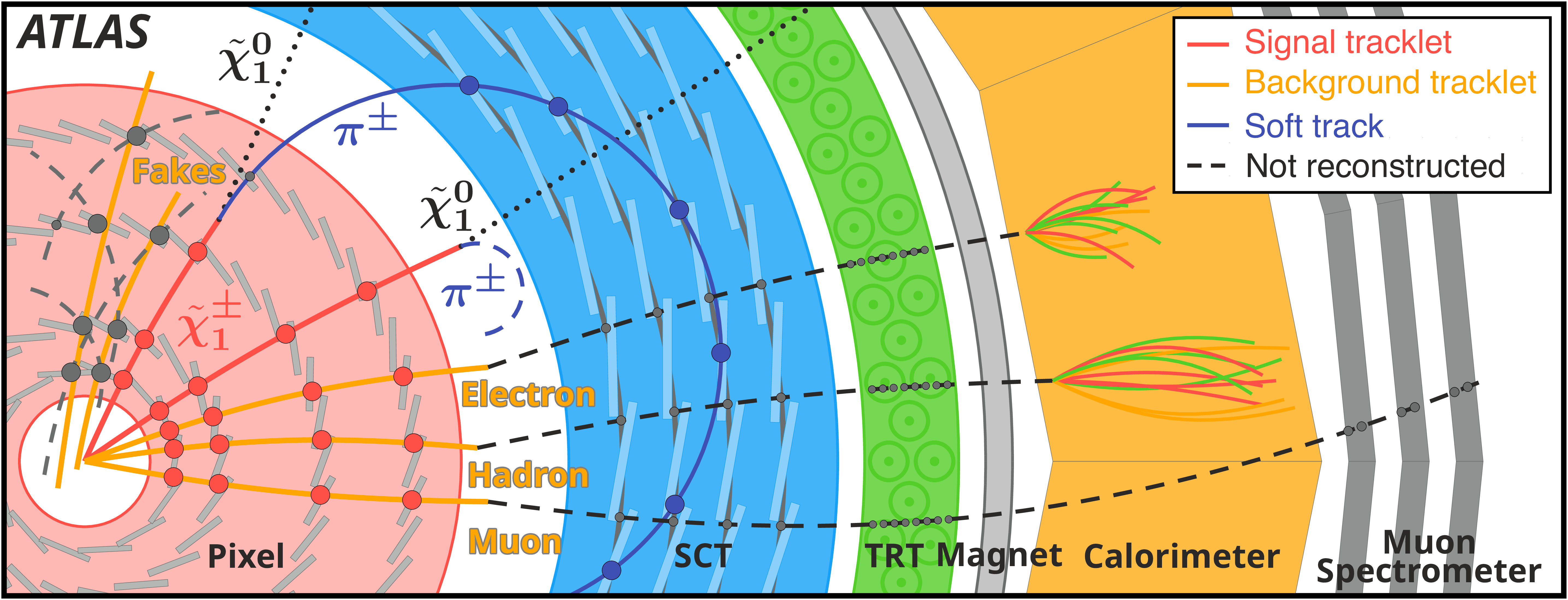
A pictorial representation of signal and background processes. Detectors are not to scale and for illustration purposes only. The signal chargino (χ1±) decays into a charged pion (π±) and neutralino (χ10). ‘Fake’, ‘Muon’ and ‘Electron or hadron’ in the figure represent the fake-tracklet background, the muon background and electron or hadron backgrounds respectively.
Page 14
Agents of Discovery
(Sascha Diefenbacher, Anna Hallin, Gregor Kasieczka, Michael Krämer, Anne Lauscher, Tim Lukas)
AI Agents, Language, Deep Learning and the Next Revolution in Science
(Ke Li, Beijiang Liu, Bruce Mellado, Changzheng Yuan, Zhengde Zhang)
Agentic AI -- Physicist Collaboration in Experimental Particle Physics: A Proof-of-Concept Measurement with LEP Open Data
(Anthony Badea, Yi Chen, Yen-Jie Lee)